Implications for Battery Testing and Validation in Next-Generation EVs
The fast pace of development in EV battery pack integration is driving a redefinition of both vehicle design and battery validation methods. As OEMs diverge from traditional modular battery designs towards highly integrated and structural batteries, existing testing methods are inadequate to cope. Battery validation needs to shift from component level verification to system-level, multi-physics evaluation where electrical, thermal, and mechanical phenomena are simultaneously investigated. Integrated solutions like CTM, CTP battery packs, CTB battery structures and even full CTC architectures bring new and challenging battery test requirements that define the capability and choice for any modern EV battery test system. This article focuses on how CTM, CTP, CTB, and CTC battery architectures fundamentally change EV battery testing and validation requirements, and what this means for next-generation EV battery test systems.
Integration Evolution: From Modular to Structural EV Battery Pack Architectures
Early EV battery packs were designed to be modular energy storage units that could be designed, tested, and replaced independently of the vehicle. The Cell-to-Module (CTM) concept is conveniently tree structured and has a clear physical boundary from this presentation point of view, while the testing is covered. However, the need for higher energy density, lower cost, better packaging efficiency, and longer vehicle range has led to the removal of some redundant structural layers. This culminated in higher and higher levels of integration and eventually in battery systems serving both energy storage and structural functions.
Figure 1 illustrates that incremental steps of battery integration decrease mechanical dissociation and increase functional association between the battery system and the EV. In CTM designs, cells, modules, and packs are all separable subsystems and can be tested locally or faults isolated. CTP architectures omit the module layer to better utilize space, but increase electrical and thermal dependencies at the pack level. CTB and CTC design extend the battery further into the vehicle body or chassis, in so doing the battery becomes a load-bearing component. At these higher integration levels, battery behavior can no longer be evaluated independently, necessitating holistic testing strategies that reflect real vehicle operating conditions.
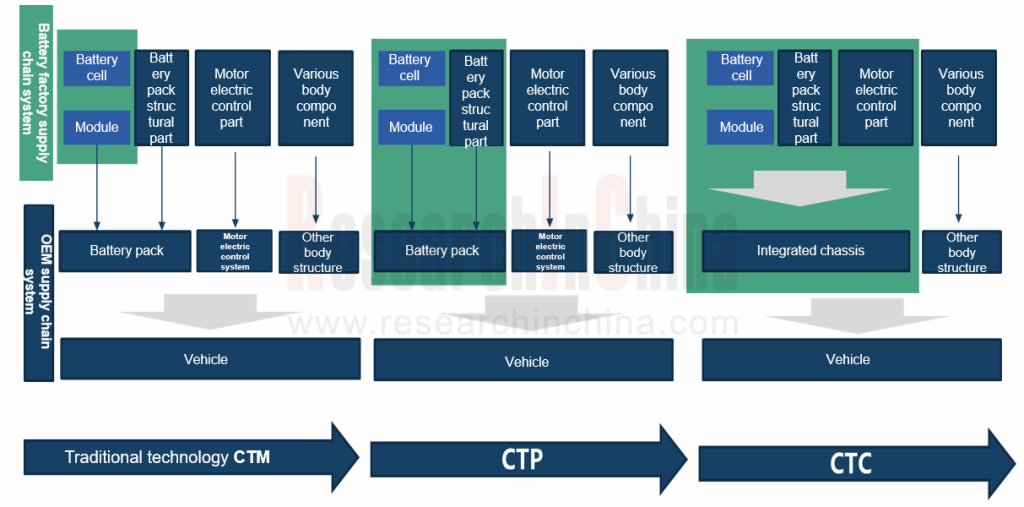
Figure 1. Progressive evolution of EV battery pack integration architectures
CTM and CTP Battery Pack Designs: Shifting EV Battery Testing Paradigms
Battery testing is hierarchical in CTM-based architecture with clear validation processes at the scales of cell, module, and pack. Module testing is essential for achieving electrical uniformity, thermal uniformity and safety performance before final pack assembly. This modular design allows for simpler fault detection, easier repair, and less developmental risk.
Instead, a CTP battery pack removes the module layer and cells are directly placed into the pack structure, which lowers part count, streamlines system architecture and space utilization is greatly improved. This design philosophy originated with producers such as CATL, BYD, and SVOLT, and is now being adopted or considered by major OEMs including Volkswagen, General Motors, Toyota, and NIO.
Nevertheless, the lack of modules does change the nature of pack behavior. Thermal paths are shorter and more networked, and electrical faults can no longer be localized within modular dominions. Consequently, the testing burdens shift to encompass pack-level electrochemical uniformity, fine-scale thermal sensing, and improved fault-propagation analysis of cells. This shift significantly increases the complexity of EV battery pack testing, requiring higher data resolution and synchronized multi-channel measurements.
Table 1.CTM vs CTP Battery Pack Integration Comparison from a Battery Testing Perspective
| Aspect | CTM (Cell-to-Module) | CTP (Cell-to-Pack) |
| Testing hierarchy | Cell → Module → Pack | Cell → Pack |
| Fault isolation | High (module-level) | Limited (pack-level) |
| Thermal behavior | Localized | Strongly coupled |
| Testing complexity | Moderate | High |
| Data resolution required | Medium | High |
For CTPs form factor, standard module test bench is not sufficient. Advanced EV battery test systems with higher channel count, synchronized measurements, integrated safety monitoring and more are necessary to accurately measure pack-level behavior.
CTB and CTC Battery Architectures: Structural Integration and Battery Testing Challenges
CTB and CTC are turning points in battery system engineering design, as the battery is not just seen as an energy storage block but as a vehicle body structure component. In a CTB battery architecture the pack is an integral part of the vehicle body floor and adds to the overall stiffness and load carrying capability of the vehicle. The cylindrical cells are placed directly into the chassis in the CTC configuration, doing away with the separate battery case.
Figure 2 shows the scalable structural commitments that are the battery system in CTB, CTC etc. The pack in a CTB design is battery pack still identifiable but it shares loading with the vehicle body. In CTC designs, the battery and chassis are integrated and the result is a powerful electro-mechanical coupling. Structural loads, vibration and deformation have a direct impact on electrochemical performance, aging rates and safety factors. At this level of integration, EV battery testing and validation must be conducted at vehicle or sub-vehicle level rather than isolated battery subsystems. As a result, testing of batteries has to go beyond their electrical and thermal validation to also cover structural fatigue, crash induced deformation and multi-physics coupling under realistic vehicular conditions.
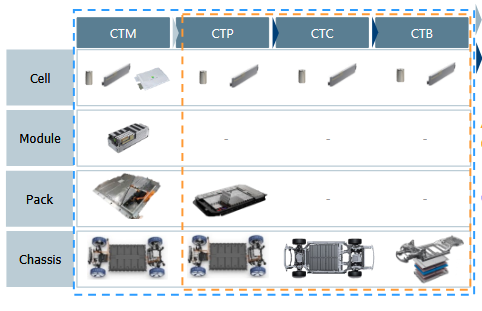
Figure 2. Conceptual illustration of battery structural integration in Cell-to-Body (CTB) and Cell-to-Chassis (CTC) architectures
New Battery Testing Requirements for High Integration Levels
Battery integration leads to testing evolution from static verification to dynamic system validation. Engineers need to consider the electrical, thermal, mechanical, and environmental aspects all at once. The change in scale dramatically broadens the range and difficulty of battery validation programs.
Table 2.EV Battery Testing Focus and Challenges Across CTM, CTP, CTB and CTC Architectures
| Integration Level | Primary Testing Focus | Key Challenges |
| CTM | Electrical & thermal safety | Cost and redundancy |
| CTP | Pack-level uniformity & thermal propagation | Fault containment |
| CTB | Electro-mechanical interaction | Structural aging effects |
| CTC | Vehicle-level safety & durability | Repairability, crash safety |
Such changing requirements call for EV battery test systems with high scalability, high flexibility and multi-domain testing capability. Systems need to support a wide range of higher voltages and currents, longer term cycling, conditioning of the environment, and real-time safety diagnostics and they must do it all in one integrated testing system.
Implications for EV Battery Test System Selection
Testing engineers and equipment procurement groups will need to take a more strategic look at test infrastructure as highly integrated battery architectures become the norm. Today’s EV battery test systems must enable high precision, multi-channel pack-scale measurements; electrical and thermal data acquisition synchronized; interface with mechanical and environmental test equipment; and strong safety protection for large energy systems.
It is critical that the test platform support a path to evolve through the CTM, CTP, CTB and CTC architectures–this is no longer just recommended for future-proofing you battery development and validation.
Conclusion
The evolution from CTM to CTP, CTB and finally CTC represents a significant change in EV battery pack architecture design. Increased integration provides obvious benefits in terms of energy density, cost reduction, and vehicle efficiency, but it brings added complexity with interdependent battery testing needs. Battery validation must progress in conjunction – adopting system-level, multi-physics testing methodologies enabled by state-of-the-art, modular EV battery test systems to achieve safety, reliability and performance. To support these evolving architectures, EV battery test systems must offer scalable channel counts, high-voltage and high-current capability, synchronized data acquisition, and advanced safety monitoring across cell, pack, and vehicle levels.
FAQ
Q1. What is EV battery pack integration?
A: It defines how cells are assembled into modules, packs, or directly into the vehicle structure.
Q2. What is CTP battery pack design?
A: Cells are mounted directly into the pack without modules to improve space and efficiency.
Q3. What are CTB and CTC architectures?
A: CTB integrates the pack into the vehicle body; CTC integrates cells into the chassis.
Q4. Why does higher integration change battery testing?
A: Electrical, thermal, and mechanical behaviors become strongly coupled.
Q5. What is required from modern EV battery test systems?
A: High-precision, scalable, system-level testing with advanced safety monitoring.
Q6. What is EV battery pack testing for CTP and CTB designs?
A: It refers to system-level testing that evaluates electrical, thermal, and mechanical behavior of highly integrated battery packs under realistic operating conditions.
Q7. How do CTB and CTC architectures affect battery test system requirements?
A: They require scalable, multi-physics EV battery test systems capable of synchronized electrical, thermal, mechanical, and safety validation.