From the steam engines of the First Industrial Revolution to the electrified skylines of modern society, human advancement has been characterized primarily by how we use energy.
This development has relied on a simple and costly assumption over the last century, that is, the burning of fossil fuels that have taken hundreds of millions of years to build up. Though effective in driving fast industrialisation, thermal power generation has created a twofold crisis, one being the exhaustion of limited resources, the other being the worsening environmental pollution.
We are currently on the edge of a new age. Countries all over the world are shifting to renewable energy sources such as solar and wind. Nonetheless, this shift faces a basic engineering dilemma, the incompatibility between the intermittency of nature and the need of man to remain constant. When the factories go online, solar radiation is not always available, or when the cities light up at night, wind energy is not always available.
The energy storage comes in at this point. Batteries are no longer just the auxiliary parts of the grid; they are the inevitable stabilisers of the modern world. Batteries have become the heart of catalyzing the shift in the world towards a zero-carbon paradigm because they bridge the gap between high-volatility generation and hard demand.
The Indispensable Stabilizer: Three Core Functions of Battery Energy Storage Systems
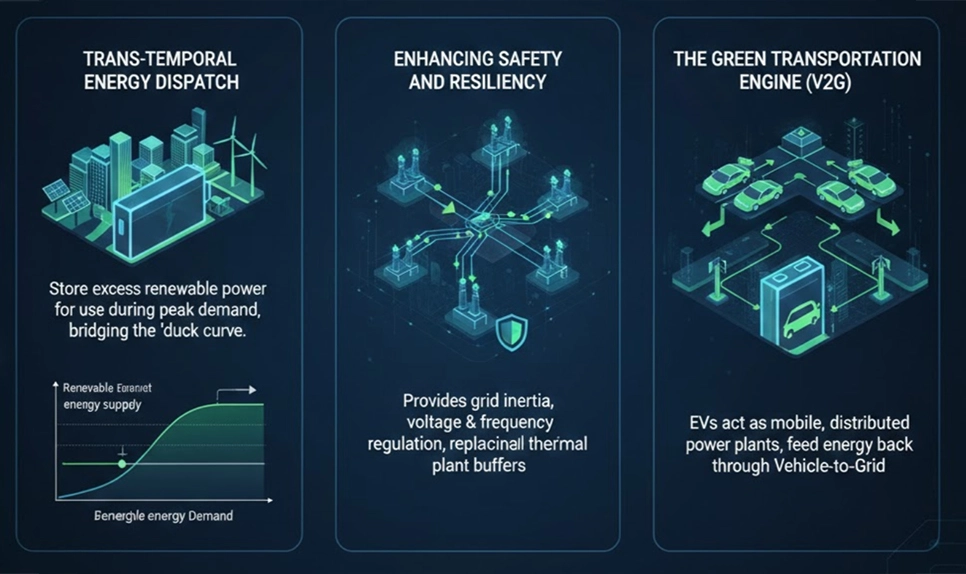
The first problem facing young energy systems is the inherent volatility of energy systems. Solar and wind generation are limited by weather conditions and diurnal cycles. Conversely, demand for electricity in society does not fluctuate during the day and tends to be higher when the sun has gone down, creating the so-called duck curve.
Batteries fill this gap by playing three important roles that transform the unpredictable renewable energy into a reliable power supply.
Trans-Temporal Energy Dispatch
Trans-temporal energy dispatch (TED) is an energy delivery scheme in which a single power plant serves a number of loads located across a large radius.In simpler terms, this means using batteries to shift electricity from when it is produced to when it is actually needed.
Batteries play a very useful role as energy bridges over time. They make power trans-temporal by enabling excess power to be stored when the abundance of a resource (e.g., midday sunshine or night winds) occurs, and released when the production decreases.
Without storage, excess renewable energy is often cut off, and the grid cannot absorb the burst. This otherwise wasted value is obtained by batteries and redistributed to times of peak demand. This essentially increases the usage of renewable infrastructure, and at a certain point, clean energy produced at 13:00 would be available to power a household at 20:00.
Enhancing Safety and Resiliency of the Grid
In modern power grids, they form sensitive ecosystems in which precision, within milliseconds , of voltage and frequency, is required. This inertia was supplied in the traditional thermal plants through huge rotating turbines. With these plants being retired, the grid loses its built-in buffer.Battery energy storage systems can respond within milliseconds, providing synthetic inertia, frequency regulation, and voltage support that were traditionally supplied by rotating generators.
The Green Transportation Engine (V2G)
In the transport industry, battery-powered operation is a direct replacement for internal combustion engines. Electric vehicles (EVs) have now reached the range of gasoline-powered cars, thanks to technological progress in energy density and cost-saving.
However, EVs have much more potential than mobility. On a more fundamental level, every EV serves as a distributed storage of energy on a mobile platform. Through a vehicle-to-grid (V2G) technology, these millions of batteries can be connected to the grid and absorb surplus power when parked and release it during situations of exigency. This transforms the entire world motor fleet into a vast, decentralised power plant, which provides extensively flexible regulation resources that further stabilise the energy network.In this way, V2G turns electric vehicles into flexible grid assets rather than passive electricity consumers.
The Global Practice: Batteries and New Energy Systems Integration
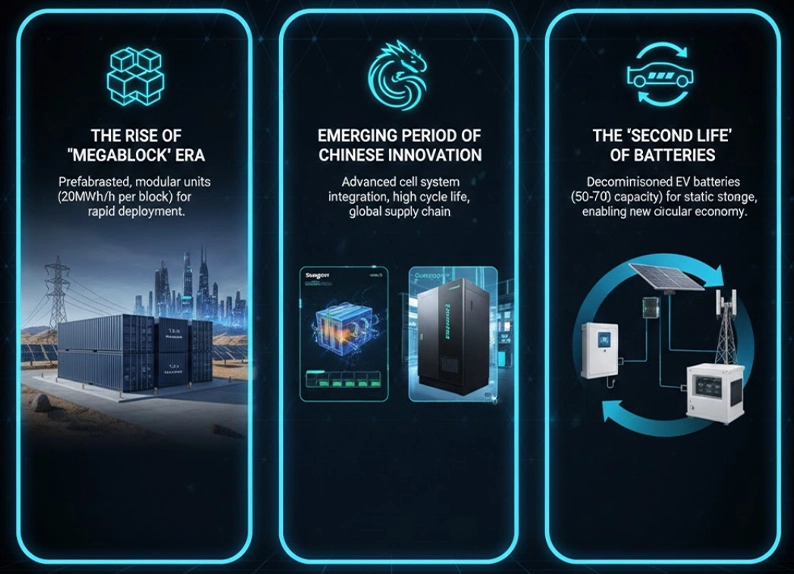
Storage integration is no longer a theory, but a reality in the global industry. In the Nevada deserts or on the coast of China, there are large-scale renewable energy plants that are connected with grid-scale battery energy storage systems to provide consistent power to megacities.
The Rise of the “Megablock” Era
A stiff rivalry has been manifest in the field of grid-scale energy storage, and this has necessitated a quick development. Tesla deployed a deployment system, Megablock, which has transformed the deployment in providing modularised energy storage. Similar to building blocks, these prefabricated modules can be piled to create stations of different capacities up to around 20 MWh per block, radically reducing construction schedules. This boost was critical in Oʻahu, Hawaii, where a large battery system allowed the island to put an end to its last coal-fired power plant.
The Emerging Period of Chinese Innovation
On the same breath, Chinese companies have risen to their feet, taking advantage of widespread supply chains and technological advancement. Other companies like Sungrow have launched the PowerTitan series, which extends the single cabinet capacities to new levels and leads the pack in terms of cycle-life.
The international battery giant, CATL, has extended its industries beyond the cell to include the fully integrated systems with its energy storage system (6.25 MWh) known as Tianheng. With these magnates, a confusing dynamic is created, where the companies often perform the role of both suppliers and competitors, all frenzied to replace traditional thermal power plants.
The Smart Regional Integration
Cross-border trading in energy is also achieved through batteries. An existing case in point is the project of a 60 MW/120 MWh smart energy storage system, co-complied with by Croatia and Slovenia. With the use of Tesla Megapacks, the initiative is not a simple power storage; it is actively participating in the ancillary services of the grid, intraday trading of power. It operates as a virtual battery network, connecting renewable producers and consumers in Southeast Europe. This is the future of batteries as very intelligent nodes of energy asset management.
The “Second Life” of Batteries
More importantly, the lifecycle of a battery does not end as soon as a battery has been pulled out of a car. EV batteries upon decommissioning often have 50/70 percent of their capacity left, which is not optimum to move around but best to store statically. Measures like the BMW Battery Bank make use of these traction batteries for residential photovoltaic storage or backup power at 5G base stations. The circular-economy strategy opens up residual value and reduces the carbon footprint of battery production.
The Battery Performance Assurance: The use of Testing Equipment.
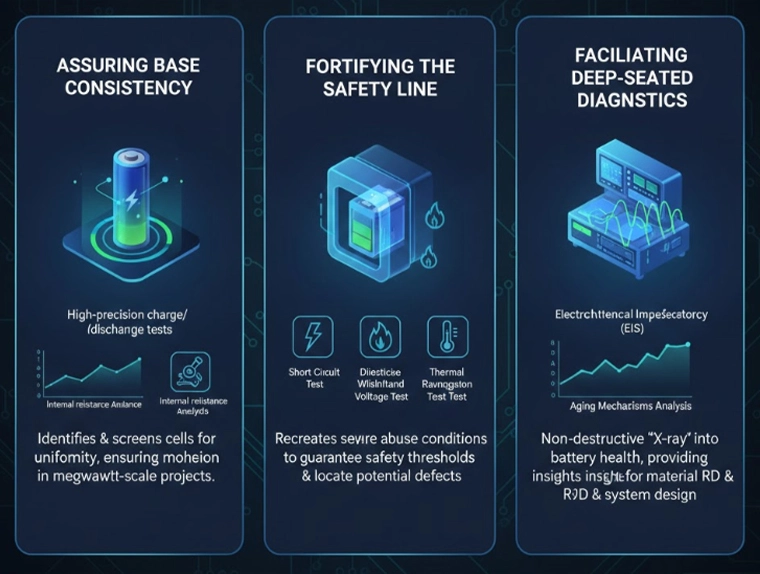
In the back of every high-performance, high-safety battery is a tight quality check system. The forward-thinking of the new energy revolution is that the battery testing instruments are the entry point to mass adoption of batteries.
Today, the major purpose of testing equipment is represented at the following three critical levels:
Assuring Base Consistency
The weakest cell in a battery pack makes the battery pack only as strong as the cell. The testing equipment identifies and screens tens of thousands of individual cells through high-precision charge-discharge tests and through internal resistance analysis. This will also make each module in a megawatt-scale project work in a cohesive fashion, ensuring there are no imbalances that would affect the quality of the whole system.
Fortifying the Safety Line
Safety is non-negotiable. Test equipment recreates severe abuse conditions – insulation withstand voltage, short circuits, and thermal runaway propagation. These tests guarantee the safety threshold of the battery both during its lifecycle and safeguard the infrastructure and people by actively finding the location of possible defects in a controlled environment.
Facilitating Deep-Seated Diagnostics
Such sophisticated instruments as Electrochemical Impedance Spectroscopy (EIS) offer a non-destructive X-ray into the health of the battery. It would be a non-damaging technology that gives insights into the aging mechanisms, and this information is essential in the development of better materials and system design by the R&D teams.
High Power and Regeneration: Future of Testing
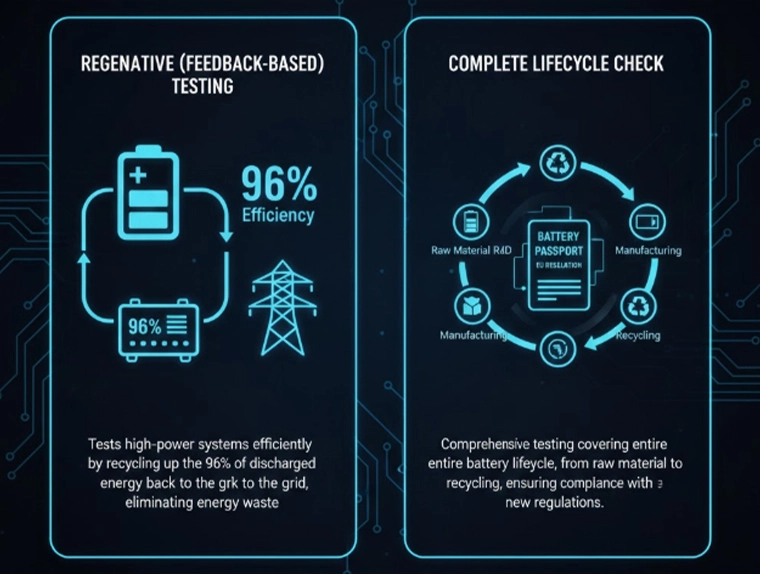
Traditional testing is becoming a thing of the past as we work towards 800 V high-voltage platforms and storage in megawatts. The industry is developing towards:
Regenerative (Feedback-based) Testing: The most advanced manufacturers are topped off at a 96 percent efficiency system. These systems instead of losing the energy released during a test through heat generated back to the grid feed this energy back into the grid, eliminating the energy consumption problems associated with high-power testing.This approach is particularly critical for high-power testing of grid-scale battery systems, where energy efficiency directly translates into lower operational costs.
Complete Lifecycle Check: In order to meet the new regulations, such as the EU one (Known as the Battery Passport), testing is now required to cover the whole lifetime cycle, from raw material R&D up to the manufacturing, use, and lastly recycling.
结论
Going green to a zero-carbon future is not a matter of whether but of how quickly. Battery technology is the accelerator of this timescale, and it is the heart of the new energy systems.
Nonetheless, the introduction of large storage space has its own responsibility. The supporting infrastructure, namely battery testing instruments, has to change in line with these systems in order to make them safe, reliable, and efficient. Quicker, smarter, and more connected test solutions are not lab devices, but rather critical segments of the next-generation energy network, as it is necessary to ensure that the batteries that our world runs on are capable of meeting the challenge.
In Sinexcel-RE, we have realized that there should be a strict checking mechanism behind every green electron stored. And we are not only measuring performance by developing the science of testing; we are establishing the basis of the new energy age.
Frequently Asked Questions About Battery Energy Storage Systems
Q1: Why can we not simply use solar and wind without batteries?
A: Wind and solar are intermittent. Solar panels are not working during the night, and wind turbines are not working when there is no wind. We cannot have a stable supply of power because we have no batteries to store the extra energy that will be produced in the peak conditions. These fluctuations are smoothed by batteries so that lights are on 24/7.
Q2: How do battery energy storage systems help lower electricity costs?
A: Batteries prevent the charging of peak demand. The time when the electricity is the most expensive is at high-demand time (early evening). Batteries enable utilities and companies to store inexpensive off-peak power (or free solar energy) and consume it during periods of high demand, which is a month-end high cost, to avoid the cycle of starting expensive and polluting peaker gas-generating facilities.
Q3: How long does the lifetime of a modern energy storage battery last?
A: The typical energy storage systems that are used today, including those based on LFP (Lithium Iron Phosphate) chemistry, have a design life of 10-15 years or approximately 6,000 to 10,000 cycles. Sophisticated testing and battery management system (BMS) play a vital role in prolonging this lifespan by preventing cells from being overcharged or overheated.
Q4: Does battery testing go along with nature?
A: It can be. In the traditional testing, the discharged energy was in the form of heat. Nevertheless, the current generation of testing (such as that Sinexcel-RE stresses) is based on regenerative technology. This can be used to recycle back into the grid up to 96 percent of the electricity that is discharged during testing, and the carbon footprint of the manufacturing process is greatly reduced.
Q5: What is V2G technology?
A: V2G is an abbreviation of Vehicle-to-Grid. It is a technology where electric vehicles are able to communicate with the power grid in order to sell demand-response services by either returning electricity to the grid or by reducing their charging rate. It effectively makes EVs mobile battery packs in the city.