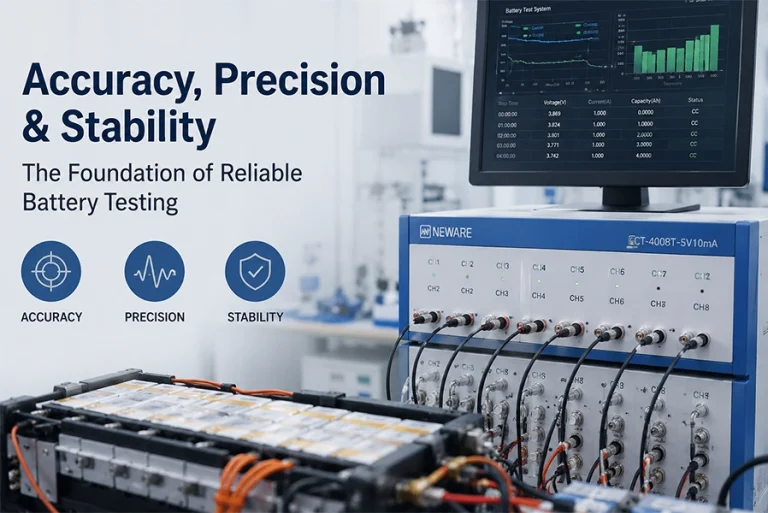
With the growing popularity of EVs and their increasing adoption across the world, the need for reliable and high-performance battery systems is more pressing than ever. Overall, the EV Battery Pack Testing System is crucial in guaranteeing that battery packs adhere to stringent standards for safety, resilience, and efficiency before being employed in real-world settings.
An EV battery testing system can simulate real-world operating conditions during the early stages of battery development to identify quality differences, potential safety hazards, and performance problems. This not only increases the reliability of the product, but it also decreases the cost of production and warranties in the long-term. This guide discusses the functions, testing specifications, and other important factors to consider when selecting the appropriate EV Battery Pack Testing System.
What is an EV Battery Pack Testing System?
An EV Battery Pack Testing System is a piece of test equipment specifically designed to test the electrical, thermal, and safety properties of an electric vehicle battery pack. It mimics real-world charging, discharging, and environment to test battery stress to evaluate battery performance.
Battery testing systems are widely used by:
- EV manufacturers
- Battery pack manufacturers
- Automotive testing laboratories
- Research institutions
- Quality control departments
The systems are typically employed for EV manufacturers, battery manufacturers, and quality control testing labs to confirm a battery pack’s performance and safety criteria. The system looks into the key performance indicators like capacity, efficiency, stability, etc., and only good battery packs make it to mass production or deployment.
Key Functions of an EV Battery Pack Testing System
The functions of the EV Battery Pack Testing System include:
Capacity Testing
Capacity testing measures the total amount of energy a battery can store and deliver under specified operating conditions.
How the Test Is Performed
The battery is charged to the manufacturer’s design, then discharged under controlled conditions, usually at a predetermined current and temperature.
- The discharge continues until the battery reaches its cutoff voltage.
- Capacity is based on the total ampere hours of discharge.
What Engineers Look For
Engineers verify:
- Capacity compliant performance
- Cell-to-cell consistency
- Performance variations under different temperatures
- Manufacturing quality variations
Typically, capacity testing is used as a baseline prior to the cycle life and durability testing.
Charge and Discharge Performance Testing
One of the basic tests that is conducted by an EV battery pack testing system is charge and discharge testing. The process is utilized to decide the effectiveness of the battery storing and giving off energy when the conditions are fulfilled. It can be applied to determine the capacity of the battery, the voltage stability, and the efficiency of energy conversion, which are important for the performance and driving range of EVs.
How the Test Is Performed
A battery cell, module, or pack is connected to a battery cycler that can precisely control the current, voltage, and power applied to the battery.
This test normally includes:
- Attempting to charge the battery with the battery charging protocol prescribed to the battery (CC-CV for Li-ion batteries)
- Electrical and thermal parameters are monitored throughout the test cycle.
- When discharging is controlled by setting the current or power output.
These tests can be performed at various temperatures, at various charge/discharge rates (C-rates), and to test performance under different operating conditions.
Parameters Measured
Key measurements include:
- Battery capacity (Ah)
- Current
- Energy efficiency (Wh)
- State of Charge (SOC)
- Charge acceptance
- Discharge performance
- Voltage consistency
- Energy (Wh)
What Engineers Look For
Engineers analyze:
- Whether the battery can maintain the specified voltage range or not.
- Current-voltage characteristics of charge and discharge of the batteries.
- Energy efficiency losses
- Heat generation
- The performance of the various C-rates.
- Degradation and/or unusual performance
Engineers use these results to validate battery performance and for calibration of the battery management system (BMS).
DCIR (Direct Current Internal Resistance) Testing
The battery is charged at a predetermined SoC and temperature.
For a short duration, a current pulse is applied for a duration ranging from a few seconds to tens of seconds. The drop in voltage due to the pulse of current is measured.
DCIR can be determined by the formula:
DCIR = ΔV / ΔI
Several different temperatures and SOC levels are typically taken for measurements.
Parameters Measured
- Voltage before pulse
- Voltage during pulse
- Current pulse magnitude
- Pulse duration
- Internal resistance
- Temperature
What Engineers Look For
Engineers evaluate:
- Power delivery capability
- Resistance growth with aging
- Heat generation potential
- Cell matching quality
- Cold-temperature performance
One of the most obvious signs of battery deterioration and loss of power is a drop in DCIR. The ambient temperature is carefully controlled in an environmental chamber in which the battery is operated.
Cycle Life Testing
Cycle life of a battery is the number of times the battery can be charged and discharged, without losing enough of its capacity and performance to be considered useless. This is a crucial piece of functionality for predicting battery life and ultimately EV reliability. This also helps the producers to make improvements on the design of the battery and optimise material selection.
How the Test Is Performed
The battery is repeatedly charged and discharged under a set of operating conditions. Testing can be scheduled to be ongoing for months or even years, depending on the cycle count target.
Profiles can model actual EV use, such as:
- Urban driving
- Highway driving
- Fast charging
- Regenerative braking events
A degradation assessment is done by periodic reference performance tests.
Parameters Measured
Typical measurements include:
- Delivered capacity (Ah)
- Delivered energy (Wh)
- Charge capacity
- Discharge capacity
- End-of-charge voltage
- End-of-discharge voltage
- Temperature
What Engineers Look For
Key aims are to establish/confirm:
- Capacity fade rate
- Resistance growth
- The end-of-life point is the time (usually 70-80% of capacity retained) at which the battery is no longer considered fit for its intended use.
- Effect of charging strategies
- Long-term reliability
Results are used to predict the lifespan of vehicle batteries and the warranty performance.
Thermal and Environmental Testing
The battery’s performance is very sensitive to changes in temperature. The EV battery testing systems simulate extreme hot conditions, extreme cold conditions, and other tests to evaluate the battery pack’s response to thermal loading. This enables it to maintain its performance in different climatic conditions and prevents possible safety hazards such as overheating or thermal runaway.
How the Test Is Performed
The tests are being carried out over a variety of temperatures, such as:
- -30°C
- -20°C
- 0°C
- 25°C
- 45°C
- 60°C
Engineers check:
- The ability to perform in cold and hot temperature environments.
- Uniformity of temperature throughout the cells
- Cooling system efficiency
- Risk of overheating
Temperature significantly affects battery capacity and power output. The results will be of key importance when designing the battery thermal management system (BTMS).
Safety and Thermal Performance Testing
Safety testing is an important test that checks the performance of battery packs when they are exposed to out-of-normal usage conditions, such as overcharging, short circuit, and over-discharging. These tests enable the detection of possible failure modes and guarantee the safety standards demanded in the field of EVs.
Important protections include:
- Overvoltage protection
- Overcurrent protection
- Emergency shutdown systems
- Thermal monitoring
- Fault diagnostics
Safety testing is a deliberate test of batteries under conditions that exceed their normal operating conditions.
The most common abuse tests are:
| Electrical Abuse | Mechanical Abuse | Thermal Abuse |
| ● Overcharge ● Over-discharge ● External short circuit ● High-rate charging | ● Crush testing ● Nail penetration ● Vibration testing ● Shock testing ● Drop testing | ● Thermal ramp testing ● Oven exposure ● Thermal shock testing |
Parameters Measured
- Voltage
- Current
- Temperature
- Pressure (where applicable)
- Gas generation
- Venting behavior
- Fire or thermal runaway occurrence
What Engineers Look For
Engineers test the battery to determine if the battery:
- Vents safely
- Does not present a risk of fire or explosion
- Ensures that thermal runaway cannot be propagated
- Maintains electrical isolation
- Meets regulatory requirements
The outcomes are evidence of compliance with standards, including:
Battery Management System (BMS) Validation
BMSs are essential to the functioning and control of today’s EV battery packs. Testing systems evaluate and ensure accurate data transmission, fault detection, and protection capabilities between the battery pack and BMS. This will ensure the batteries’ health and safety during use. Testing ensures:
- Accurate monitoring
- Cell balancing performance
- Fault detection
- Communication reliability
- Protection system functionality
Standards for EV Battery Pack Testing System
The EV Battery Pack Testing System is tested according to the following standards.
Any EV battery testing system should meet internationally recognized standards to guarantee that the product is safe and will be accepted by the global market. There are a number of standards that set performance testing criteria for lithium-ion batteries, which are used in electric vehicles, such as IEC 62660, and there are also a number of standards that define transportation safety criteria, such as vibration, shock, and environmental stress tests (UN 38.3). UN 38.3 sets the requirements for transportation safety for lithium battery packs and cells.
| Standard | Purpose |
|---|---|
| IEC 62660 | Lithium-ion cell performance testing |
| ISO 12405 | EV battery pack and system testing |
| UN 38.3 | Transportation safety testing |
| SAE J2464 | Abuse testing |
| UL 2580 | EV battery safety requirements |
Other commonly referenced standards include IEC 62619, ISO 6469, SAE J2929, GB/T 31485, GB/T 31467.3, QC/T 749, and ISO/IEC 17025, depending on regional regulatory and testing requirements.
Testing includes:
- Vibration
- Shock
- Altitude simulation
- Thermal testing
- Impact testing
To ensure the same method of testing lithium-ion battery packs and systems, ISO 12405 offers guidelines for battery testing. Moreover, GB/T standards can also be applied to the battery tests of electric vehicle applications, and for manufacturers to aim for the Chinese market. Adhering to these standards ensures that battery packs are safe, secure, and appropriate for commercial applications.
How to Choose an EV Battery Pack Testing System
In selecting the type of EV Battery Pack Testing System to be utilized, technical features, application requirements, future expansion, and growth should be considered.
Evaluate Voltage and Current Range Requirements
The voltage and current range of the system is one of the most important factors; it is important to match current testing requirements and future battery technologies. Choose a system capable of supporting:
- Present testing requirements
- Future battery technologies
- High-power applications
Prioritize Accuracy and Measurement Stability
The other essential requirements are accuracy and stability, since accurate measurements are directly related to the reliability of the tests and the quality of the products. High-resolution data acquisition and stability of control properties are available, and provide a consistent test result over a long period of time in advanced systems. Consider the:
- Accurate voltage measurement
- Precise current control
- Stable data acquisition
- Advanced calibration capabilities
Consider Automation and Testing Efficiency
Scale of testing is another factor to be considered, especially when testing is large-scale, and automation is applicable. Automated systems increase efficiency, decrease human error, and allow for continuous testing without too much manual effort. For high-energy testing, safety features such as over-voltage protection, temperature monitoring, and emergency shutdown are critical. There may be advanced systems featuring:
- Automated test sequencing
- Remote monitoring
- Data logging
- Report generation
- Cloud integration
Choose a Scalable System for Future Growth
Scalability is also an important factor to consider, particularly for manufacturers looking to expand their operations in the future. They can be scaled up by adding additional channels and test modules as needs evolve, and make them an investment in EV development.
- Add testing channels
- Support new battery platforms
- Increase production throughput
Advantages of EV Battery Pack Testing System
The EV Battery Pack Testing System is beneficial in many ways to product development and manufacturing.
- It enhances the quality of the batteries as early defects and problems are detected during the manufacturing process.
- It also enhances safety by making sure the batteries are deployed only after they have been tested to comply with rigorous regulations.
- More significantly, however, these systems can be used to help reduce development time by ensuring accurate and repeatable test data, allowing engineers to optimise designs more effectively.
- They also contribute to lower expenses and minimise field warranty claims and product failures.
- Reduced warranty claims
- Increased customer confidence
In summary, battery testing systems are vital in enhancing the reliability and competitiveness of EV battery products.
Future Trends in EV Battery Testing
Emerging trends include:
- AI-assisted battery diagnostics
- Digital twin battery simulations
- High-voltage battery testing
- Fast-charging validation
- Real-time battery analytics
- Automated testing platforms
As battery technologies evolve, testing systems will become increasingly intelligent, precise, and automated.
Conclusion
The EV Battery Pack Testing System is a crucial tool used in the development and production of EVs today. It helps to guarantee battery packs are capable, secure, and long-lasting, and enables advancements in battery innovation. The systems are fully validated in all areas of system performance, including charge discharge analysis, thermal, and safety testing.
The most appropriate testing system can be determined by the technical feasibility, accuracy, safety properties, and scalability of the system. Advanced battery testing systems are becoming more and more critical as the electric vehicle industry continues to grow, and remain a competitive advantage when competing globally for quality.
FAQ
What is an EV Battery Pack Testing System used for?
The EV Battery Pack Testing System is used to test the performance, safety, and reliability of electric vehicle battery packs in a controlled environment.
Why is battery testing important in EV development?
The testing of batteries confirms that EV batteries can be safe, perform consistently under real use, and last longer.
Which standards are used in EV battery testing?
The standard adopted is usually IEC 62660, UN 38.3, ISO 12405, SAE standards and GB/T regulations.
What functions are included in battery testing systems?
Some of the main applications are charge-discharge testing, cycle life testing, thermal testing, safety testing, and validation of Battery Management Systems.
How do I choose the right battery testing system?
Selecting a voltage range, current capacity, accuracy, level of automation, safety features, and scalability should be taken into consideration.