Introduction
Battery development during 18650 to 21700 and currently to 4680 has been portrayed as a mere technological improvement. Practically it represents a sequence of trade-offs due to constraints in manufacturing, cost, and system-level design decisions and not merely increase in energy density.
Any person who has had actual experience in the battery or the EV supply chain is aware that format selection is not often spearheaded by specification alone. They are motivated by what they have the capability to produce on an ongoing basis, verified safely, shipped reliably and supported on millions of vehicles.
That fact makes the use of older formats still common, some of the manufacturing companies simply not employing 4680, and the approaches to battery practices start and end in a stark contrast of Tesla, BYD, CATL, LG Energy Solution, Panasonic, and Samsung SDI.
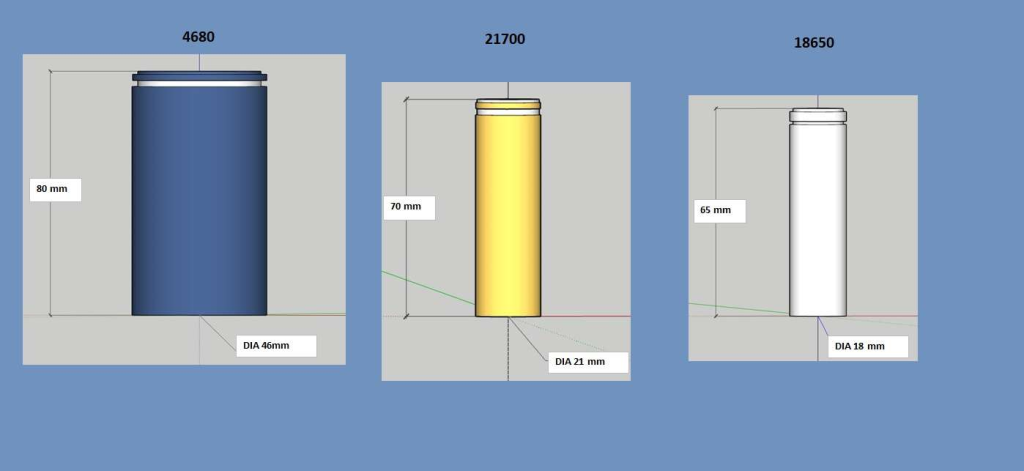
18650: It is still a Workhorse in the Industrial Ecosystem.
Industrially, the 18650 batteries is not a new one, it is a mature cell.
Manufacturers are aware of it. There is a clear definition of process windows. The modes of defects are predictable. Yield is high. Such a combination is highly useful in mass manufacturing and in any case where cost is a more important factor than energy density.
This is the reason as to why 18650 batteries remain supreme:
- Power tools (DeWalt, Makita, Milwaukee).
- Consumer electronics
- Backup power systems
- Medical and industrial appliances.
To this day, 18650 batteries are still in use by some EV manufacturers in some platforms or legacy designs due to their knowledge of how to deal with them thermally and electrically.
Of 18650, it is not performance it is scale. The number of small cells is dramatically raised to thousands to enhance pack complexity and welding and failure points. It became more challenging to reason that as EV packs were increasing in size.
21700: The most comfortable upgrade in the Industry.
The transition of 18650 to 21700 was not disruptive. It was pragmatic.
Under factory standpoint, 21700 needed:
- Adjusted machinery, not other plants.
- Conventional tab-based design.
- Little retraining of the production personnel.
- Transposable quality-control experience.
In the case of automakers, the pay-off was quick:
- Fewer cells per pack
- Reduced wiring and welding
- Minor improvement in thermal properties.
- Higher pack level energy density.
It is the reason why 21700 was the default option to most EV platforms, including:
- Tesla (Model 3 / Model Y, previous models)
- Various Chinese and Korean OEMs.
- Energy-storage systems and industrial EV.
To this day, a number of manufacturers are willing to use 21700 due to its location in a low-risk corner: sufficiently advanced to simplify the complexity of the pack, yet mature enough to be used on a large scale.
4680: Forget a Larger Cell, Bet on the System.
There is the 4680 format, which is poorly understood. The fact that it is larger is not the only importance because it presents a tabless electrode architecture that alters current flow and heat distribution within the cell.
In theory, this enables:
- Lower internal resistance
- Unless there is a thermal resonator, the thermal behavior is more uniform.
- Higher power capability
- Design of structural battery packs.
Nonetheless, both large cells and increase manufacturing risk.
The coating of heavier electrodes becomes more difficult. Jelly-rolls that are wider are not sensitively handmade. Minor differences in the processes have magnified outcomes. The cost of losses on yields is very rapid.
This is the main factor, as to why 4680 mass production has not been as speedy as it was initially anticipated. It is not design which is the challenge, but production discipline.
Batteries type used by Vehicle companies:
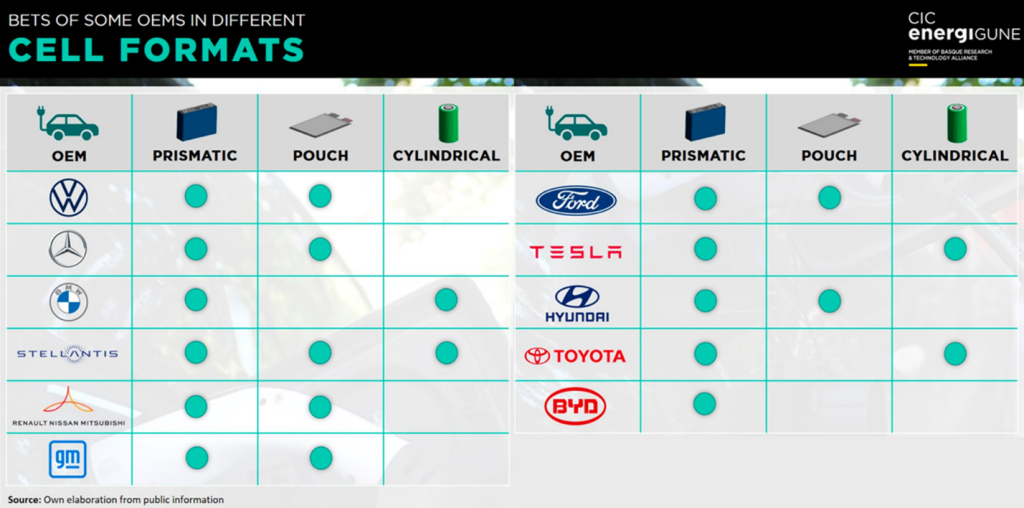
The reasons BYD does not use 4680 (and why that is a sensible thing to do)
Any person having acquaintance with the market of the industrial battery understands that BYD has gone in a very different direction.
Rather than massive 4680 cylindrically shaped cells, BYD specializes in:
- Prismatic LFP battery of blades.
- High thermal stability
- Long cycle life
- Large-scale manufacturing that can be predicted.
This choice indicates the priorities of BYD:
- Maximum energy density versus safety.
- Manufacturing repeatability
- Millions of vehicles cost controlled.
- Less thermal-runaway propagation.
LFP chemistry is more stable and robust naturally, which is why it is blended best with blade batteries. Long, flat geometry enhances the heat dissipation and integration of the pack is easier.
This is not a conservative measure, industrial-wise, it is a strategic measure.
BYD optimizes on a system level and not cell-spec level. This is why its strategy is different as compared to Tesla, and the two strategies can exist successfully.
Practical Comparison: The Way Industry Engineers Realistically Perceive these Formats.
Instead of idealized classifications, engineers normally perceive formats such as the following:
| Aspect | 18650 | 21700 | 4680 |
| Manufacturing | Very high | High | Still evolving |
| Complexity of integrating products/packs. | High | Moderate | Low (in theory) |
| Yield sensitivity | Low | Medium | High |
| Thermal risk per cell | Low | Medium | Higher if defects exist |
| Cost predictability | Strong | Stable | Variable |
| Best suited for | Tools, electronics | EVs, ESS | Structural EV packs |
One of the lessons of actual projects:
A good 21700 pack can be much better than a poorly managed 4680 pack, not on paper, but in reality, delivered cars with warrants attached.
The reasons that make 4680 Still of interest to the OEM.
Nevertheless, 4680 is appealing due to the fact that it allows:
- Fewer cells per vehicle
- Less wiring and assembling time.
- Structural battery ideologies.
- Lower mass at system level
These are important to high-performance EVs or the next-generation vehicle architecture. Success, however, relies more on consistency of manufacturing than on the geometry of the cell.
The Next Decade: What It Is Probably Going to Be Like.
The use of industrial batteries hardly extinguishes outdated formats. It segments them.
- 18650: tools, electronics, specialty industrial systems.
- 21700: mainstream EVs and energy storage.
- 4680: selective and high-integration EVs.
- Prismatic LFP (Blade): mass-market EVs with a focus on safety and durability.
This co-existence does not signify inefficiency. This is the way big industrial complexes develop.
Conclusion
It is not the best battery between 18650, 21700 and 4680. It is concerning which trade-offs a manufacturer is ready to accept.
Battery formats are successful when they are able to be:
- Produced reliably
- Scaled economically
- Integrated safely
- Sustained on extended lifespan.
That is the reason why the industry still follows several directions at once – and as to the development of batteries, the picture becomes incomplete unless we examine the aspect of manufacturing reality.
FAQ
Do 18650 batteries become obsolete today?
Not really. Around 18650 batteries are still used in most industrial and commercial applications, as they are highly familiar, readily available and very predictable to manufacture. Although they can no longer be used in very large EV battery packs, they still dominate in power tools, electronics and systems where reliability and cost control are of greater concern than maximum energy density.
Why did the industry not go at once 18650 to 4680?
Since manufacturing battery is not very quick at taking leaps. The migration to 21700 enabled manufacturers to simplify pack without entirely rewriting their production scripts. It was a step forward that was regulated. Going to much larger cells would have imposed excessive unknowns simultaneously, particularly in the vicinity of yield, thermal behaviour and long-term reliability.
Is that primarily a Tesla-driven battery 4680?
Tesla has contributed significantly to making the idea of the 4680 come into the limelight, though the concepts of larger cells, decrease of internal resistance, and simplification of packs are not exclusive to Tesla. The peculiar feature is in the fact that Tesla tried to implement the cell in the vehicle itself as aggressively as possible. Other manufacturers are also watching keenly but taking their steps more slowly.
Why is the mass production of 4680 batteries not occurring as fast as it should?
The large-format cells are hard to scale. Wider process tolerances, tighter electrode, and heavier electrodes all combine to diminish manufacturing leeway. An error that occurs in a big cell is more risky than in a small cell. High yield is always a long process even in case the design behind it is excellent.
Assuming that 4680 is so promising, why would many companies still use 21700?
Since 21700 is already the solution to many problems, there is no reason to introduce new problems with it. It reduces the count of cells, enhances the efficiency of the packs, and can be installed easily in the existing manufacturing facilities. The incremental value of going to 4680 is not yet felt to be worth the increased risk of production to many OEMs.
Why is BYD not using a cylindrical battery, such as 4680?
The strategy of BYD is founded on security, reliability, and predictability of its production. Its prismatic LFP battery of blades is more in line with those priorities. Such a decision represents optimization at the system level and not the unavailability of cylindrical technology. BYD places fidelity to scaleable rather than cell-level energy density production.
Would bigger battery cells be more hazardous in nature?
The bigger the cells the greater the amount of their energy and that way, in case of failure the consequences can be worse. Nevertheless, the large cells can indeed be manufactured well, capable of working with the lower internal resistance and high thermal uniformity. The quality of manufacturing, the design of the pack, and thermal control is much more important than cell size.
What type has the most battery life?
Cycle life is not dependent on format. Of much more importance is chemistry, charging behavior, temperature control and depth of discharge. LFP-based systems tend to have longer lifespans, whereas aggressive fast charging shortens all types of cylindrical form factor lifespan, size notwithstanding.
Will the disappearance of 21700 batteries occur when 4680 is mature?
Unlikely. Formats of batteries do not die; they niche. Although 4680 may become a commodity in certain EV platforms, 21700 will still be applied where its performance-to-cost-to-manufacturing-stability ratio is more appropriate.
Always is the objective of battery design higher energy density?
No. Safety margins, predictability of costs, thermal behavior, and long-term reliability are also important in most real-world applications than maximizing energy density. That is one of the reasons why there are manufacturers intentionally compromising energy density to gain improved system-level performance.
Is it better to select the correct form of battery or perform it adequately?
Execution matters more. A consistent conservative battery format will stand better than an advanced format that is not produced in a consistent manner. It is the reason why yield, quality control and warranty risk are oftentimes considered more important by OEMs than headline specifications.
Will a single battery format become the one to take over the whole market?
Very unlikely. The battery business is not converging but getting segmented. The various forms will still be used which will be suited to different applications, cost structure, and manufacturing philosophies.