The introduction of the BYD Blade Battery 2.0 represents a significant shift in electrochemical engineering. This battery provides superior LFP cells that support ultra-fast charging without sacrificing safety or thermal stability.
A highlight of this battery is its 9-minute flash charging, targeting a 10% to 80% state of charge (SOC) in a timeframe previously considered impossible for stable LFP cells. This charging speed allows EVs to match the refueling speed of internal combustion engines.
But how does the 9-minutes flash charging/flash charging 2.0 work? What systems keep this battery safe and durable? And how did BYD achieve this breakthrough? Keep reading to find the answers to these and other questions.
Key Takeaway: How the 9-Minute Flash Charging Works
To achieve the 9-minute flash charging, BYD adopts an improved ecosystem that delivers a massive 1500kW charging peak through a single connector. This system is supported by a 1000V architecture and an ion-transport system with about 50% lower internal resistance.
The 1500kW ultra-fast charging is made possible by the evolution of Lithium Manganese Iron Phosphate (LMFP) cells from Lithium Iron Phosphate (LFP) cells. In addition, BYD provides a particle-size cathode and a high-speed anode in the cells, allowing lithium ions to enter and exit the battery 10 times faster than other batteries.
To prevent overheating and maintain safety, BYD adopts a 3D refrigerant cooling system that dissipates heat aout 90% more efficiently. This keeps the battery within a safe temperature range, even during high-speed charging.
The result is a battery that charges from 10% to 97% in 9 minutes. Because of the battery’s architecture, it remains durable despite frequent flash charging, offering over 1.3 million kilometers and can survive a mail penetration test even while being charged at maximum power.
Understanding the BYD Blade Battery 2.0 Architecture
The difference between the original Blade battery and the Blade battery 2.0 is not a simple geometric refinement of the cell-to-pack layout. Instead, it is an evolution of the cell’s electrochemical blueprint.
While the first-generation Blade used the regular Lithium Iron Phosphate (LFP), version 2.0 uses Lithium Manganese Iron Phosphate (LMFP). BYD has strategically boosted the cell cathode with Manganese, raising the voltage platform from 3.2V to about 3.8V.
Like increasing pressure in a water pipe, BYD introduced Manganese into the battery cell structure to help the battery hold and move more energy.
In addition, the second-generation battery design is optimized for energy and power. It features a more modular, short-blade format in some applications, reducing the internal path lengths for electrons and ions. This shorter pathway is mechanically necessary to support the high-current demands of ultra-fast charging.
The table below provides a visual overview of the technical evolution of the BYD Blade battery 2.0 from the original Blade battery.
| Feature | BYD Blade Battery 1.0 | BYD Blade Battery 2.0 |
| Cell Chemistry | LFP (Lithium Iron Phosphate) | LMFP (Lithium Manganese Iron Phosphate) |
| Pack Energy Density | ~140 – 150 Wh/kg | 210 Wh/kg |
| Max Charging Rate | 1.5C – 2.0C | Up to 10C |
| Peak Power Input | ~150 kW – 250 kW | 1500 kW ultra-fast charging |
| Voltage Architecture | 400V / 800V | 1000V+ High-Voltage Platform |
| Thermal Management | Single-Side Liquid Cooling | 3D Dual-Plane Refrigerant Cooling |
| Compliance Standards | UN38.3, GB/T 31485 | UN38.3, IEC 62133, UL 2580, SAE J2464 |
Engineering the 1500kW Ultra-Fast Charging Ecosystem
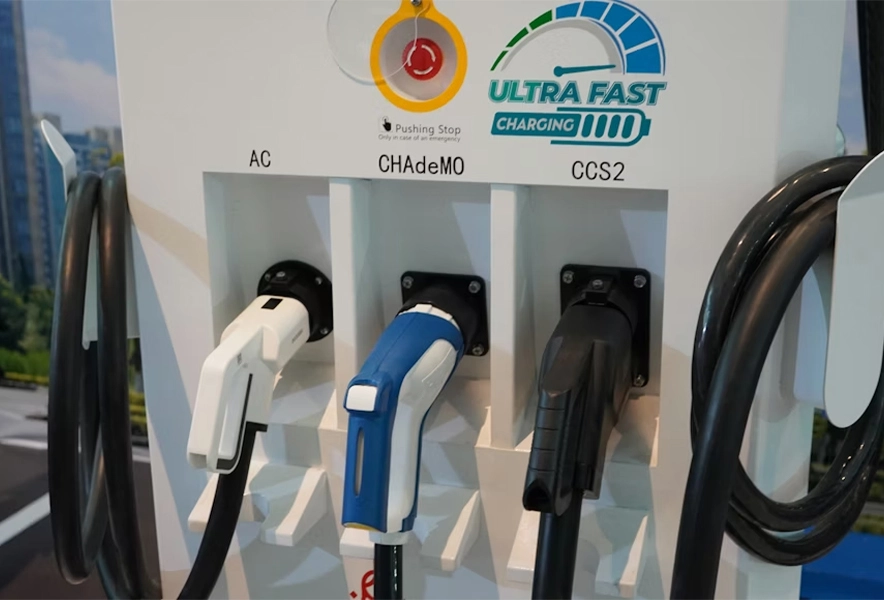
To get a full charge in under ten minutes, an EV battery must be able to ingest energy at an unprecedented rate. So, ultra-fast charging is not just about the battery; it’s about the thermal and electrical handshake between the vehicle and the charger.
To handle the high current required for 9-minute flash charging, BYD uses a high-voltage (1000V+) architecture. The high-voltage system allows electricity to flow more easily through wires, reducing friction that can cause overheating during fast charging.
Even with high voltage, much heat is generated during a 10C charge (charging at ten times the battery capacity). To manage this, the 2.0 battery uses improved hardware featuring a revamped internal busbar system. The busbars are designed with ultra-low resistance materials that prevent localized hot spots despite the ultra-fast input.
In addition, BYD’s 1500kW ultra-fast charging stations use liquid-cooled charging cables and proprietary FlashPass connectors that keep electrical resistance at the contact negligible during high-voltage charging, preventing the connector from welding to the vehicle.
Understanding the Science of Flash Charging
In standard EV batteries, forcing ions into the anode too quickly causes lithium plating. This is when ions turn into metallic lithium on the surface rather than nesting inside the anode.
Lithium plating remains a primary cause of battery fires and permanent capacity loss, which is why there is hesitation to adopt fast charging. However, BYD has solved the lithium plating pain point in the Blade battery 2.0 through three primary innovations, including:
Nano-Structured Electrodes: The anode surface is designed with high-speed ionic channels that guide ions into the graphite matrix. This allows the ions to move from the cathode to the anode with minimal resistance, even during ultra-fast charging,
Flash-Flow Electrolytes: For this new battery, BYD developed a new electrolyte with lower viscosity and higher ionic conductivity. This enhances ionic mobility across a wider temperature range and allows it to remain stable under the high-stress environment.
Advanced Self-Healing SEI Layer: The Solid Electrolyte Interphase (SEI) layer is designed to remain ultra-thin and permeable, preventing cracking even during the rapid volume expansion that occurs during a 10C charge, even after thousands of cycles.
These innovations primarily ensure that lithium ions are pushed into the host material before they can plate on the surface, preserving the cells’ health over thousands of cycles.
Thermal Management: Staying Cool Under 1500kW Pressure

Charging at such a high speed generates significant heat. But if the battery’s thermal management system cannot reject this heat as quickly as it is generated, the Battery Management System (BMS) must throttle power, defeating the purpose of flash charging.
With this in mind, the BYD Blade Battery 2.0 replaces traditional cold-plate liquid cooling with a 3D dual-plane refrigerant cooling system. This system integrates the vehicle’s HVAC refrigerant loop directly into the battery pack’s internal structure.
Instead of just using liquid like a car radiator, this battery is cooled by the car’s air conditioning system. This removes heat 90% faster, similar to how an AC unit cools a room on a hot day.
This cooling system ensures that the temperature difference between the hottest and coolest cell remains within a narrow margin (about 5°C). This uniform temperature is important to prevent differential aging, in which cells at the center of the pack degrade faster due to reduced heat dissipation.
Safety and Standards Compliance With Ultra-Fast Charging
In traction battery testing, speed is the enemy of safety. However, the BYD Blade battery 2.0 was designed to bridge this gap. Like its flash charging time, the battery’s behavior under extreme abuse conditions is just as impressive.
Like the original Blade battery, version 2.0 remained stable even under the famous Nail Penetration Test. In fact, it raises the bar by maintaining similar stability even under the electrical stress of 1500kW ultra-fast charging.
Going a step further, BYD subjected the version 2.0 battery to an internal Impossible Test , which involves performing a nail penetration immediately after a full 10C charge cycle. Even here, the battery cells showed no open flames or smoke, with surface temperatures below 60°C.
Beyond the nail penetration and impossible test, the 2.0 battery is designed to comply with rigorous international standards, including:
UN38.3 Compliance: Ensuring safety during vibration, shock, and altitude changes during transport.
SAE J2464 and UL 2580 Compliance: Focusing on the structural and electrical safety.
The BYD Blade battery 2.0 features a honeycomb structure, where each cell acts as a structural beam, allowing the pack to withstand a 50-ton crush test without a thermal event.
BYD Blade Battery 2.0: Where Longevity Meets Speed
Acceleration of aging is a common concern among EV users and fleet operators. It is a situation where repeated high-power charging cycles lead to mechanical strain and chemical depletion.
Ideally, the extreme current density required for ultra-fast charging should significantly shorten an EV’s battery lifespan. However, the Blade battery 2.0 challenges this limitation, projecting a service life of 1.2 million kilometers.
Here are some features of the BYD Blade battery 2.0 designed to help it attain this service life:
Mitigation of Mechanical Strain
At the microscopic level, high-speed charging causes rapid contraction and expansion of the cathode and anode materials as lithium ions move between them. In standard cells, these cycles can lead to a microcracking of the electrode material.
In contrast, the Blade battery 2.0 uses a high-elasticity binder and a specialized electrode coating that acts as a buffer to help prevent this effect. These features allow the cell to survive the physical stress of fast charging for over thousands of cycles while maintaining 80% of its original capacity.
Precision State of Health (SOH) Monitoring
The advanced BMS on the Blade battery 2.0 is another important feature that ensures its longevity. To balance ultra-fast charging with longevity, the BMS adopts:
Real-Time Impedence Spectroscopy: This involves continuously measuring internal resistance to detect early signs of lithium plating.
Active Balancing: This ensures immediate correction of voltage drift between cells to prevent over-voltage stress on individual units.
Environmental Resilience and Reliability
LMFP chemistry demonstrates significant stability, making these battery packs highly reliable even in extreme climates. BYD’s version 2.0 battery has significantly reduced the rate of capacity fade under high-load operations.
In the commercial sector, this is an important metric. Having an EV that you can use with daily flash charging without degrading its asset value puts the total cost of ownership on par with diesel vehicles.
Conclusion
The BYD Blade battery 2.0 marks a definitive turning point in the global transition to sustainable transport. By successfully integrating 9-Minute Flash Charging into an LFP-based architecture, BYD has solved the two-pronged challenge of cost and performance that has slowed EV adoption.
Looking ahead, the widespread deployment of the BYD Blade Battery 2.0 will rely on the rapid expansion of a charging infrastructure capable of delivering such massive power levels. However, the roadmap is clear: the technical barriers to high-speed, long-range, and safe electric mobility have been removed.
FAQs
- Does frequent 9-minute flash charging accelerate the growth of the SEI layer?
While high-power charging generally thickens the SEI layer, the 2.0 battery electrolyte is formulated with special additives to promote a more stable, thinner SEI layer.
- How does the 2.0 battery perform in extreme cold during a 9-minute flash charging session?
The Blade 2.0 battery uses an internal pulse-heating strategy to overcome the typical challenges of LFP batteries in cold climates. Using high-frequency pulses to generate internal heat within cells before and during the initial charging phase allows the battery to reach optimal temperature levels quickly.
- Is the BYD Blade battery 2.0 compliant with international shipping and safety regulations?
Yes, it does. The battery is designed to exceed the requirements of UN38.3, IEC 62133, and UL 2580. Passing the nail penetration test even at high SOC makes it one of the few high-power batteries that meet these rigorous global safety standards.