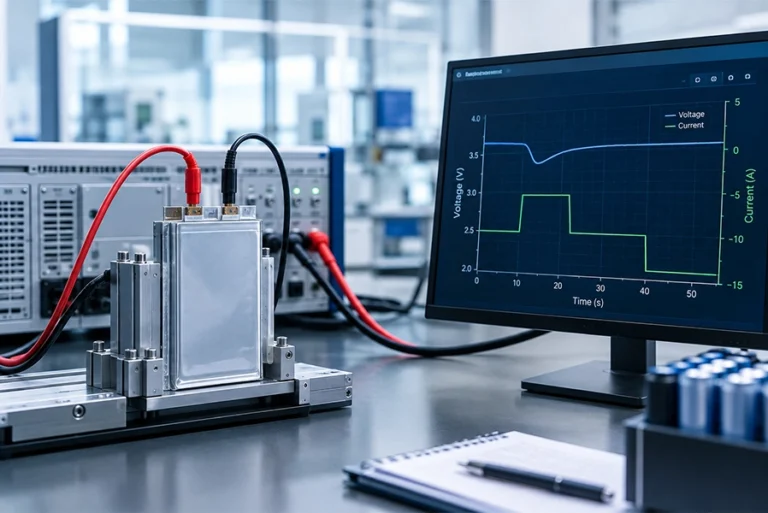
As electrification pushes battery performance further in every direction — from micro-cells in wearables to high-voltage packs in electric vehicles — the quality of the test data behind a battery is only as good as the equipment used to generate it. For engineers and manufacturers, the choice of battery testing equipment has real consequences: bad data doesn’t just slow down R&D, it can mask safety issues that only show up much later.
Accuracy, precision, and stability are the three core metrics used to evaluate testing hardware in power electronics and electrochemical analysis. In everyday speech, “accuracy” and “precision” are often used interchangeably — but in a testing context, they describe genuinely different properties, and understanding the distinction is essential to getting reliable data and maximizing battery cycle life.
Defining the Core Metrics
Before building a rigorous battery testing process, it’s worth being precise about what these terms actually mean.
Accuracy: The Approximation of Truth
Accuracy describes how close a measurement is to the true value. In battery testing, that means how closely a reported voltage or current matches the battery’s actual physical state. If a cell sits at exactly 3.700V and your tester reads exactly 3.700V, that system is accurate.
Accuracy is typically expressed as a percentage of full scale (FS) or percentage of reading. In systems that estimate State of Charge (SoC) and State of Health (SoH), high accuracy isn’t optional — even a small voltage offset can compound into significant errors in downstream energy calculations. Accuracy is also what keeps a system grounded in physical reality, preventing it from missing an over-discharge or overcharge condition that could compromise safety.
Precision: The Strength of Consistency
Precision refers to repeatability — a measurement system’s ability to return the same result under identical conditions, regardless of whether that result matches the true value. A system can be precise without being accurate: a tester that reads 3.705V every single time you connect the same 3.700V cell is precise, but not accurate — it has a consistent 5mV offset.
Precision matters enormously in battery R&D, where engineers need to detect subtle degradation trends over time. Without high precision, it’s difficult to tell whether a small shift in readings reflects real electrochemical change in the battery or is simply measurement noise — which makes precision essential for reliably tracking small changes across comparative aging experiments.
Stability: The Power to be Consistent
Stability is a system’s ability to maintain consistent measurements over an extended period, accounting for drift caused by component aging or changing environmental conditions. Where accuracy and precision describe a snapshot in time, stability describes how reliable that snapshot remains across weeks, months, or years.
Because battery cycle-life testing is inherently a long-duration exercise, stability is what makes it possible to directly compare data collected on day one with data collected on day 500. High stability reduces how often equipment needs recalibration, and — just as importantly — helps ensure that any long-term trend observed in the data reflects real battery behavior, rather than equipment drift.
The Target Analogy
A useful way to visualize the difference between these metrics is the classic “target shooting” analogy used in metrology — shown below.
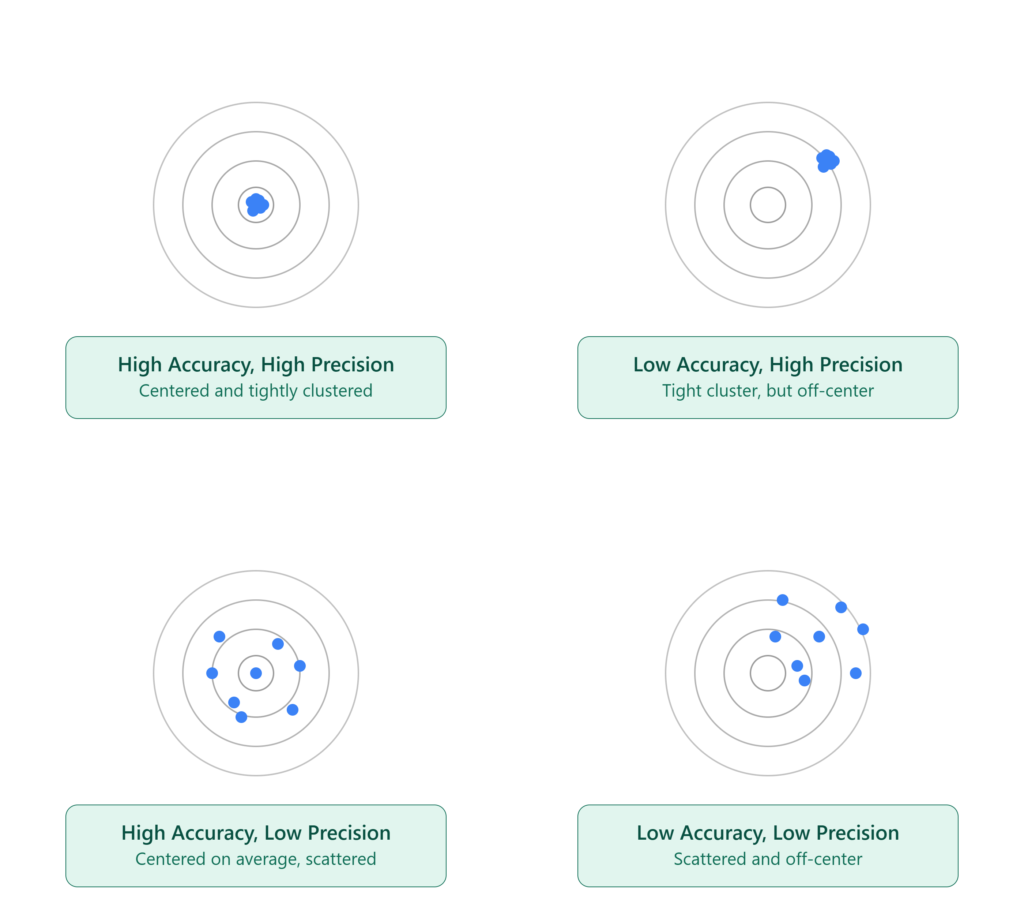
- High accuracy, high precision: shots cluster tightly around the center — the ideal outcome.
- Low accuracy, high precision: shots cluster tightly together, but consistently off-center — a systematic error, like a tester with a fixed offset.
- High accuracy, low precision: shots scatter widely, but average out near the center — random error, or noise, without a systematic bias.
- Low accuracy, low precision: shots scatter widely and land off-center on average — the worst-case combination, where neither the individual readings nor their average can be trusted.
Stability adds a fourth dimension to this picture: it’s the equivalent of a shooter maintaining the same shot cluster, in the same position on the target, over an entire day of shooting — regardless of fatigue or a shift in the wind. Accuracy tells you where a single measurement sits right now; precision tells you how tightly repeated measurements cluster together; stability tells you whether that entire picture holds steady over the long run.
Why Stability Matters in Long-Term Testing
Stability is a very neglected but important measure in the context of power electronics. Testing of batteries cannot be a one-time test; they have thousands of hours of operation.
Short vs. Long-term Stability
Short-term stability is a system’s ability to resist noise and immediate temperature fluctuations within a single test cycle. Long-term stability additionally accounts for gradual drift in internal shunts, voltage dividers, and analog-to-digital converters (ADCs) over extended use.
If a battery tester lacks long-term stability, its measurements drift over time — and that drift can be mistaken for real battery behavior. Consider a researcher studying a new solid-state chemistry who observes 2% capacity loss per 1,000 cycles: if the test equipment itself has drifted by even 1% over that same period, a meaningful share of that “finding” may actually be equipment error, not battery degradation — which can undermine the validity of the entire study. In short: accuracy tells you where the battery is right now, but stability is what tells you the direction it’s actually heading over time.
Application Scenario Analysis
Accuracy, precision, and stability requirements shift depending on the scale and purpose of the test.
Scenario A: Consumer Electronics (milliampere-scale)
For small cells used in wearables or smartphones, resolution and precision are the priorities. At the milliampere scale, equipment needs to detect very small changes to accurately characterize self-discharge rates.
Scenario B: EVs and High-Voltage Battery
At high voltages (1000V and above), accuracy and channel synchronization become critical. A 1% error in a high-power system isn’t just imprecise data — it can translate into megawatts of miscalculated power, or worse, a masked safety issue that leads to thermal runaway. This is also where high-voltage EV battery testing and rigorous BMS validation testing intersect directly with measurement precision — verifying that a BMS is balancing hundreds of cells correctly depends entirely on the fidelity of the underlying measurement.
Scenario C: Production and Quality in Industry
production environment, repeatability — precision — across many channels is what matters most. If Channel 1 and Channel 100 on a large-scale test rig report different readings for identical cells, a manufacturer can’t reliably guarantee consistent product quality.
Eliminating Technical Problems in Measurement Reliability
Achieving these three metrics in practice requires deliberate engineering to counter the main enemies of good data: signal noise and thermal drift.
Signal Noise and Resolution
Every electronic system generates some noise, often introduced by the switching power supplies used to charge and discharge the battery under test. High-performance systems rely on advanced filtering and high-resolution ADCs to keep the actual battery signal from being buried under power ripple — noise suppression that’s particularly important for resolving the fine electrochemical behavior that occurs near end-of-charge.
Thermal Effect and Drift of Measures
Temperature is arguably the biggest threat to measurement consistency. During high-current testing, the electrical properties of internal components shift as they heat up. Without effective thermal management — high-quality cooling design, low-temperature-coefficient components, and a fixed reference zero-point — equipment can drift meaningfully under sustained industrial test conditions. Without thermal stability, data integrity simply isn’t achievable.
Choosing Equipment: Beyond the Spec Sheet
A single accuracy percentage on a brochure doesn’t tell the whole story. System architecture — not just a headline spec — is what actually determines data reliability. A few things worth evaluating:
- Calibration intervals. A genuinely stable system holds its specifications longer, reducing the downtime and labor cost that comes with frequent manual recalibration.
- Environmental compensation. Well-designed testers include onboard sensors that monitor ambient temperature changes in real time and compensate proactively, rather than reactively.
- Data synchronization. In multi-channel setups, communication bus speed matters — high-speed ADCs need to transmit data without lag so voltage and current readings stay precisely aligned in time.
- Redundancy. In high-voltage testing, redundant sensing (a built-in sanity check) helps ensure a single component failure doesn’t produce erroneous data or trigger a dangerous overcharge condition.
Investing in equipment with proper thermal compensation and high-speed data buses is, in effect, an investment in long-term data integrity.
Conclusion
Data is the most valuable asset in battery research and production. Prioritizing accuracy, precision, and stability isn’t just a matter of following protocol — it’s foundational to the safety and efficiency of the broader energy transition.
Accuracy tells you the truth about a single reading. Precision tells you how consistent repeated readings are. Stability tells you whether that consistency holds up over the long run. Understanding all three lets engineers choose the right tools to design better, safer batteries — equipment that minimizes signal noise, manages thermal effects, and delivers the synchronized measurement that modern battery testing demands.
FAQ
Battery Tester Accuracy vs. Precision: What is the difference?
Accuracy is the ability of a measurement to be near the actual voltage or current value. Precision implies the form of consistency of such measurements when they are repeated under identical conditions. You can have an accurate tester (gives the same answer each time), though inaccurate (the result is always 10mV out ).
What is the importance of stability in battery cycle life testing?
The cycle life tests may take months. Stability makes sure that there is no drift of equipment during that period. Lack of stability will fail to provide you with an awareness of whether the reduction in the measured capacity is caused by the battery degrading or the equipment that loses its calibration.
What is the temperature sensitivity of the battery measurements?
Resistance varies with the temperature of the internal components in the tester. This thermal drift may lead to the equipment displaying varying values when it is warming up. Quality systems contain thermal compensation and sophisticated cooling to counter this.
What is the measurement drift of power electronics?
Measurement drift refers to the gradual variation in the output of a system when the input to the system is held fixed. During battery testing, aging components typically cause it, or temperature changes in the environment, which is the most significant risk to long-term stability.
What are the needs of testing high-voltage battery packs?
Extreme precision is needed to ensure safety in high-voltage testing (typically 1000 V and higher) and to coordinate the measurement of all cells. This is to guarantee that the BMS is filling the pack properly, and it does not result in dangerous overcharging conditions.
What is the reason signal noise occurs in battery testers?
Noise in the signal is usually brought in through the switching power supplies that are used to charge and discharge. Unless well filtered, this noise may cause the data to be “jittered,” making it hard to observe the actual electrochemical behaviour of the battery.