As electrification pushes battery performance further in every direction — from micro-cells in wearables to high-voltage packs in electric vehicles — the quality of the test data behind a battery is only as good as the equipment used to generate it. For engineers and manufacturers, the choice of battery testing equipment has real consequences: bad data doesn’t just slow down R&D, it can mask safety issues that only show up much later.
Accuracy, precision, and stability are the three core metrics used to evaluate testing hardware in power electronics and electrochemical analysis. In everyday speech, “accuracy” and “precision” are often used interchangeably — but in a testing context, they describe genuinely different properties, and understanding the distinction is essential to getting reliable data and maximizing battery cycle life.
定义核心指标
Before building a rigorous battery testing process, it’s worth being precise about what these terms actually mean.
准确性:真理的近似
Accuracy describes how close a measurement is to the true value. In battery testing, that means how closely a reported voltage or current matches the battery’s actual physical state. If a cell sits at exactly 3.700V and your tester reads exactly 3.700V, that system is accurate.
Accuracy is typically expressed as a percentage of full scale (FS) or percentage of reading. In systems that estimate State of Charge (SoC) and State of Health (SoH), high accuracy isn’t optional — even a small voltage offset can compound into significant errors in downstream energy calculations. Accuracy is also what keeps a system grounded in physical reality, preventing it from missing an over-discharge or overcharge condition that could compromise safety.
精确:坚持的力量
Precision refers to repeatability — a measurement system’s ability to return the same result under identical conditions, regardless of whether that result matches the true value. A system can be precise without being accurate: a tester that reads 3.705V every single time you connect the same 3.700V cell is precise, but not accurate — it has a consistent 5mV offset.
Precision matters enormously in battery R&D, where engineers need to detect subtle degradation trends over time. Without high precision, it’s difficult to tell whether a small shift in readings reflects real electrochemical change in the battery or is simply measurement noise — which makes precision essential for reliably tracking small changes across comparative aging experiments.
稳定性:坚持的力量
Stability is a system’s ability to maintain consistent measurements over an extended period, accounting for drift caused by component aging or changing environmental conditions. Where accuracy and precision describe a snapshot in time, stability describes how reliable that snapshot remains across weeks, months, or years.
Because battery cycle-life testing is inherently a long-duration exercise, stability is what makes it possible to directly compare data collected on day one with data collected on day 500. High stability reduces how often equipment needs recalibration, and — just as importantly — helps ensure that any long-term trend observed in the data reflects real battery behavior, rather than equipment drift.
The Target Analogy
A useful way to visualize the difference between these metrics is the classic “target shooting” analogy used in metrology — shown below.
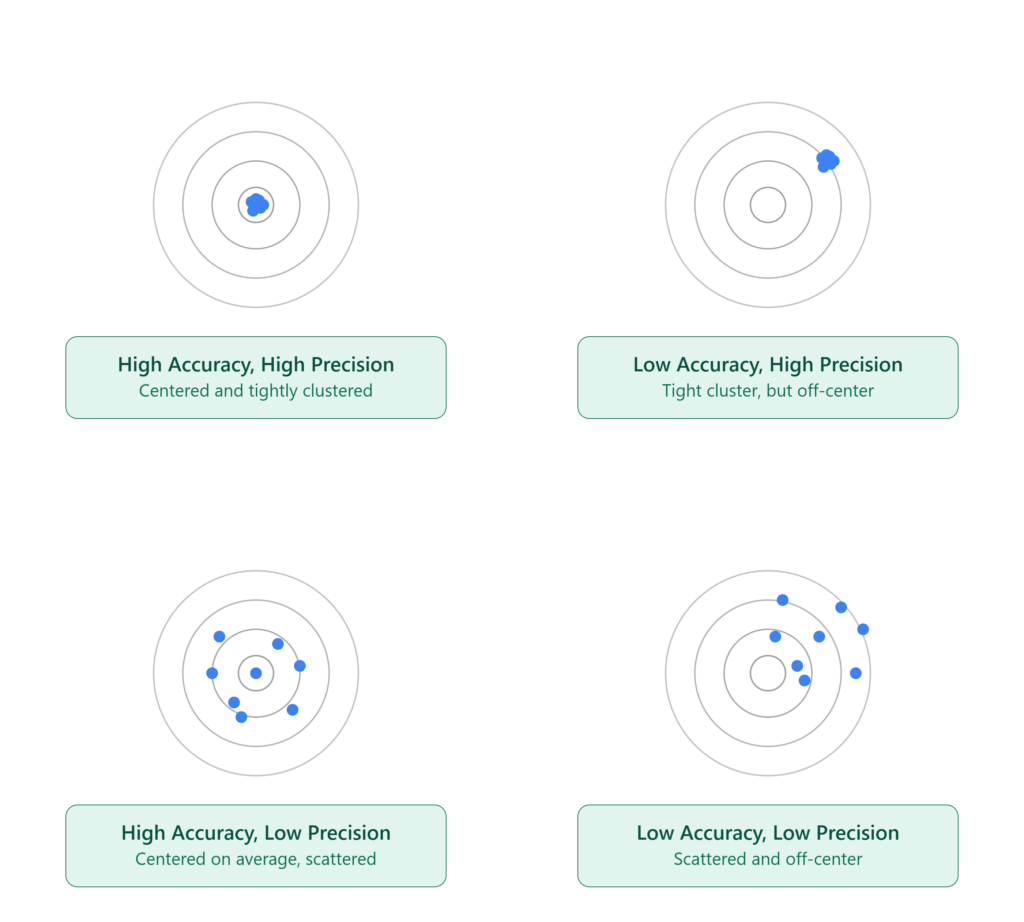
- High accuracy, high precision: shots cluster tightly around the center — the ideal outcome.
- Low accuracy, high precision: shots cluster tightly together, but consistently off-center — a systematic error, like a tester with a fixed offset.
- High accuracy, low precision: shots scatter widely, but average out near the center — random error, or noise, without a systematic bias.
- Low accuracy, low precision: shots scatter widely 和 land off-center on average — the worst-case combination, where neither the individual readings nor their average can be trusted.
Stability adds a fourth dimension to this picture: it’s the equivalent of a shooter maintaining the same shot cluster, in the same position on the target, over an entire day of shooting — regardless of fatigue or a shift in the wind. Accuracy tells you where a single measurement sits right now; precision tells you how tightly repeated measurements cluster together; stability tells you whether that entire picture holds steady over the long run.
Why Stability Matters in Long-Term Testing
在电力电子领域,稳定性是一个被忽视但却重要的指标。电池的测试不能是一次性的,它们需要数千小时的运行。.
短期和长期稳定性
Short-term stability is a system’s ability to resist noise and immediate temperature fluctuations within a single test cycle. Long-term stability additionally accounts for gradual drift in internal shunts, voltage dividers, and analog-to-digital converters (ADCs) over extended use.
If a battery tester lacks long-term stability, its measurements drift over time — and that drift can be mistaken for real battery behavior. Consider a researcher studying a new solid-state chemistry who observes 2% capacity loss per 1,000 cycles: if the test equipment itself has drifted by even 1% over that same period, a meaningful share of that “finding” may actually be equipment error, not battery degradation — which can undermine the validity of the entire study. In short: accuracy tells you where the battery is right now, but stability is what tells you the direction it’s actually heading over time.
应用场景分析
Accuracy, precision, and stability requirements shift depending on the scale and purpose of the test.
场景A:消费电子(毫安级)
For small cells used in wearables or smartphones, resolution and precision are the priorities. At the milliampere scale, equipment needs to detect very small changes to accurately characterize self-discharge rates.
场景 B:电动汽车和高压电池
At high voltages (1000V and above), accuracy and channel synchronization become critical. A 1% error in a high-power system isn’t just imprecise data — it can translate into megawatts of miscalculated power, or worse, a masked safety issue that leads to thermal runaway. This is also where high-voltage EV battery testing and rigorous BMS validation testing intersect directly with measurement precision — verifying that a BMS is balancing hundreds of cells correctly depends entirely on the fidelity of the underlying measurement.
场景 C:工业生产与质量
production environment, repeatability — precision — across many channels is what matters most. If Channel 1 and Channel 100 on a large-scale test rig report different readings for identical cells, a manufacturer can’t reliably guarantee consistent product quality.
消除测量可靠性中的技术问题
Achieving these three metrics in practice requires deliberate engineering to counter the main enemies of good data: signal noise and thermal drift.
信号、噪声和分辨率
Every electronic system generates some noise, often introduced by the switching power supplies used to charge and discharge the battery under test. High-performance systems rely on advanced filtering and high-resolution ADCs to keep the actual battery signal from being buried under power ripple — noise suppression that’s particularly important for resolving the fine electrochemical behavior that occurs near end-of-charge.
热效应和测量漂移
Temperature is arguably the biggest threat to measurement consistency. During high-current testing, the electrical properties of internal components shift as they heat up. Without effective thermal management — high-quality cooling design, low-temperature-coefficient components, and a fixed reference zero-point — equipment can drift meaningfully under sustained industrial test conditions. Without thermal stability, data integrity simply isn’t achievable.
Choosing Equipment: Beyond the Spec Sheet
A single accuracy percentage on a brochure doesn’t tell the whole story. System architecture — not just a headline spec — is what actually determines data reliability. A few things worth evaluating:
- Calibration intervals. A genuinely stable system holds its specifications longer, reducing the downtime and labor cost that comes with frequent manual recalibration.
- Environmental compensation. Well-designed testers include onboard sensors that monitor ambient temperature changes in real time and compensate proactively, rather than reactively.
- Data synchronization. In multi-channel setups, communication bus speed matters — high-speed ADCs need to transmit data without lag so voltage and current readings stay precisely aligned in time.
- Redundancy. In high-voltage testing, redundant sensing (a built-in sanity check) helps ensure a single component failure doesn’t produce erroneous data or trigger a dangerous overcharge condition.
Investing in equipment with proper thermal compensation and high-speed data buses is, in effect, an investment in long-term data integrity.
结论
Data is the most valuable asset in battery research and production. Prioritizing accuracy, precision, and stability isn’t just a matter of following protocol — it’s foundational to the safety and efficiency of the broader energy transition.
Accuracy tells you the truth about a single reading. Precision tells you how consistent repeated readings are. Stability tells you whether that consistency holds up over the long run. Understanding all three lets engineers choose the right tools to design better, safer batteries — equipment that minimizes signal noise, manages thermal effects, and delivers the synchronized measurement that modern battery testing demands.
常见问题
电池测试仪的准确度与精密度:有何区别?
精确度是指测量值接近实际电压或电流值的能力。精确度意味着在相同条件下重复测量时,测量值的一致性形式。你可以有一个精确度高的测试仪(每次都给出相同的答案),但精确度低(结果总是相差 10mV)。.
What is the importance of stability in battery cycle life testing?
循环寿命测试可能需要数月时间。稳定性确保在此期间设备不会发生漂移。不稳定的设备将无法让您了解测量容量的降低是由于电池退化还是设备失去校准。.
电池测量的温度敏感性是多少?
电阻随测试仪内部组件的温度而变化。这种热漂移可能导致设备在预热时显示不同的值。质量系统包含热补偿和复杂的冷却措施来应对这种情况。.
电力电子的测量漂移
测量漂移是指当系统的输入保持固定时,系统输出的逐渐变化。在电池测试过程中,这通常是由老化元件或环境温度变化引起的,这是对长期稳定性的最显著风险。.
对高压电池组进行测试的需求有:
高压测试(通常为1000 V及以上)需要极高的精度来确保安全,并协调所有电池的测量。这是为了保证BMS能够正确地为电池组充电,避免出现危险的过度充电情况。.
电池测试仪中产生信号噪声的原因是什么?
信号中的噪声通常通过用于充电和放电的开关电源引入。如果滤波不当,这种噪声可能会导致数据“抖动”,从而难以观察电池的实际电化学行为。.