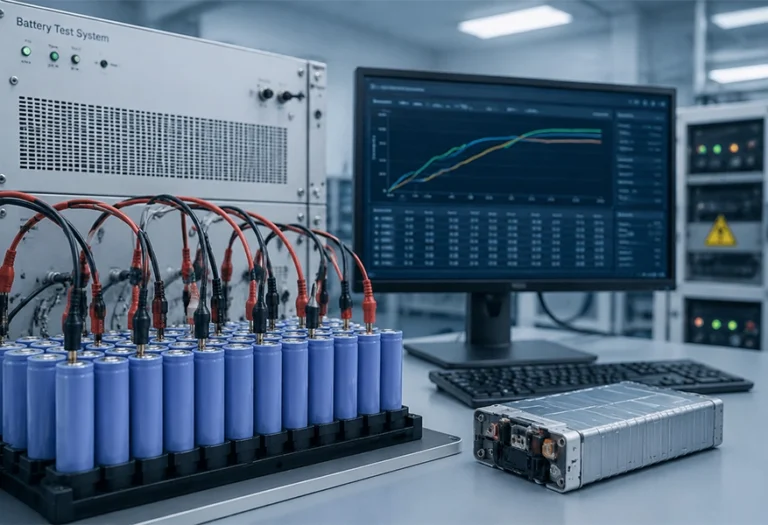
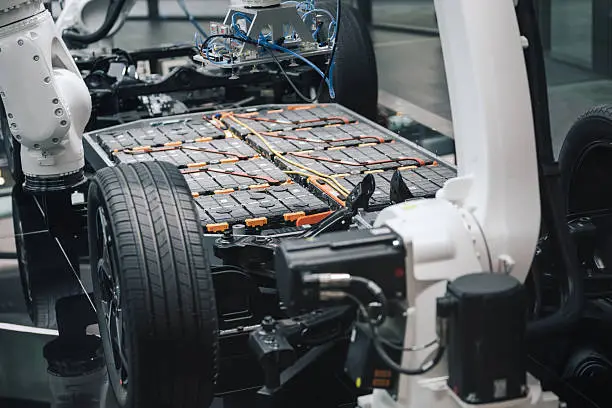
Battery test equipment is used to evaluate battery performance, safety, lifespan, and reliability by applying controlled charge and discharge cycles while monitoring voltage, current, capacity, internal resistance, and other electrical parameters. It is widely used in lithium-ion battery manufacturing, electric vehicle development, energy storage systems, and battery research laboratories.
Most lab managers don’t think much about battery test equipment until something goes wrong with it — a channel drifts out of calibration mid-cycle, a chamber can’t keep pace with a fast discharge, or a tester that looked fine on paper turns out to be the wrong fit for the packs coming off next year’s production line. Getting this purchase right matters more than people expect going in, because the equipment you choose shapes what your lab can and can’t test for years afterward.
This guide covers the ground you’d want covered before signing a purchase order: what battery test equipment actually does, the specs worth losing sleep over, how the major test types work in practice, a sensible way to narrow down vendors, where this kind of equipment ends up being used, the standards that tend to come up, and finally, how Sinexcel-RE has approached the problem.
What Battery Test Equipment Actually Is
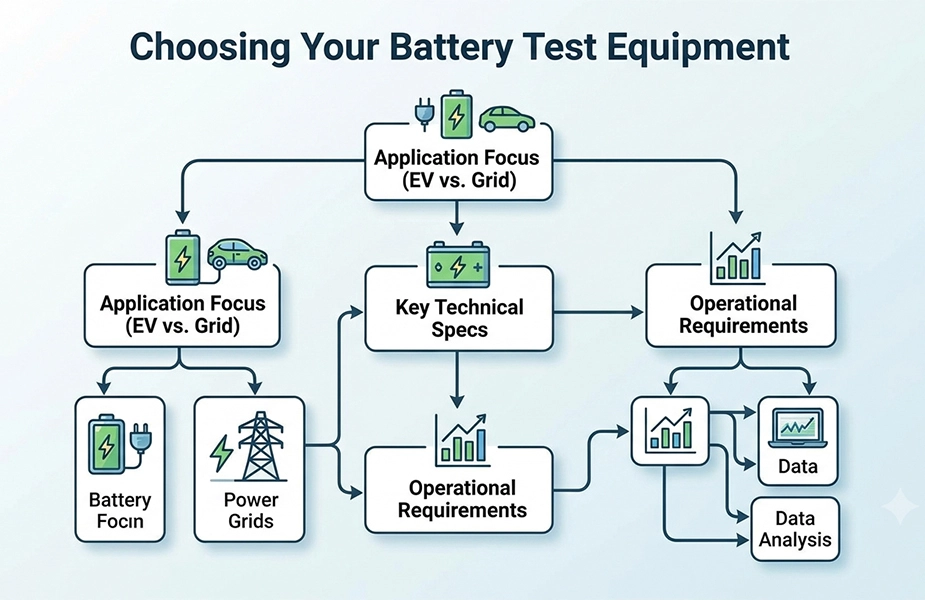
Strip away the marketing language, and a battery tester does three jobs. It pushes a controlled current or voltage into a cell, module, or pack. It watches how the battery reacts. And it writes all of that down so an engineer somewhere can later figure out what the capacity was, how the internal resistance behaved, and whether anything looked off.
Everything else — the temperature chambers, the cooling loops, the safety interlocks, the software dashboards — exists to support that basic loop. A formation line running thousands of cells a day and a university lab running a dozen coin cells are technically doing the same thing, just at wildly different scales.
And the scale really does vary a lot. Milliampere-level testers handle small lithium cells and coin cells for consumer gadgets. At the other extreme, cluster-level systems are built to push 1700V and 2000A through grid storage racks or heavy commercial EV packs. Knowing roughly where your product sits on that range narrows the field before you even start comparing brochures.
The Specs That Actually Matter
Spec sheets are long, but only a handful of numbers really determine whether a tester will hold up.
Voltage & Current Range
Voltage and current range come first, and the mistake people make is sizing to the nominal rating instead of the real operating window. A 400V-nominal pack can spike considerably higher during charging, so you want headroom, not a tester that’s barely adequate on paper. Current ranges vary just as widely — EV module testers commonly run 50A to 2000A, while cell testers might work in single-digit milliamps.
Accuracy
Accuracy gets expressed as a percentage of full scale, and the tolerance you need depends on what stage of work you’re doing. Cell characterization and R&D work often calls for 0.02% F.S. accuracy on both voltage and current; production testing can sometimes get away with 0.05% F.S. in exchange for faster throughput. It sounds like a small difference until you realize capacity numbers everyone downstream trusts are only as good as this figure.
Response Time
Response time is easy to overlook and shouldn’t be. If you’re simulating a drive cycle or a grid frequency event, a system needs to switch between charge, discharge, and rest states quickly enough to mimic reality — testers with response times down in the low milliseconds do a noticeably better job than older equipment built for slower, steadier test profiles.
Channel Count
Channel count matters for anyone running cycle-life studies or production QC, where you need dozens or hundreds of units cycling in parallel. What matters more than the raw count, though, is whether channels operate independently or share a common power bus — shared buses tend to restrict what tests you can run at the same time.
Energy Efficiency
Energy handling is where older and newer platforms diverge sharply. Legacy testers dump discharge energy into resistive loads as heat, which shows up later as an electricity bill and a cooling problem. Regenerative systems feed that energy back to the grid instead, and depending on the architecture, efficiencies anywhere from 75% up to 96% are achievable — a difference that compounds fast over a multi-year test program.
Safety
Safety design deserves its own line item, not an afterthought. Hardware-level cutoffs for overvoltage, overcurrent, overtemperature, and short circuits should function independently of whatever software is running, and isolation design needs to match the voltage class involved. Above 1700V, creepage and clearance distances stop being a minor detail and start being a real engineering concern.
Temperature Chamber
Finally, don’t test in a vacuum — literally. A battery cycled at a comfortable room temperature tells you almost nothing about how it’ll behave on a cold morning or a hot afternoon. Tight integration with a temperature chamber, rather than a separate box connected by a tangle of long cables, tends to produce far more realistic results.
| Specification | Why It Matters |
|---|---|
| Voltage Range | Supports different battery types |
| Current Range | Determines charging/discharging capability |
| Accuracy | Ensures reliable measurement |
| Response Time | Simulates dynamic load profiles |
| Channel Count | Improves testing throughput |
| Energy Recovery | Reduces operating costs |
| Safety Protection | Prevents equipment damage |
What You’re Actually Testing For
Once the hardware is set up, most test programs revolve around a handful of recurring procedures.
Capacity testing checks how much energy a battery can genuinely deliver against its rated number, usually through a series of controlled charge-discharge cycles run at defined rates. Cycle life testing repeats that process hundreds or thousands of times to track how capacity fades — and this is exactly where equipment reliability starts to matter, since a test running for a year can’t tolerate frequent downtime.
Internal resistance and impedance measurements (sometimes taken further with electrochemical impedance spectroscopy) reveal how a cell’s resistance shifts with age and heat, which tends to track closely with both degradation and safety risk. Rate capability and pulse testing looks at how a battery handles sudden high current demand, which is essentially what happens during hard acceleration in a vehicle or a frequency-support event on the grid.
Thermal and abuse testing pushes cells into conditions they’re never meant to see under normal use — extreme heat or cold, overcharge, short circuit, mechanical stress — specifically to find out where the safety margins actually are. This is the category that demands the most robust protection built into the test equipment itself, since things can go wrong quickly.
Earlier in manufacturing, formation and grading applies carefully controlled initial charge cycles to build the solid electrolyte interphase inside lithium-ion cells, then sorts them by the capacity and resistance measured during that process so packs get assembled from cells that actually match.
Narrowing Down the Equipment
With those parameters and test types in mind, the actual selection process comes down to matching the equipment to what you’ll really be doing with it, rather than chasing the most impressive-looking spec sheet.
Start with what you’re testing. Cell work needs milliampere or low-current, high-precision equipment. Modules — typically in the 60V to 300V range for most EV architectures — need mid-tier voltage and current capability. Full packs and clusters for commercial vehicles or grid storage push well past that, into 500V–1700V territory with current demands as high as 2000A.
Think about whether your priority is throughput or flexibility, because they pull in different directions. A production floor cares about channel density, quick changeovers, and software that plays nicely with automation. An R&D bench cares more about programmable test steps, high sampling rates, and the freedom to run a custom protocol that isn’t sitting in anyone’s standard library.
Look past the purchase price to the total cost of ownership. Energy regeneration, less wiring to install and maintain, and lower service frequency can offset a higher sticker price within a year or two, especially for a lab running equipment around the clock.
Software is worth more attention than it usually gets. A tester is only as good as the data coming out of it, so check whether the platform handles automated reporting, plays well with a lab information management system, and supports remote monitoring — particularly important if the lab runs unattended overnight or on weekends.
A few questions rarely make it onto a spec sheet but end up mattering a lot two or three years in. How much floor space and electrical infrastructure will the system realistically need once chambers, cabling, and cooling are all accounted for? How often does it need calibration, and can that happen on-site, or does the unit have to be shipped back to the manufacturer? How fast does the vendor actually respond when something breaks at 2 a.m. on a multi-shift line? And if test volume grows, does the system scale by adding channels, or does growth mean buying an entirely new platform?
It’s also worth thinking a step ahead on chemistry. A lab set up strictly for today’s lithium-ion cells can find itself boxed in fast once sodium-ion, solid-state, or newer lithium variants show up in the pipeline. Equipment with extra voltage headroom and configurable protocols tends to age a lot better than a system built tightly around one chemistry’s current profile.
Last on the list, but not least important, is certification. A vendor that’s already secured the relevant international certifications for its equipment saves you time getting a new test line qualified — that burden doesn’t have to fall entirely on your own team.
Where This Equipment Actually Gets Used
Battery test equipment shows up all along the value chain. EV manufacturers rely on it for cell, module, and pack validation during development, then again on the production floor for ongoing quality control. Energy storage integrators use high-voltage cluster testers to validate racks and containers before they go into a grid or commercial installation. Battery manufacturers build formation and grading systems directly into the production line, sorting cells before anyone assembles a pack. Consumer electronics companies rely on smaller-format testers for the batteries inside phones, laptops, and wearables. Universities and research labs favor flexible, high-precision systems for studying new chemistries and degradation mechanisms that haven’t made it into commercial products yet.
The Standards Behind the Testing
Most battery test programs are shaped by a mix of international and regional standards, and it’s worth knowing which ones apply to your market before finalizing equipment. IEC 62660 and IEC 61960 cover lithium-ion cells used in EVs and portable devices. UN 38.3 governs transport safety testing. UL 2580 and UL 1973 address EV and stationary storage battery safety in North America. GB/T 31485 and GB/T 34013 apply if you’re selling into China. ISO 12405 covers EV battery pack and system-level testing. Equipment that’s already certified against the standards relevant to your target markets can shave real time off your own qualification process.
Types of Battery Test Equipment
Battery Cell Test Equipment
Battery cell test equipment is designed to evaluate the electrical performance of individual battery cells during research, development, and mass production. These systems perform charge-discharge cycling, capacity measurement, DCIR testing, cycle life testing, and efficiency evaluation while maintaining high measurement accuracy.
Because cell testing is the foundation of battery quality control, modern systems often support hundreds or even thousands of independent channels to maximize testing throughput.
Typical applications
- Lithium-ion cell manufacturing
- Cell R&D laboratories
- Quality inspection
- Battery formation and grading
Battery Module Test Equipment
Battery modules consist of multiple cells connected together, requiring higher voltage and current testing than individual cells. Module test equipment evaluates module capacity, power output, thermal behavior, and balancing performance before modules are assembled into battery packs.
Compared with cell testers, module testing systems provide greater power capability and enhanced protection functions to safely handle larger energy storage devices.
Typical applications
- EV battery modules
- Energy storage modules
- Production validation
- Engineering verification
Battery Pack Test Equipment
Battery pack test equipment is used to validate complete battery packs under real operating conditions. These systems simulate charging, discharging, regenerative braking, and dynamic load profiles while monitoring voltage, current, temperature, insulation resistance, and communication protocols.
Pack testing is essential for ensuring safety, durability, and compliance before batteries are installed in electric vehicles or stationary energy storage systems.
Typical applications
- EV battery packs
- Commercial vehicles
- Energy storage systems
- Product certification
Battery Formation and Grading Equipment
Formation and grading equipment is used during battery manufacturing to activate newly assembled cells and classify them according to capacity, internal resistance, and consistency. Unlike conventional battery testers, these systems are optimized for high-volume production with thousands of independent channels operating simultaneously.
Formation equipment plays a critical role in stabilizing battery performance and improving manufacturing yield.
Typical applications
- Lithium battery production lines
- Gigafactories
- Automated battery manufacturing
Battery Cyclers
Battery cyclers are specialized systems designed for repetitive charge-discharge cycling over hundreds or thousands of cycles. They are commonly used to evaluate cycle life, degradation mechanisms, and long-term reliability under different operating conditions.
Cyclers are widely used in battery research laboratories, material development, and product validation testing.
How Sinexcel-RE Fits Into This
Sinexcel-RE has been building battery test and formation systems since setting up its dedicated battery testing unit in 2012, building on its parent company’s power electronics work going back to 2007. The lineup covers most of what’s discussed above: milliampere-level testers for small-format cells, IT battery test systems, EV module testers in the 60V–300V range, and high-performance systems built for packs and clusters up to 1700V and 2000A, with accuracy as tight as 0.02% F.S. and response times as fast as 2 milliseconds.
One of the more distinctive parts of the platform is a distributed architecture built around a dual-bus energy circulation design, which cuts down on separate AC power modules and integrates temperature chambers directly with the charge-discharge hardware rather than bolting them on separately. The practical effect is shorter wiring runs and better use of floor space — reported figures put the infrastructure savings around 25% and space savings around 20% compared with a conventional standalone chamber-and-cycler setup, alongside regenerative discharge efficiency up to 96%. Several models hold UL certification, and the company has shipped more than 300,000 test channels to customers across over 60 countries, spanning EV manufacturers, energy storage integrators, battery producers, and research institutions.
Ready to Choose the Right Test Equipment?
This isn’t a purchase you make once and forget about — the system you pick will shape your lab’s throughput, data quality, and safety posture for a long time to come. If a new test line or an equipment upgrade for EV or energy storage work is on your radar, Sinexcel-RE’s engineering team can help work out a configuration that matches your voltage range, throughput needs, and compliance requirements. Visit sinexcel-re.com to see the full product range, or get in touch directly for a consultation tailored to your project.