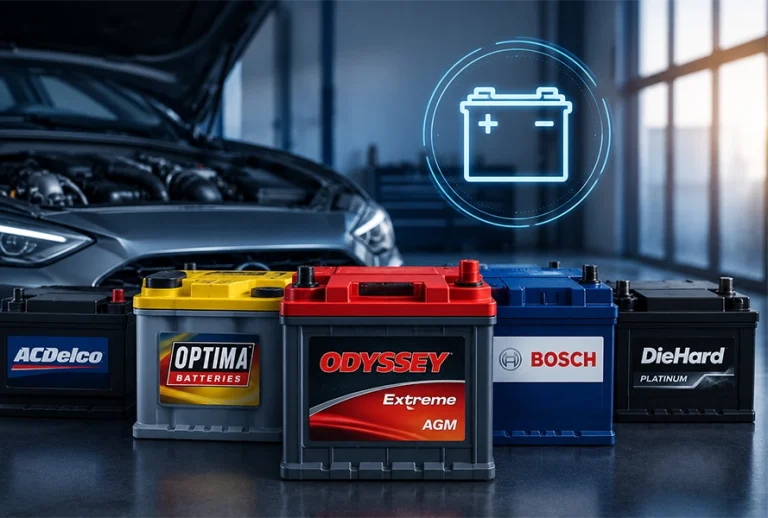
Electric and hybrid vehicles use two separate battery systems: a standard 12V battery system, which powers auxiliary equipment (such as headlights, windshield wipers, ECUs, and multimedia systems); and a high-voltage battery system, which powers the propulsion system. In modern hybrid, plug-in hybrid, and all-electric vehicles, the voltage of the high-voltage system ranges from 48 volts to 800 volts, depending on the vehicle’s level of hybridization—ranging from mild hybrids (approximately 48 volts), full hybrids (200–300 volts), plug-in hybrids, and pure electric vehicles (300–400 volts), to the more advanced 800-volt systems used in models such as the Porsche Taycan and Kia EV6/EV9.
Increases in voltage and capacity mean that testing such systems becomes more complex. High-voltage batteries are critical components for the safe and efficient operation of vehicles, so extensive testing is required to ensure that everything functions properly throughout the entire process—from design and manufacturing to operation. This article will discuss testing issues related to high-voltage electric vehicle batteries.
Why High Voltage Battery Testing Matters
High voltage battery systems introduce risks and performance considerations that don’t exist in traditional 12V systems — higher energy density, higher fault currents, and more complex thermal and electrical behavior under load. Rigorous testing is what allows engineers to confirm that a battery system performs reliably, degrades predictably, and fails safely under abnormal conditions.
Effective high voltage battery testing emulates real-world operational scenarios — varying electrical, climatic, and load conditions — rather than relying on a single fixed test condition. This is what makes the results representative of how the battery will actually behave once it’s in a vehicle.
Function Test Checks
Function tests confirm that the battery system and its Battery Management System (BMS) behave correctly under normal operating conditions. Key checks include:
- Communication interface verification — confirming the BMS communicates correctly with the vehicle and test system, and that supported protocols are functioning as specified
- Charge/discharge pulse testing — applying defined charging and discharging pulses while continuously monitoring State of Charge (SoC)
- BMS status reporting — verifying the BMS accurately reports battery status throughout the test sequence
Safety Test Checks
Safety testing is critical for high voltage systems given their operating voltage and the range of conditions they may encounter in service. Key checks include:
- Crash signal response — confirming the battery disconnects correctly upon receiving a crash signal
- Relay shutdown behavior — monitoring safe, immediate closure of output relays to cut power to the vehicle system
- BMS functionality under fault conditions — verifying the control unit can read individual cell data to assess per-cell health
- Insulation testing — confirming insulation resistance meets required safety thresholds
Core Test Categories for High Voltage EV Batteries
Beyond function and safety checks, high voltage battery validation typically includes the following test categories:
| Test Type | What It Evaluates | Why It Matters |
|---|---|---|
| Capacity Testing | Total energy the battery can deliver, measured through charge/discharge cycling | Confirms the battery meets its rated energy specification |
| Cycle Life Testing | Battery degradation across repeated charge/discharge cycles | Predicts usable service life and warranty performance |
| Internal Resistance Testing | Resistance affecting power capacity and heat generation (DCIR and ACIR methods) | Indicates power delivery capability and early signs of degradation |
| Thermal Performance Testing | Behavior at high and low operating temperatures | Validates performance and safety across real-world climate conditions |
| Fast-Charging Validation | Charging speed and safety under fast-charge conditions | Confirms the battery and BMS handle high-current charging safely |
| Safety Testing | Insulation, short-circuit, overcharge, crash-signal response, and emergency shutdown | Verifies the system fails safely under abnormal or hazardous conditions |
Internal resistance testing in particular connects closely to the function and safety checks above — for a closer look at how resistance is measured and what it reveals about degradation, see our guide to DCIR testing.
Battery Testing Equipment for High Voltage EV Batteries
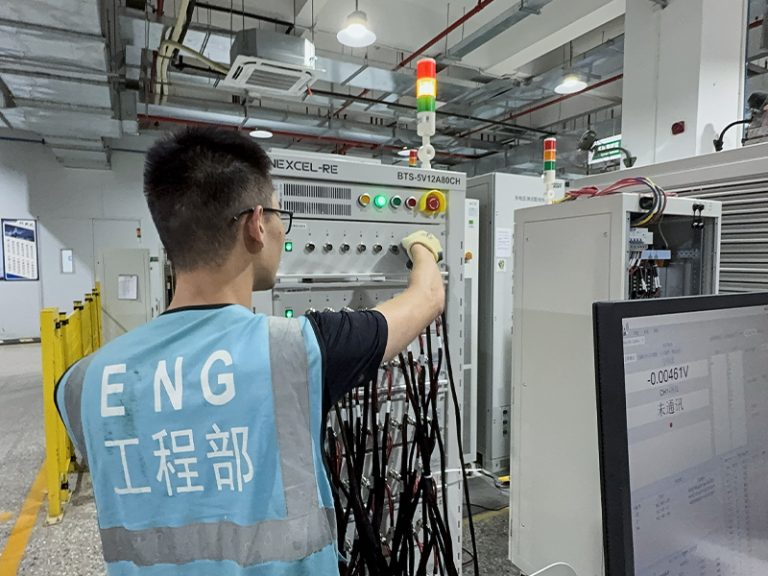
Testing high voltage EV batteries requires equipment capable of simulating real-world operating and fault conditions at scale. Common equipment includes:
- Battery cycler systems — for controlled charge-discharge testing
- Environmental chambers — for thermal performance validation across temperature ranges
- High-voltage battery test systems — for functional and safety testing at pack level
- Electrochemical Impedance Spectroscopy (EIS) systems — for degradation analysis
- BMS communication and validation tools — for protocol testing and fault-response verification (see our guide to BMS testing systems for battery pack validation for a closer look at this category)
Selecting the right combination of equipment depends on the battery’s voltage and current range, the test level (cell, module, or pack), and which of the categories above the test program needs to cover.
Selecting High Voltage Car Batteries
If you have an EV and you have to replace its battery, then you don’t have much options. Power system of each car is designed at the time of manufacturing to support a specific voltage or a specific voltage range at best. Already installed power system confines you to select battery which has nominal voltage falling between mentioned ranges. Anyhow, if you are considerate about battery voltage before buying the car, you must consider some capability factors like performance, charging time, pricing, available supporting infrastructure, range, and weight. It must be mentioned that inherently, all batteries are same. Number of battery modules and cells are the only variation making all these battery systems distinct from each other.
Some of the important factors are discussed here in detail. To make concepts clear, 400V and 800V battery systems are considered as examples because these two are most established and promising types as of now. Here, detailed comparison is established consistently between these two options.
Charging Time: As battery’s nominal voltage and its size increases, associated charging station and its current output also changes. In a 400V charging station, output current can’t be increased beyond limit to minimize losses, decrease heat generation, and ensure safety. In 800V battery system, charging station will be supplying current at 800V or somewhere in the voltage range of 600 to 900V. So low current will be required to charge this battery rapidly. Thus, 800V battery systems will support faster charging than those of 400V battery systems.
Performance: Voltage of battery will impact performance characteristics of vehicle also. During acceleration, cars demand higher amount of energy. With a 400V battery system, more current will be needed to give required acceleration. Capacity of wires, safety concerns, and losses will push system to keep current lower in safety range which might compromise performance e.g. acceleration curve. On the other hand, for an 800V battery system, it would be easy to follow demanded speed trajectory because of higher voltage and lower current.
Let’s discuss another performance parameter – regenerative braking – for EVs of both 400 and 800V system to clear the stance. 800V batteries can absorb higher amount of energy more quickly than those of 400V batteries. So 800V batteries will turn out to be more efficient than their counterparts.
Coming to range, 800V battery systems will make an EV more efficient and guarantee extended range.
Weight: As discussed earlier, to deliver same amount of power for any purpose, 800V battery system will need to deliver less amount of work. So, power system can be designed with thinner cables and lighter components. This is also because of lower heat losses due to lower current. So 800V battery system will lead to weight reduction in electric cars.
Charging Infrastructure: Currently, charging infrastructure for 400V systems is developed quite much. Because almost all car manufacturers were designing and manufacturing cars with 400V nominal voltage system and it became like a standard. Anyhow, charging infrastructure for 800V power systems is not developed yet and this aspect needs special consideration so benefits of these high voltage systems could be reaped. It must also be noted that 400V charging station can be used for 800V car battery systems but special electronic circuitry will be required in the vehicle to support low voltage charger.
Price: economies of scale impact every product and so production of batteries is also impacted by this. Batteries with lower voltage levels have been in the market for so long. Their mass production, advanced research, and increased utilization have brought their prices down. On the other hand, batteries with voltages as high as 800V don’t have very large market size and their use is not established as norm in EVs either. Moreover, research and development is lacking in design and production of these batteries. So, as of now, 800V batteries cost far more than other batteries.
Once all these aspects are discussed and a comparison is established between different types of batteries (based on voltage level), you are in the position to select a suitable battery or an electric car with suitable voltage level. You must consider safety, charging infrastructure around you, budget, your usage, and time dedicated for charging at minimum.
Testing High Voltage Car Batteries
Battery system or battery module lies at the heart of an electric car. So rigorous testing and analysis is essential for safety, good performance, and prolonged life of battery and vehicle. For high voltage car battery testing, emulation of real-time operational scenario is the key where electrical, climatic, and load conditions are varied and tests are conducted.
Function Test Checks:
Function tests comprise a series of tests. Here, few important ones are mentioned.
Presence and correct working of communication interface is crucial to functioning of EVs. So, in function test checks, it is ensured that communication interface in working correctly. During this test, battery is attached with high voltage and Battery Management System is employed to check battery’s status. Defined charging pulses are given to charge the battery, discharge the battery, and checking SoC (State of Charge) continuously. Function tests are also executed to check if supported protocols are in place.
Safety Test Checks
Safety checks are very important for High voltage batteries because of their operating voltage and varying operational conditions in vehicles. In safety checks, various tests are performed. For example, it is monitored if battery switches off or not upon receiving crash signal. Our high voltage battery test systems simulate real-world safety events to validate insulation, relay performance, and emergency shutdown responses.It includes monitoring of safe and immediate closing of output relays so power supply is cut-off to vehicle system. During safety checks, it is checked if BMS is fully functional and control unit is capable of reading all cells individually so health of each cell could be estimated. Insulation is also tested during safety tests.
How Are High Voltage Car Batteries Tested?
Capacity Testing
Tests the total energy that can be delivered by a car battery based on charge/discharge tests.
Cycle Life Testing
Considers the battery’s deterioration after multiple charge/discharge cycles.
Internal Resistance Testing
Takes into consideration the internal resistance in batteries that affect power capacity and heat.
Thermal Performance Testing
Measures performance at high and low temperatures of operation.
Fast-Charging Validation
Tests charging ability and the safety associated with fast charging.
Safety Testing
Includes insulation testing, short-circuit testing, overcharge testing, crash signal simulation, and emergency shutdown verification.
Battery Testing Equipment for High Voltage EV Batteries
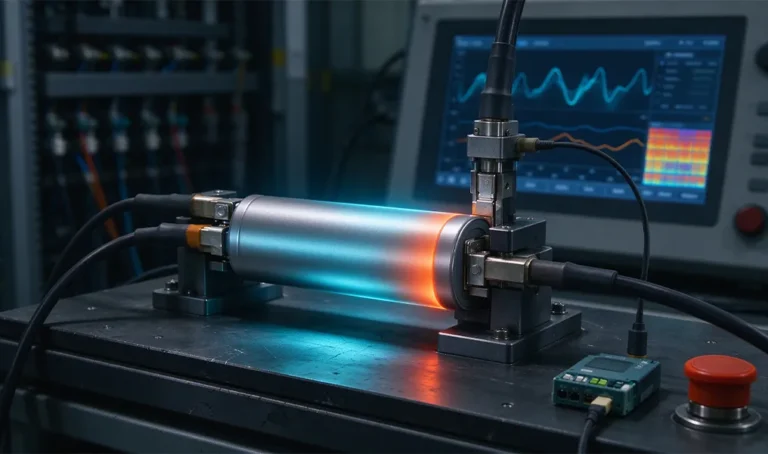
Testing high-voltage EV batteries requires advanced battery cyclers and integrated testing systems capable of simulating real-world operating conditions.
Common equipment includes:
• Battery Cycler Systems for charge-discharge testing
• Environmental Chambers for thermal validation
• High-Voltage Battery Test Systems for functional and safety testing
• Electrochemical Impedance Spectroscopy (EIS) systems for degradation analysis
• Battery Management System (BMS) communication and validation tools
These systems help engineers evaluate battery performance, safety, and long-term reliability throughout the battery development process.
Conclusion
High voltage batteries are among the most critical — and most expensive — components in an electric vehicle, and their performance and safety depend directly on the rigor of the testing behind them. A complete test program spans function checks, safety validation, and the core categories of capacity, cycle life, internal resistance, thermal performance, and fast-charging behavior, backed by equipment capable of reproducing real-world operating conditions.
Looking to validate a high voltage EV battery system? Explore our high voltage EV battery testing solutions for equipment covering function, safety, and performance validation across cell, module, and pack levels.
FAQs About High Voltage EV Battery Testing
What voltage range do high voltage EV batteries operate at?
Depending on the vehicle type, high voltage systems typically range from around 48V in mild hybrids up to 800V (600–900V range) in newer high-performance EV architectures.
What’s the difference between function testing and safety testing?
Function testing confirms the battery and BMS operate correctly under normal conditions (communication, charge/discharge behavior, SoC tracking). Safety testing confirms the system responds correctly to abnormal or hazardous conditions, such as crash signals, insulation faults, or short circuits.
What equipment is needed to test a high voltage EV battery?
A typical test program requires battery cycler systems, environmental chambers, high-voltage test systems, EIS equipment for degradation analysis, and BMS communication/validation tools.
Why is internal resistance testing important for high voltage batteries?
Internal resistance affects both power delivery capability and heat generation, and tends to increase as a battery degrades — making it a useful indicator for both performance and state-of-health assessment.
Can 400V and 800V batteries be tested with the same equipment?
Not always. Equipment needs to match the voltage and current range of the battery under test, and 800V systems in particular require test systems rated for their higher voltage range and appropriate safety isolation.