Crack open a smartphone, a laptop, or a pair of wireless earbuds and there’s a lithium-ion cell tucked in there, quietly doing more work than most people ever think about. It survives thousands of charge cycles, fits into a shell often no thicker than a pencil, and keeps performing that way year after year. None of that happens by accident. Before a battery ever leaves the factory, it’s already been pushed through a testing process built to catch exactly the kind of problems a user would never notice until it’s too late.
3C electronics, short for computer, communication, and consumer devices, live or die by how consistent their batteries turn out. Let even one weak cell slip through a production run, and you’re staring down a recall, a safety incident, or a wave of bad reviews. Manufacturers handle this with battery testing equipment built specifically for low-voltage, low-current applications, since generic industrial gear doesn’t cut it here. This guide covers what that equipment measures, the equipment types available, how 3C testing compares to EV testing, and what matters most when sourcing a system.
Why 3C Electronics Need Specialized Battery Testing
Everything starts with size. A typical smartphone battery operates at a relatively low voltage and current compared with an EV battery pack, while the charging system may operate under different voltage and current conditions. Put that next to an EV pack running hundreds of volts, and it’s clear why the same equipment can’t do both jobs well.
Small cells need resolution industrial-scale gear was never built for. An accuracy error that barely registers on an EV pack might completely wreck a reading on a coin cell or a milliampere-level battery. Engineers are chasing fractions of a millivolt, currents down in the microamp range, and if the equipment can’t resolve that, a cell quietly failing looks no different from one that’s perfectly fine.
There’s also sheer volume. Consumer electronics companies push out millions of devices a year, so testing needs speed without giving up accuracy, and that balance is basically the reason purpose-built 3C test systems exist instead of everyone repurposing industrial equipment that wasn’t designed for the job.
What Battery Testing Equipment Actually Measures
No battery gets tested with just one check. A proper 3C setup runs several evaluations on the same cell, sometimes at once.
Capacity comes first — not the number on the label, but how the cell actually performs once it’s cycling under real conditions. Engineers step through constant current, constant voltage, constant power, and pulse modes to see what the battery really delivers under load.
Internal resistance gets watched closely too. When DCIR starts climbing, that usually signals aging, though sometimes it points to a manufacturing flaw instead. Either way, catching it here keeps a bad cell from making it into an assembled product. Underneath all of that, voltage and current get sampled continuously through the whole test, and a decent system flags anything drifting past safe limits, cutting power the instant a threshold gets crossed to protect the cell and the equipment both.
Cycle life is its own animal. Simulating hundreds or thousands of charge-discharge cycles to figure out roughly when capacity drops below usable takes time, often the longest single test in the lineup, sometimes stretching across weeks.
Formation and Grading: A Step of Their Own
Formation and grading don’t really belong with the tests above. They happen earlier, solving a different problem.
Formation is the very first charge a brand-new cell gets, run under tightly controlled conditions. It builds the internal chemistry that determines how the cell behaves for the rest of its life — rush this step and there’s no fixing the damage later. Grading comes right after, sorting cells by what they actually measured at: capacity, resistance, self-discharge. Only cells that closely match end up in the same pack together, because a pack built from mismatched cells wears unevenly and fails earlier than it should. Both steps depend on equipment that can control very low currents with real precision, since formation currents run much gentler than a standard charge-discharge test.
Types of Battery Testing Equipment
Not every 3C battery, or every stage of development, needs the same equipment. Battery testing equipment can be categorized by the battery size, test current range, test objective, and stage of development.
| Equipment Type | Typical Application | Main Tests |
|---|---|---|
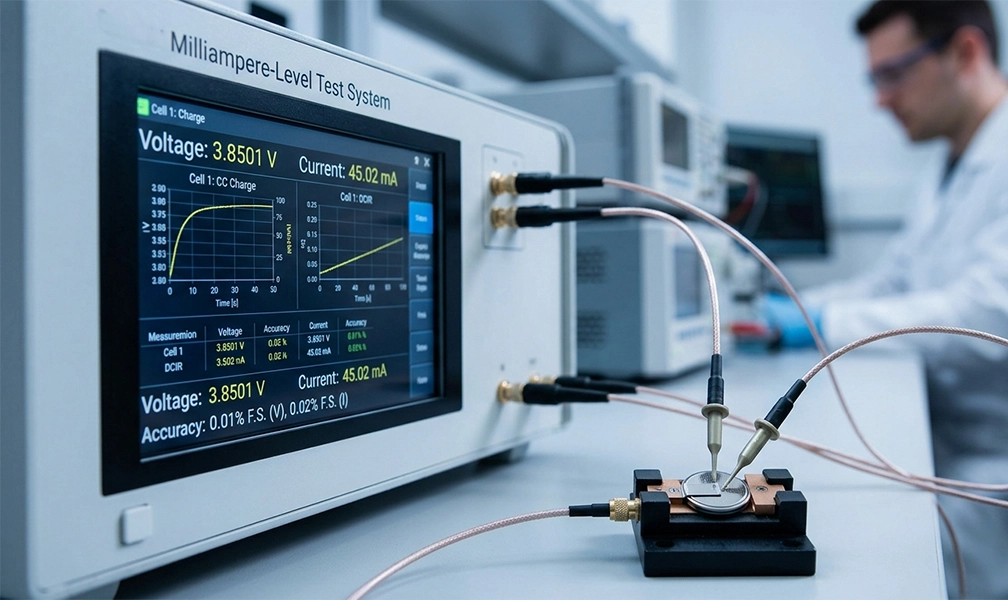
| Milliampere-Level Test System | Small cells, wearables, R&D | Capacity, cycle life, pulse |
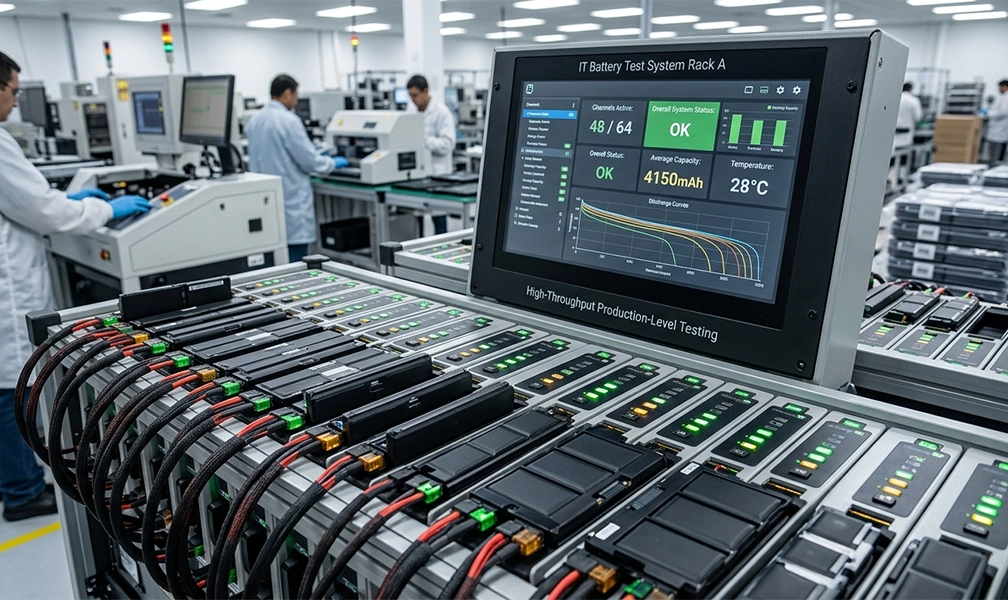
| IT Battery Test System | Laptops, tablets, power banks | Charge/discharge, capacity, pulse |
| Battery Cycle Test System | Long-term reliability testing | Cycle life, capacity retention |
| DCIR Test System | Cell screening, aging analysis | Internal resistance |
| Battery Pack Test System | Laptop/tool battery packs | Pack, BMS, protection testing |
Milliampere-Level Test Systems are for the smallest cells around — R&D labs working on new chemistries, or wearables and medical devices pulling milliamp-level current. A typical unit covers roughly -5V to 5V, discharge currents in the tens to low hundreds of milliamps, and voltage accuracy near 0.01% F.S. Best fit: early material research and small sensor or wearable batteries.
IT Battery Test Systems handle more current, aimed at laptop, tablet, and power bank batteries. They run CC, CV, CP, and pulse modes across dozens of channels per unit. Best fit: production-line qualification and R&D validation where speed matters as much as precision.
Battery Cycle Test Systems exist for long-duration endurance testing — pushing cells through thousands of cycles to project usable lifespan, built to run continuously for weeks with automated logging. Best fit: warranty-life projections and reliability work needing extended unattended runtime.
DCIR / Internal Resistance Test Systems measure resistance fast, using a quick current pulse rather than a full charge-discharge sweep, often finishing in seconds. Best fit: incoming inspection and high-speed sorting before pack assembly.
Battery Pack Test Systems shift focus onto the finished pack — checking the BMS, protection circuits, and communication interfaces alongside basic voltage and capacity readings. Best fit: final-stage testing on assembled packs going into laptops and power tools.
3C Battery Testing vs. EV Battery Testing
These two worlds look similar from a distance but don’t overlap much once you get into the details, and equipment rarely transfers cleanly between them.
Voltage and current range is the starkest contrast. 3C battery testing typically involves lower voltage and current levels than EV battery testing, although pack-level consumer electronics applications can require significantly higher current than individual cells. EV testing operates in a different range entirely — pack voltages in the hundreds of volts, currents climbing into the thousands of amps when simulating fast charging.
Precision requirements essentially flip between the two. 3C work needs extremely fine resolution at low signal levels, since a small cell’s usable range might only span a few volts total. EV testing cares less about microamp-level detail and more about handling serious power safely and reliably.
Channel count and safety needs diverge too. 3C manufacturers often run dozens, sometimes hundreds, of channels in parallel to keep pace with high-volume small-cell production. EV testing runs far fewer channels but at dramatically higher power each, bringing in thermal management and high-voltage isolation requirements 3C testing simply doesn’t need at the same scale.
Neither one is harder than the other — they’re just different problems, and equipment built for one rarely does the other job well. That’s why companies working across both categories usually end up owning two separate, purpose-built systems.
Key Features to Evaluate in a Battery Test System
Voltage and current accuracy This separates a real defect from measurement noise. Loose accuracy hides small but genuine problems at the low signal levels common in 3C work. For high-precision 3C battery testing, look for systems that can provide accuracy appropriate to the cell’s voltage and current range.For example, some high-precision systems can achieve 0.02% F.S. accuracy.
Current response and conversion time Pulse testing and fast-charging validation depend on how fast the system reacts to a changing load. Anything slow misses the transient behavior it’s supposed to catch. Aim for under 5 milliseconds.
Channel density More channels running at once means more samples cleared per shift, shortening how long it takes to qualify a new product line. Dozens of channels per rack is fairly standard for IT-level systems.
Recording interval Sampling too coarsely smooths over anomalies a tighter interval would catch. Somewhere around 10 to 50 milliseconds gives useful detail without drowning engineers in data.
Protection functions Reverse-connection protection, overvoltage and undervoltage cutoffs, and thermal shutoffs keep one bad sample from taking out expensive equipment or an entire batch. Automatic fault logging matters here too, since a shutdown with no record behind it doesn’t help much when someone’s trying to figure out what went wrong.
Test mode coverage Batteries in the real world don’t sit under one steady load, so a system needs CC, CV, CP, CC-CV, DCIR, and pulse testing at minimum to reproduce actual usage, fast-charging included.
Software and data management Step-based programming, real-time monitoring, and clean data export aren’t extras, they’re the baseline. Great hardware paired with clumsy software still wastes half its value.
How to Choose Battery Testing Equipment
Start with the basics: voltage and current range. A milliampere-level system can’t handle an IT-scale pack, and running IT-scale equipment on coin cells wastes precision you actually need.
Match accuracy to what the work demands rather than chasing the tightest spec available. New-chemistry R&D wants the best accuracy money can buy; production qualification can often live with something looser if it buys higher throughput in return.
Think about channel count in terms of where production is headed, not just today’s numbers — buying too little capacity now usually means a second purchase arrives sooner than planned. Dynamic response speed deserves attention too, especially if fast-charging validation is on the roadmap, since a system that can’t catch millisecond-scale transients will miss the exact thing those charging protocols are designed to test.
Check that supported test modes line up with actual use cases, and flag any gaps in pulse or CC-CV support before committing. Software deserves as much scrutiny as the hardware — strong measurement specs don’t count for much if the resulting data is a pain to work with afterward. Safety protections shouldn’t get skipped either; automatic cutoffs and fault logging are what stop a single bad sample from ruining an entire test run. Finally, think about how the system fits into everything else already running in the lab, since compatibility with temperature chambers, existing data systems, or MES integration can matter just as much as the core specifications.
The Role of Battery Testing in Product Safety and Compliance
Testing isn’t only about confirming performance. Depending on the target market and product category, battery products may need to meet applicable safety standards and certification requirements. Test data and traceable records can support compliance, validation, and certification processes.
There’s also a reputation cost behind all of this. Lithium-ion thermal runaway incidents have made headlines more than once, and the recalls that followed cost far more than the testing ever would have. Thorough charge-discharge testing, combined with proper formation and grading earlier in the process, filters out weak cells before they ever get near a finished product. Whatever the equipment costs going in, it’s a fraction of what a recall costs coming out.
Choosing the Right Battery Testing Equipment Supplier
Picking a supplier shouldn’t come down to comparing spec sheets and calling it a day. A few practical questions matter more than the numbers.
Does the supplier genuinely understand what 3C testing requires, or is most of their lineup EV and grid-storage equipment adapted downward? As the comparison above shows, these are different enough problems that gear built for one doesn’t always translate to the other. Can the equipment grow alongside your needs? An early-stage research lab and a factory running thousands of cells a day want very different things, so a supplier offering everything from milliampere-level research systems up through production-scale and pack testing equipment saves a vendor switch down the line.
And when something inevitably breaks, what then? Test systems tend to run around the clock, so downtime isn’t a minor annoyance, it’s a delayed launch. Responsive engineering support, clear documentation, and an actual track record in this specific category rather than a bolted-on side product all count for something here.
SINEXCEL-RE is one of the companies building across that spectrum, from milliampere-level systems for battery material research through IT and pack-level testing equipment for consumer electronics production. For companies looking for a supplier that covers both R&D and production-scale battery testing, SINEXCEL-RE offers systems ranging from milliampere-level research equipment to IT and battery pack test systems.
Conclusion
Battery testing equipment plays an important role in evaluating the performance, reliability, and safety of batteries used in 3C electronics. The right system depends on the battery’s voltage and current range, required accuracy, channel count, test modes, dynamic response, safety functions, and integration requirements.
For small cells and low-current applications, milliampere-level systems can provide the measurement resolution required for R&D. IT and battery pack test systems are better suited to larger consumer-electronics batteries and production validation.
As batteries become smaller, faster-charging, and more energy-dense, accurate and repeatable testing will remain an important part of battery development and manufacturing.
Frequently Asked Questions
What’s the difference between a milliampere-level test system and an IT battery test system? A milliampere-level system is built for very small cells and early-stage battery material research, usually within a -5V to 5V range and discharge currents up to around 100mA. An IT battery test system handles larger consumer batteries like those in laptops and tablets, with higher current capacity and multi-channel testing geared toward production-scale work.
How is 3C battery testing different from EV battery testing? 3C testing works at low voltage and current with a strong focus on fine resolution across many parallel channels, since manufacturers are qualifying huge volumes of small cells at once. EV testing deals with much higher voltage and current, needs heavier safety infrastructure, and runs fewer channels at far greater power per channel.
Which charge-discharge modes should a battery test system support? At a minimum, look for constant current, constant voltage, constant power, CC-CV, DCIR, and pulse testing. These reproduce real-world usage and show how a battery holds up under different loads, including the fast-charging conditions most 3C devices deal with now.
Do I need a separate test system for battery packs versus individual cells? Usually, yes. Cell-level testing zeroes in on capacity, resistance, and cycle life, while pack testing has to evaluate the BMS, protection circuits, and communication interfaces of the whole assembled unit — functions that cell-level equipment isn’t built to check in the first place.