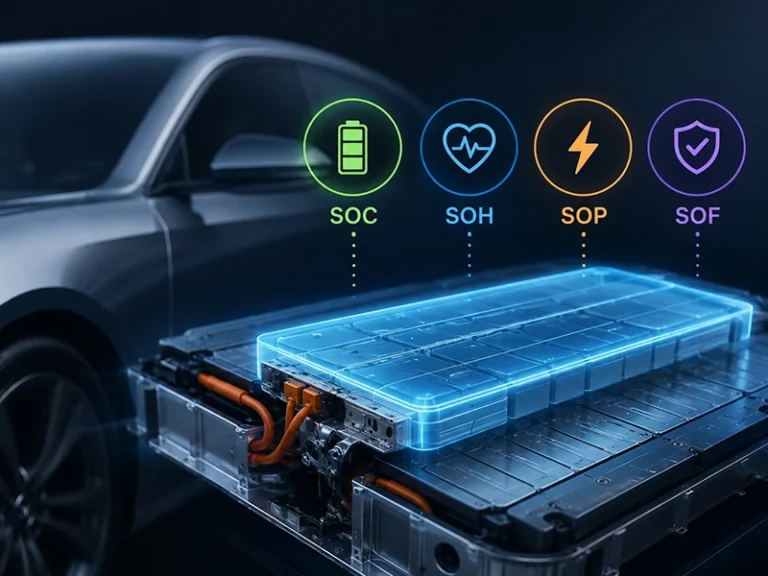
Battery health directly affects performance, safety, and service life. Batteries can age, wear and tear with charging cycles and operating conditions, which result in a gradual degradation of performance over time in both electric vehicles (EVs) and consumer electronics and energy storage systems (ESSes). By measuring battery health, manufacturers, researchers, and maintenance teams can detect battery performance degradation, estimate battery life, and meet or exceed industry standards. This guide covers the main methods and standards used to accurately assess battery health and the equipment used for testing batteries.
What Is Battery Health?
Battery health highlights how much a battery stores and delivers energy, compared to its performance upon new manufacture. It is usually reported as State of Health (SOH), a percentage that represents the amount of remaining capacity and performance of the battery over time.
Batteries lose efficiency and the amount of time they can run as they age, due to charge/discharge cycles, temperature and operating conditions etc. Performance testing of battery health will facilitate manufacturers and users to track battery degradation, estimate battery service life and ensure safe and reliable service for battery life.
The most common indicator is State of Health (SOH), usually expressed as a percentage.
- 100% SOH– Battery performs like new.
- 80% SOH– Common end-of-life threshold for EV batteries.
- Below 70% SOH– Often unsuitable for demanding applications but may still be useful for secondary energy storage.
Battery degradation occurs gradually due to:
- Electrochemical aging
- Calendar aging
- Charge/discharge cycling
- 高温
- High charging rates
- 机械应力
- Internal side reactions
Key Battery Health Indicators
- State of Health (SOH):Percentage of battery’s overall state of health and performance.
- Capacity Retention:Percent of battery’s charge retention that has been lost since new.
- 内部电阻: Resistances of the battery to the flow of current. Resistance is higher when the efficiency is less, and lower if it’s old.
- State of Charge (SOC): Displays the amount of charge remaining in the battery, which indicates the available battery power and not just its health.
- 周期寿命: The number of times that a battery can be charged and discharged before it reaches a minimum capacity.
- Power Capability:describes the battery’s capacity to provide the appropriate power at various operating conditions.
- Coulombic Efficiency:This compares the quantity of charge discharged to the amount of charge that was added during the charging of the battery to give it its capacity.
How Is Battery State of Health (SOH) Calculated?
Capacity-Based SOH
The formula to calculate SOH is given as: SOH (%) = (Measured Capacity / Rated Capacity) × 100
Measures the amount of remaining battery capacity. Most accurate and widely used method.
Resistance-Based SOH
- Compares internal resistance of the battery to its original internal resistance.
- The higher the resistance, the more the battery is aged and its power is reduced.
- The common fast diagnostics and field testing.
Model-Based SOH
- Estimates Battery Health (SOH) based on BMS algorithm.
- Gathers data of various types, including capacity, internal resistance, voltage, current, temperature, charge/discharge history, etc.
- Allows for ongoing, real-time health monitoring.
Hybrid SOH Estimation
- Uses several techniques (capacity, resistance, impedance, and BMS data).
- Gives a more detailed and precise battery health assessment.
- Commonly used in electric vehicles (EVs) and energy storage systems (ESS).
注意: There are various approaches to calculating SOH, and it is important to recognize that they can yield different values due to the fact that they measure different properties of the battery’s degradation and may measure energy storage, power delivery, or overall electrochemical properties.
Why Battery Health Measurement Is Important
- Predict remaining battery life
- Improve safety
- Detect early degradation
- Reduce maintenance costs
- Improve EV reliability
- Support warranty decisions
- Meet regulatory requirements
Common Battery Health Measurement Methods
容量测试
Capacity testing is a way to determine the amount of energy a battery can hold versus the amount it is rated for. Under controlled conditions, the battery is fully charged and discharged to determine how the battery’s capacity will change over time.
What It Measures
- Remaining energy storage capability
- Capacity fade
- Loss of active lithium
- Electrode degradation
优势
- Highest measurement accuracy
- Direct indicator of battery aging
- Universally accepted for laboratory validation
- Required by many battery qualification standards
局限性
- Time-consuming (often several hours)
- Requires full charge and discharge cycles
- Not suitable for batteries that must remain in service
- Controlled temperature is essential for repeatability
典型应用
- Battery manufacturing
- Research laboratories
- 电动汽车电池验证
- Warranty testing
- Cell qualification
Internal Resistance Measurement
This is the way to determine the electrical resistance of the battery. The internal resistance increases in batteries as they get older, which decreases their power output and creates more heat when they are being used.
What It Measures
- Internal electrical losses
- Power capability
- 发热潜力
- Electrode degradation
- Contact resistance
优势
- Very fast (seconds)
- Non-destructive
- Suitable for field inspections
- Ideal for production-line screening
局限性
- Capacity cannot be measured directly
- Strongly affected by temperature
- Different instruments may produce different values
- Requires standardized testing conditions
典型应用
- EV service diagnostics
- Battery sorting
- Manufacturing quality control
- Telecom backup batteries
- Routine maintenance
电化学阻抗谱
The idea of EIS is to apply a small AC voltage over a range of frequencies to study the internal electrochemical processes of the battery. It offers very precise data regarding degradation, aging, and battery status without harming the battery.
What It Measures
- Ohmic resistance
- Charge transfer resistance
- Diffusion impedance
- SEI layer growth
- Electrochemical reaction kinetics
优势
- Extremely sensitive to early degradation
- Separates different aging mechanisms
- Highly valuable for research and battery model development
- Enables predictive diagnostics
局限性
- Expensive instrumentation
- Complex interpretation
- Long testing times at low frequencies
- Typically requires laboratory conditions
典型应用
- Battery R&D
- Failure analysis
- Material research
- Aging mechanism studies
- Model validation
Pulse Power Testing
Pulse power testing measures the ability of a battery to produce brief amounts of high power. Popularly used for EV batteries to check the power capability under acceleration and other heavy loads.
What It Measures
- Peak power capability
- Dynamic resistance
- Voltage stability
- Power fade
优势
- Simulates real operating conditions
- Faster than full capacity testing
- Useful for EV and hybrid applications
- Reveals power-related degradation
局限性
- Does not directly measure capacity
- Results depend on pulse profile
- 需要专业设备
典型应用
- EV battery testing
- Hybrid vehicle development
- Power tools
- Aerospace batteries
Open Circuit Voltage (OCV)
OCV is the voltage of the battery when there is no load on it. The voltage reading can be used to gauge the battery’s level of charge and as a preliminary check to determine the battery’s condition.
What It Measures
- Approximate state of charge
- Cell imbalance
- Abnormal self-discharge
优势
- Simple
- 无创
- Requires minimal equipment
局限性
- Not a direct measure of SOH
- Long rest periods required
- Limited sensitivity to aging
典型应用
- Battery management systems
- Portable electronics
- Initial diagnostics
Incremental Capacity Analysis (ICA)
The analysis of changes in the capacity of the battery during charging is called Incremental Capacity Analysis, which focuses on the relationship between battery capacity and voltage. It can identify the early indications of degradation, before significant loss of performance occurs.
What They Measure
- Lithium inventory loss
- Electrode degradation
- Active material loss
- Aging pathways
优势
- High sensitivity
- Excellent research tool
- Detects early degradation
局限性
- Requires highly accurate data
- Computationally intensive
- Primarily used in laboratories
典型应用
- Battery research
- Degradation analysis
- Cell design optimization
8. Differential Voltage Analysis (DVA)
DVA is a method to measure voltage changes in various charging and discharging cycles that can detect aging mechanisms within the cell. It has many applications in battery research and quality testing of lithium-ion batteries.
Comparison of Battery Health Measurement Methods
| Method | Primary Measurement | 优势 | 局限性 | 典型应用 |
| 能力测试 | Remaining energy (Ah/Wh) | Most accurate SOH indicator | Slow, requires full cycle | Laboratory testing, validation |
| 内部电阻 | Electrical resistance | Fast, non-destructive | Temperature-sensitive, indirect SOH | Field diagnostics, production |
| EIS | Electrochemical processes | Detects early aging mechanisms | Complex, expensive | R&D, failure analysis |
| Pulse Power Test | Dynamic power capability | Simulates real operation | Does not directly measure capacity | EV and hybrid batteries |
| OCV Analysis | 静态电压 | Simple and inexpensive | Weak correlation with SOH | Initial screening, BMS |
| IC/DV Analysis | Electrochemical degradation signatures | Highly sensitive | Requires precise measurements | Advanced research |
Battery Health Testing Standards
Battery health testing is conducted according to international standards, which help the battery to fulfill performance, safety, reliability and quality requirements during the battery lifespan and to guarantee the battery’s safety.
These standards set uniform testing practices and methodologies for assessing battery capacity, cycle life, thermal performance, durability, transportation safety, and battery health for a variety of applications including electric vehicles (EVs), energy storage systems (ESS), and portable electronics.
Battery Health Testing Standards Table
| 标准 | Organization | 目的 | 典型应用 |
| IEC 62660 | International Electrotechnical Commission (IEC) | Specifies performance and reliability testing for lithium-ion cells used in electric vehicles. | Electric vehicles (EVs) |
| IEC 61960 | IEC | Defines performance, capacity, cycle life, and safety requirements for rechargeable lithium cells and batteries. | Consumer electronics and portable devices |
| IEC 62619 | IEC | Establishes safety requirements for lithium-ion batteries used in industrial applications. | Energy storage systems (ESS), industrial equipment |
| ISO 12405 | International Organization for Standardization (ISO) | Provides testing procedures for lithium-ion battery packs and systems used in electric vehicles. | EV battery packs and systems |
| UL 1973 | Underwriters Laboratories (UL) | Covers safety and performance requirements for stationary battery systems used in energy storage applications. | ESS, UPS systems, renewable energy storage |
| UL 2580 | Underwriters Laboratories (UL) | Evaluates the electrical, mechanical, and thermal safety of EV battery packs. | Electric vehicle battery packs |
| SAE J2464 | SAE International | Defines abuse testing methods to assess battery safety under extreme operating conditions. | Automotive battery safety testing |
| 联合国38.3 | United Nations | Specifies transportation safety tests required before lithium batteries can be shipped internationally. | Battery transportation and logistics |
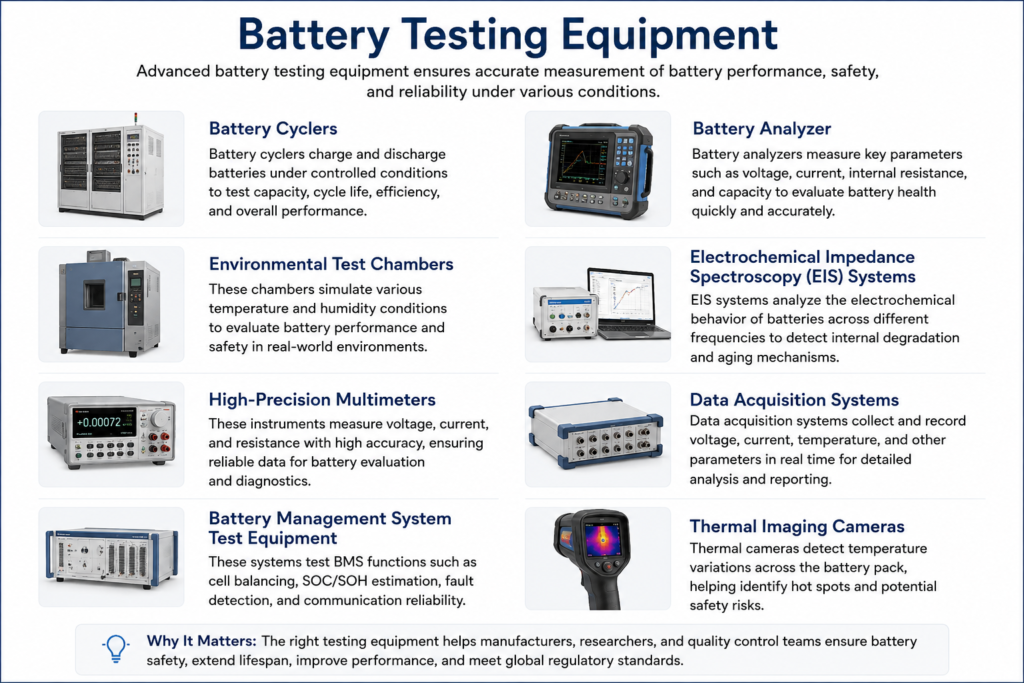
Common Battery Testing Equipment
电池循环器
Battery cyclers are the main devices used to charge and discharge batteries with a controlled process. They quantify capacity, cycle life, energy efficiency and performance with repeated charging-discharging, which is crucial for battery development and quality testing.
电池分析仪
Battery analyzers measure important battery parameters like voltage, current, internal resistance, and capacity. They offer comprehensive performance metrics that can be used to monitor battery degradation, detect faults, and assess the battery’s overall condition (state of health, SoH).
Environmental Test Chambers
Environmental test chambers are used to test battery reliability in conditions of extreme humidity, temperature and other environmental conditions. These tests confirm that batteries are capable of performing safely and effectively in actual climates and applications.
Internal Resistance Testers
Internal resistance testers measure the electric resistance that is inside the battery—this has a direct impact on the power output and efficiency of the battery. A rise in the internal resistance may mean that the battery is getting old, damaged, or that the battery health is poor.
Thermal Imaging Cameras
Thermal imaging cameras measure the heat pattern of battery cells and packs without contacting them. They enable detection of overheating, thermal imbalances, and potential safety hazards before they become major problems.
Battery Management System (BMS) Testers
The functions that are tested include functions like cell balancing, voltage monitoring, temperature sensing, and protection. This will keep the battery pack safe and at peak performance throughout its life cycle.
Factors That Affect Battery Health
- 温度
- Charge/discharge rate
- Depth of discharge
- 过度充电
- Storage conditions
- Battery chemistry
- Operating environment
Common Challenges in Battery Health Testing
Long Testing Time
Proper battery health testing may involve going through several charge and discharge cycles, a process that can take hours or even several days to complete. This is impractical in large scale testing, particularly in manufacturing and research settings.
Cell-to-Cell Variations
Different brands and types of batteries made in the same lot may have minor variations in capacity, internal resistance, and performance. Such differences make it difficult to determine the health of a battery pack in a consistent manner.
Environmental Influences
Battery performance and test results can be greatly influenced by temperature, humidity and operating conditions. For accurate and repeatable measurements, it is essential to keep the environment under control.
Measurement Accuracy
The measurement of voltage, current or temperature may be incorrect, resulting in an incorrect health assessment. To ensure reliability, it is essential to use high-precision testing equipment and to regularly calibrate the equipment.
Predicting Battery Aging
The degradation of batteries is influenced by several factors such as battery chemistry, charging practices, battery operating temperature, and charging usage. One of the greatest challenges in battery health evaluation is the ability to accurately predict remaining useful life (RUL).
Testing Cost and Scalability
Investment in advanced battery health testing systems and special equipment is substantial. Scaling up these tests to large-scale production, without compromising accuracy, can result in higher operational costs and complexity.
结论
The reliability, safety, and performance of EV applications, consumer electronics, and energy storage all depend on accurate battery health measurement. Standardized testing procedures, industry standards, and cutting-edge testing tools enable manufacturers and engineers to assess a battery’s condition, detect degradation at an early stage, and determine battery maintenance or replacement strategies. As batteries evolve, full health testing is more and more an integral part of product development and quality assurance.
Looking for cutting-edge battery testing equipment for research, manufacturing, or quality control? Discover our 电池测试解决方案 for high accuracy, repeatability, and compliance with standards for all types of batteries.
常见问题解答
What is the best way to measure battery health?
A typical state of health (SOH) measurement involves a combination of capacity testing, internal resistance measurement, and performance analysis to provide a complete picture.
What equipment is used for battery health testing?
Common equipment includes battery cyclers, battery analyzers, EIS systems, environmental chambers, multimeters, thermal cameras, and BMS testing tools.
What standards are used for battery testing?
Common standards include IEC 62660, IEC 61960, IEC 62619, ISO 12405, UL 1973, UL 2580, SAE J2464, and UN 38.3.
What is a good battery SOH?
If the battery SOH is greater than 80%, it is typically acceptable to continue using the battery, though there are varying uses for different batteries.