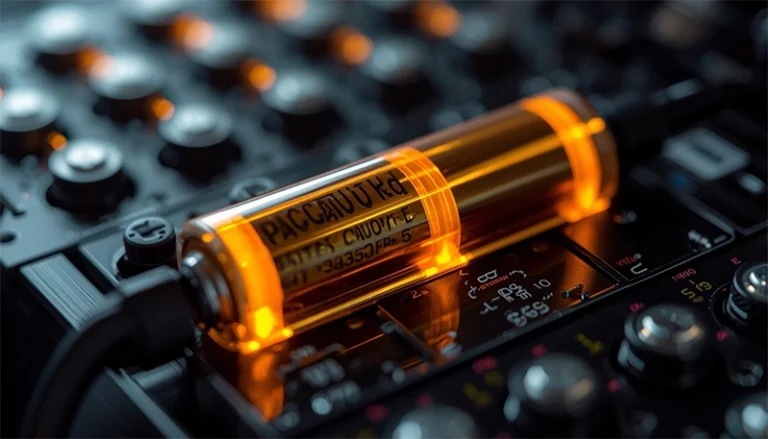
Look around and you’ll find lithium-ion cells almost everywhere — in your phone, your cordless drill, the car in your driveway, maybe even the storage unit humming next to a solar array down the street. That spread comes with a price. A weak cell in a laptop means a shorter workday. A weak cell in an EV pack, or worse, a grid-scale storage container, can mean a fire.
That gap in consequence is why lithium-ion battery testing isn’t treated as paperwork. It’s the filter that decides whether a battery is actually ready for the market, not just close enough. Below, we’ll walk through the main test methods labs run — including DCIR and HPPC, the two pulse-based checks that come up constantly in EV and BESS work — the standards behind them, and how to actually choose the equipment that gets the job done.
Why Bother Testing at All?
A cell doesn’t arrive at your doorstep in one step. Raw materials get assembled, the cell gets formed and aged, then graded. Sorted cells get grouped into modules, and modules get built into packs. Each handoff opens the door to variation — a slightly off tolerance here, an inconsistent material batch there, a mishandled charge cycle somewhere along the line.
Testing is how these problems surface before a customer ever sees them. It confirms real capacity against rated capacity, checks internal resistance, and pressure-tests whether a cell stays stable under abuse. Skip it, and you haven’t saved money — you’ve just relocated the cost of failure to somewhere much more expensive: a recall, a lawsuit, a headline.
Battery manufacturers, EV makers, storage integrators, and university labs all run structured testing programs for this reason. Broadly, the work splits into four buckets: performance testing, safety and abuse testing, environmental testing, and formation and grading.
Lithium-ion Battery Testing Methods
Formation and Grading
Formation happens first. It’s the initial charge-discharge cycle a cell goes through right after assembly, and it builds the solid electrolyte interphase — SEI for short — a thin protective film on the anode. Get this step wrong and you’re not just risking a shorter lifespan; you’re baking instability into the cell from day one.
Grading comes next. Cells get sorted by capacity, internal resistance, and voltage consistency. Why does this matter so much? Because a pack built from mismatched cells ages unevenly. One weak cell drags the whole group down over time. Precision formation and grading equipment — running at milliampere accuracy for small-format cells, higher current for larger ones — is what gives manufacturers that consistency before cells ever leave the line.
电气性能测试
This is the “does it actually do what the spec sheet claims” category. A few of the standard checks:
- Capacity testingmeasures real delivered energy against rated capacity.
- Charge-discharge cyclingruns repeated CC-CV cycles to see how consistent performance stays over time.
- Internal resistance testingcatches cells with poor conductivity before assembly locks them in.
- Cycle life testingrepeats full charge-discharge cycles, sometimes thousands of them, to project real-world lifespan.
- Rate capability testingchecks how a cell handles fast charging or heavy load — critical for anything going into an EV.
- DCIR testingpulses a set discharge current for a fixed duration and reads the voltage drop, giving DC internal resistance rather than the AC impedance from an EIS scan. It’s the go-to check for power-fade tracking over a cell’s life, and it’s fast enough to run at scale on a production line.
- HPPC testing— Hybrid Pulse Power Characterization — applies short charge and discharge pulses at set points across the state-of-charge range to map out power capability. It’s the method most EV and HEV programs lean on to feed resistance and power data straight into battery management system models, since a single DCIR reading at one SOC point won’t tell you how a pack behaves at 20% charge versus 80%.
Environmental and Thermal Testing
No battery lives in a climate-controlled lab forever. It sits in a hot car in July, a freezing warehouse in January, a humid shipping container somewhere in between. Environmental testing tries to catch what those swings do:
- Temperature cyclingmoves cells between extremes, often -40°C to 75°C, watching for leakage or deformation.
- High and low temperature performancechecks whether usable capacity holds up at the edges of that range.
- Humidity testinglooks for corrosion or breakdown in insulation.
- 海拔模拟drops surrounding pressure to mimic high-altitude air transport — a requirement, not a nice-to-have, for shipping approval.
Mechanical and Abuse Testing
These push a battery well past normal use, on purpose, to see how it fails — because at some point, something eventually will.
- Vibration and shock testing simulates transport and vehicle operation.
- Crush testing applies controlled force to check for internal shorts.
- Nail penetration testing pierces the cell to trigger and observe a worst-case internal short circuit.
- External short-circuit testing connects terminals directly and watches the thermal response.
- Overcharge and forced discharge testing pushes voltage past safe limits to confirm protection circuits actually work.
- Thermal runaway testing deliberately sets off runaway conditions to study how it spreads — a big deal for BESS and EV pack design in particular.
None of this is optional. Regulators and OEMs expect documented results across all four categories before a battery goes anywhere near commercial sale.
The Standards Behind the Tests
Standards exist so a battery tested in Shenzhen means the same thing as a battery tested in Michigan. A handful carry the most weight across the industry.
UN 38.3 governs transport safety, full stop. Every lithium-ion battery moving by air, sea, or road needs to clear this test series — altitude simulation, thermal cycling, vibration, shock, external short circuit, all of it.
UL 1642 and UL 2054, both from Underwriters Laboratories, split the work: UL 1642 covers individual cells, UL 2054 covers packs used in consumer and industrial products. Both dig into overcharge behavior, short circuit response, and abnormal charging.
IEC 62133 acts as the international baseline for portable cell and battery safety — it’s the standard most others get referenced alongside. IEC 62660, meanwhile, is built specifically for lithium-ion cells inside electric vehicles, covering performance and reliability under automotive stress.
China’s national framework — GB/T 18287, GB 31241, and GB/T 31485 — stretches from mobile phone batteries all the way to EV traction battery safety. Japan runs its own pair: JIS C8712 sets the baseline for portable lithium-ion batteries, and JIS C8714 layers on tougher mechanical tests on top of it.
Worth a mention too: UL 9540A, a newer standard built specifically to evaluate how thermal runaway propagates through fire inside battery energy storage systems — increasingly relevant as grid-scale storage keeps expanding.
In practice, almost nobody tests against just one of these. Selling globally means complying globally, so most testing programs map their protocols against several standards at once rather than repeating the same work five different ways.
What Equipment Actually Gets This Done
Standards and methods matter only as far as the equipment behind them can execute them accurately. A working battery test lab typically needs several equipment categories operating together.
Battery test systems sit at the center of it all — charging and discharging cells, modules, or packs while logging voltage, current, capacity, and temperature with tight precision. Which system fits depends heavily on format, and the differences between categories are big enough that treating them as interchangeable is where a lot of equipment budgets go wrong. Here’s what each one actually covers.
Milliampere-Level Systems for Material R&D and Small-Format Cells
These are the instruments a lab reaches for before a cell design ever gets near a production line. Operating in the milliampere to low-ampere range, they’re built to resolve small differences in capacity and internal resistance across coin cells and small pouch cells — the format researchers use while a new electrolyte, coating, or electrode chemistry is still being tuned. R&D work depends on repeatability more than raw speed, so a channel that drifts even slightly can bury the actual effect someone is trying to measure. Channel counts also tend to run high on this equipment, since most research programs want dozens of small variations running side by side rather than testing one formulation at a time.
IT Battery Test Systems for Consumer Electronics
Move from R&D into production and the requirements shift. Cells destined for phones, laptops, wearables, and power tools need testers built around volume rather than isolating tiny variables. IT battery test systems — the industry’s shorthand for this category, not a reference to computing infrastructure — run in the ampere range with fast cycling built in, since a production line grading thousands of cells a day can’t afford a slow protocol. Precision still matters here; a mis-graded cell in a laptop pack eventually shows up as an inconsistent runtime claim. But the emphasis leans harder toward throughput, multi-channel parallelism, and tight integration with the sorting and binning software running downstream.
EV and BESS Test Systems
Electric vehicle and battery energy storage system testing spans three scales at once — individual cells, assembled modules, and complete packs — and no single platform handles all three well. In practice, EV and BESS test systems are built as a family: cell-level testers running higher current than consumer electronics gear, paired with separate module- and pack-level units that step up in both voltage and current capacity. What ties the family together is the ability to run pulse-based tests cleanly, particularly DCIR and HPPC, since EV programs lean on that data to feed battery management system models. A cell tester that can’t execute a clean HPPC pulse sequence isn’t much use to a team validating a traction battery.
High-Voltage Systems for Battery Modules and Packs
Once testing moves up to assembled modules and packs, voltage becomes the defining constraint rather than current. Module-level systems typically operate across 60V–300V, while pack-level testers need to handle 500V–1250V — territory that overlaps with the DC bus voltages found in modern EV drivetrains and grid-scale storage racks. Working at this range brings its own engineering demands: insulation testing, arc-flash protection, and interlock systems all become mandatory rather than optional, since a fault at 1000V behaves nothing like a fault at 5V. Labs testing at this scale also need chargers and loads rated with real margin above nominal pack voltage, since state-of-charge swings shift the voltage a pack presents throughout a test cycle.
High-Volt Storage Battery Cluster Testers
Grid-scale storage doesn’t stop at the pack. Packs get wired into strings, and strings get wired into containers, and testing at that level calls for equipment sized specifically for cluster-scale current and voltage. The job here is less about a single cell’s performance and more about confirming that strings balance correctly and that a fault in one unit doesn’t cascade through an entire container. This is a newer equipment category relative to cell- and pack-level testing, driven largely by how fast utility-scale storage has expanded over the past several years — and it’s often the gap labs discover first when they try to scale up from EV or consumer electronics testing into grid storage work.
环境室
Electrical cycling on its own doesn’t reveal how a battery behaves once temperature and humidity get involved, which is why environmental chambers sit right next to the cyclers in most labs. A chamber wraps around a battery test system, or houses cells being conditioned separately, holding a controlled temperature and humidity profile — often the same -40°C to 75°C span used in temperature cycling — while electrical testing runs underneath it. Running combined tests instead of isolated ones matters because real-world failures rarely come from a single stress. A cell that sails through a room-temperature cycle life test can still fail at -20°C, and a chamber is what catches that gap before a customer does.
Safety Test Chambers
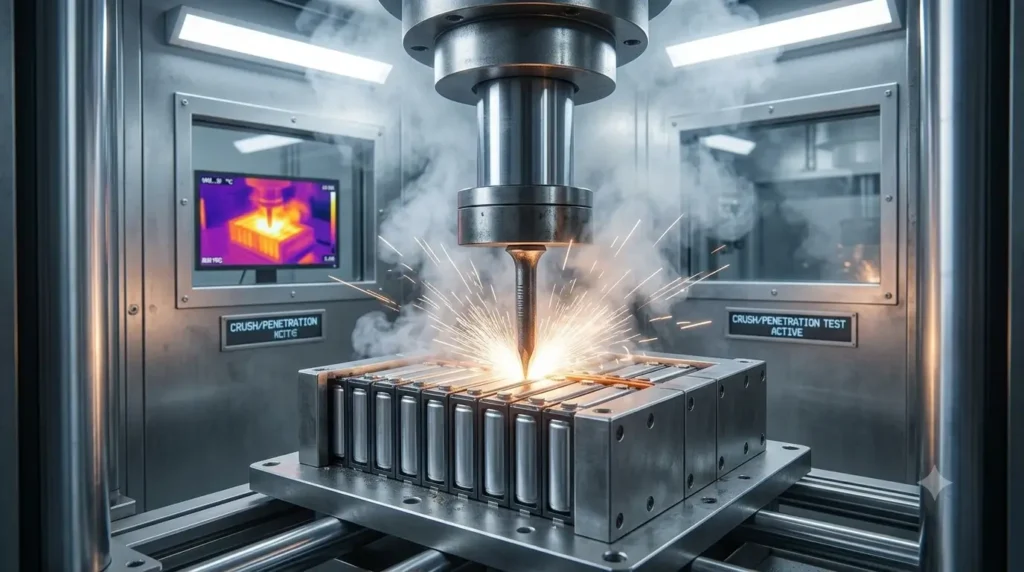
Crush, nail penetration, and thermal runaway testing can’t happen in an open lab. These tests are designed to make a cell fail, sometimes violently, so the equipment surrounding them exists to contain that failure rather than avoid it. Safety test chambers are built with reinforced enclosures, exhaust and filtration systems for smoke and off-gassing, and remote-operation controls so technicians aren’t standing beside a cell mid-runaway. This category has grown in importance for BESS and EV programs specifically, tracking alongside standards like UL 9540A, which evaluates how runaway propagates through a whole system rather than judging a single cell in isolation.
Data Acquisition Software
None of the hardware above means much without software that can make sense of what it’s recording. Data acquisition software logs voltage, current, capacity, and temperature in real time across however many channels a lab is running, flags readings that fall outside expected bounds, and, critically for regulated industries, generates the documentation that standards bodies and OEM customers expect to see. A lab running formation and grading at scale needs software that can sort cells into bins automatically from live measurements rather than having someone review spreadsheets after the fact. The stronger platforms also integrate directly with environmental and safety chambers, so a single test record captures electrical performance and environmental conditions together instead of forcing someone to stitch two separate logs into one report.
A company like Sinexcel-RE illustrates how these categories tend to come together in a working lab. As a manufacturer of precision battery test equipment, Sinexcel-RE builds across this whole range — milliampere-level R&D testers, high-voltage EV and BESS pack systems, formation and grading solutions, and integrated test bench setups that combine multiple systems into one controlled environment. That breadth matters for a lab building a testing program from scratch, or replacing aging gear, because no single tester covers every battery format a facility is likely to run into over its lifetime.
How to Choose a Lithium-ion Battery Testing System
Knowing the categories is one thing — actually committing budget to a specific system is another. A few questions tend to narrow the field quickly and keep the decision from turning into an endless spec-sheet comparison.
What formats will you actually be testing? A lab focused on consumer electronics cells has very different needs from one testing 1000V EV packs.
How much accuracy does the work demand? Formation and grading especially needs tight tolerances — weak measurement precision here introduces variability that undermines the whole sorting process downstream.
Is the equipment itself certified? Look for ETL, TUV, CE, SAA, and UL marks on the testing gear, not just on the batteries it’s meant to evaluate.
Can it scale with you? Modular systems that expand alongside rising production volume beat equipment that forces a full replacement the moment you outgrow it.
And what happens when something breaks? Battery testing gear runs long hours under real strain. Responsive technical support and a dependable supply chain matter just as much as anything on a spec sheet.
Run those five questions against a shortlist of vendors before signing anything, and weigh format coverage and accuracy first — support and scalability matter, but they don’t fix a system that can’t test what you actually build.
结论
Lithium-ion battery testing was never going to be a single checkbox. It’s layered — formation, performance validation, environmental stress, abuse simulation — measured against a tangle of international standards that all demand their own documentation. Get it right, and you protect users, protect the brand, and keep products moving through certification without the delays that come from cutting corners.
The equipment behind that process deserves just as much scrutiny as the batteries it’s testing. Precision systems, matched to the specific formats a lab actually handles, are what make a testing program credible in the first place.
常见问题
What’s the actual difference between formation and grading?
Formation is that first charge-discharge cycle after assembly — it’s what builds a stable SEI layer on a new cell. Grading happens right after, sorting cells by capacity, resistance, and voltage so manufacturers can group consistent ones into modules and packs.
Which standard covers shipping lithium-ion batteries internationally?
UN 38.3. It applies to lithium-ion batteries moving by air, sea, or road, and nearly every commercial shipment needs documented results before it can move at all.
How long does a full safety testing program usually take?
It depends a lot on battery format and scope, but a complete run covering electrical, environmental, and abuse testing can stretch from several weeks to a few months — cycle life testing alone adds significant time.
Do EV batteries need different testing than consumer electronics batteries?
Yes, pretty substantially. EV batteries deal with higher voltages, larger formats, and standards like IEC 62660 and GB 31241 that don’t apply to a phone battery. Thermal runaway and mechanical abuse testing also carry more weight in EV programs, given how much more energy is packed into these cells.
What’s the difference between DCIR and HPPC testing?
DCIR gives you one resistance reading from a single current pulse, usually run at a fixed state of charge. HPPC repeats that pulse pattern across the full state-of-charge range, so it maps how power capability shifts as a cell drains — which is why BMS teams rely on HPPC data and production lines lean on the faster DCIR check.