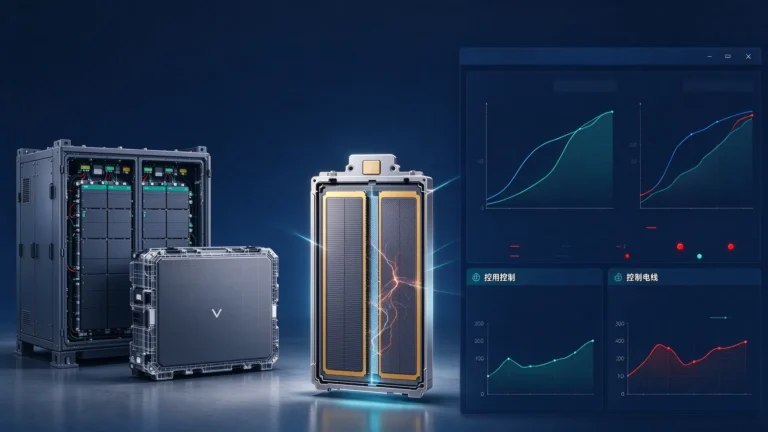
Selecting a programmable DC power supply requires you to match its voltage range, current capacity, power rating, and control functions to your battery or energy storage test requirements. You must also verify automation interfaces, protection features, and the ability to expand capacity as testing demands increase.
What Is a Programmable DC Power Supply?
A programmable DC power supply allows you to program the output voltage, current limits, and operating sequences. It can be used in automated test beds for battery modules, power electronics, and energy storage devices.
A conventional unidirectional DC power supply delivers power to the device under test (DUT) but cannot actively absorb returned energy. If the DUT can feed power back during testing, a bidirectional source/sink system or a separate electronic load may be required, depending on the test setup.
For battery charge-discharge testing, verify that the selected equipment supports the required operating modes, measurement accuracy, test sequences, and data logging. A bidirectional programmable DC power supply may support certain battery testing tasks, but it should not automatically be treated as a substitute for a dedicated battery test system.
6 Factors to Consider When Choosing a Programmable DC Power Supply
Voltage and Current Range
Match the range of the supply voltage to the minimum and maximum operating voltage of the device. Please note: maximum current may only be available at lower voltages; check current delivery at each required voltage.
A battery pack with a operating voltage range of 300–450 V needs a power supply that can handle this voltage range and the current/power limits.
Power Rating and Autoranging
Determine the output power needed from:
where is power in watts, is voltage in volts, and is current in amperes.
Check the voltage-current output envelope to confirm that the required current is available at your target voltage. A supply’s maximum voltage, maximum current, and rated power may not all be available simultaneously at every operating point.
Different supply voltage/combinations of current are allowed through autoranging. For example, the Sinexcel SXN6215-500-90 delivers 15 kW across 166.6–500 V, with 90 A at 166.6 V and 30 A at 500 V. This flexibility supports testing across a range of voltage levels without multiple voltage supplies.
Operating Modes
Select a supply that will provide the desired control modes for the test procedure:
Constant Voltage (CV): Regulates the output voltage at the setpoint while the load remains within the supply’s operating limits.
Constant Current (CC): Regulates output current at the setpoint within the supply’s specified operating range.
Constant Power (CP): Adjusts voltage and current to maintain the programmed power level within the supply’s voltage, current, and power limits.
The Sinexcel SXN62 Series can be operated automatically in CV, CC and CP modes. These modes offer flexibility with test conditions, but do not guarantee bidirectional battery cycling on their own.
Programmability and Communication
If automated testing is desired, determine if the supply can be programmed for setpoints, dwell, and operating sequence. Check with your test controller and software for compatibility.
The SXN62 Series offers RS232, RS485, CAN, LAN and USB interfaces, and can optionally switch to analog control. It has a programmable test procedure based on its sequence test function.
Protection and Efficiency
Inspect overtemperature, overcurrent, overvoltage and overpower protection. It is also helpful to log the faults for abnormal operating conditions and for investigation of interrupted tests.
According to the company, the SXN62 Series is up to 93% efficient and has an input power factor of up to 0.99. Actual performance will vary with operating conditions.
Expansion Capacity
If you expect higher power requirements, check if the power supply will operate in parallel and what modes the manufacturer allows. Evaluate facility power, cooling, cabling and electrical safety needs as well.
SXN62 units with the same ratings can be connected in parallel to increase available output power, subject to the manufacturer’s specifications.
How to Choose the Right Sinexcel SXN62 Model
The Sinexcel SXN62 Series offers models with voltage ratings up to 2,250 V and power ratings up to 18 kW per unit. Your choice should depend on the required voltage, current, and power at each test point.
| Testing requirement | Example model | Rated power |
| up to 80 V | SXN6210-80-340 | 10 kW |
| up to 500 V | SXN6215-500-120 | 15 kW |
| up to 1,000 V | SXN6215-1000-60 | 15 kW |
| up to 1,500 V | SXN6215-1500-40 | 15 kW |
| up to 2,250 V | SXN6215-2250-20 | 15 kW |
Model ratings are based on Sinexcel’s published specifications. Confirm the exact operating envelope and model configuration before purchasing.
Review the SXN62 Series specifications to compare available models. If your application requires bidirectional power flow for battery charging and discharging, evaluate whether a bidirectional source/sink system, such as Sinexcel’s SXN63 Series, is more appropriate.
结论
Choosing a programmable DC power supply requires you to evaluate the complete operating envelope, not just maximum voltage or rated power. Match the supply to your test current, voltage range, control modes, automation requirements, protection needs, and expansion plans.
The Sinexcel SXN62 Series provides wide-range output, programmable test sequences, multiple communication interfaces, and parallel expansion options for suitable testing applications. Review the SXN62 Series and compare its specifications with your test profile to identify the configuration that fits your engineering requirements
常见问题解答
How do you calculate the required DC power supply rating?
Multiply voltage by current at each test point. For example, 400 V at 30 A requires 12 kW. Verify that the supply supports this operating point.
Can a programmable DC power supply charge and discharge batteries?
Not necessarily. Confirm bidirectional source-and-sink capability or determine whether your setup requires a separate electronic load.
Why choose an autoranging DC power supply?
Autoranging provides different voltage-and-current combinations within a defined power envelope, improving flexibility when testing devices with different operating voltages.
How do you select a programmable DC power supply for battery testing?
Evaluate your battery’s voltage range, maximum current, power demand, test sequences, and automation interfaces. For production lines or R&D laboratories, also verify protection functions, parallel operation, and compatibility with your test control system.
What should B2B buyers verify before purchasing a programmable DC power supply?
Confirm the model’s voltage-current operating envelope, rated power, control modes, communication protocols, and expansion options. If your application requires battery charge-discharge cycling, verify bidirectional operation separately rather than assuming a conventional DC source supports it.