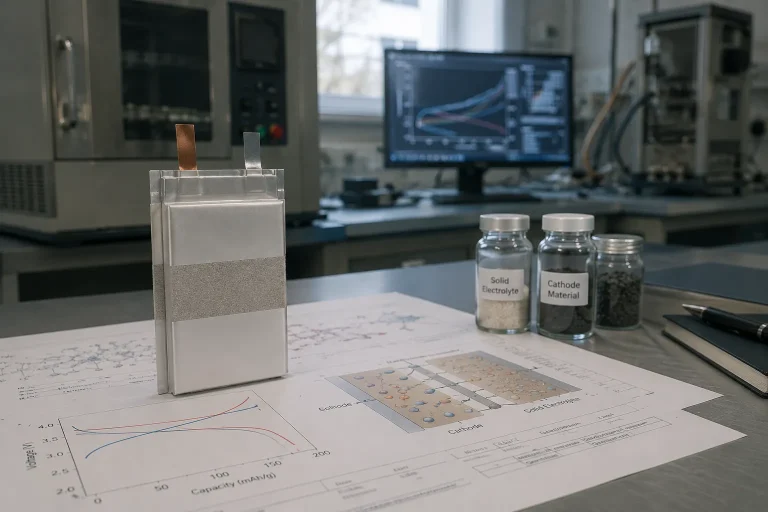
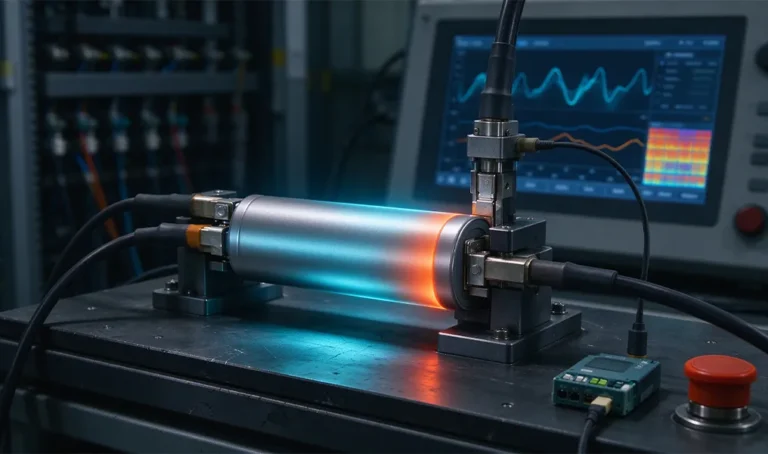
Battery testing systems and battery cyclers overlap but serve different engineering purposes. A cycler primarily controls charge/discharge profiles, while a broader testing system can integrate cycling with measurement, thermal control, safety monitoring, impedance analysis, and automated data acquisition. Choosing between them depends on cell format, voltage/current range, test methodology, throughput, and required measurement accuracy.
Battery Testing System vs Battery Cycler Definition
Battery Testing System
A battery testing system is an integrated system that is utilized for characterizing battery cells, modules, or packs by conducting controlled electrical tests, measurements, data acquisition, monitoring battery safety, and (if needed) control of the battery temperature or the environment. It can be used in conjunction with other specific tests like capacity, efficiency, DCIR, pulse response, and degradation analysis.
For example, along with charge/discharge cycling, you can evaluate capacity, DCIR, pulse response, efficiency, temperature behavior, degradation, and other configured test parameters. This makes it more suitable for R&D, validation, and comprehensive battery performance analysis.
Battery Cycler
The main function of a battery cycler is to apply a predetermined voltage or current profile, to measure the battery’s voltage, current, capacity and energy, and to be an electronic charge/discharge device. It can be widely used in cycle-life testing, charge/discharge characterization, formation studies, and performance evaluation.
For example, the cycler can run hundreds or thousands of cycles while recording voltage, current, capacity, energy, and cycle count. This makes it suitable for cycle-life and charge/discharge performance testing.
Battery Testing System vs Battery Cycler Differences
Primary Function Difference
A battery testing system offers a wider testing platform that integrates battery charge/discharge control and measurement, monitoring, safety, and other test capabilities. A battery cycler is an electrical device that applies programmed charge/discharge cycles. The difference is that a testing system will have a broader array of test requirements, whereas the cycler will be for controlled cycling.
Testing Scope Difference
Depending on the configuration, a battery testing system offers support for various battery characterization techniques such as capacity, efficiency, DCIR, pulse response, degradation, and thermal-related testing. The primary applications of a battery cycler are repeated charge/discharge testing, capacity testing and cycle-life testing. If using a basic cycler, then there may be additional diagnostic measurements that need their own equipment.
System Integration Difference
A testing system can be configured to have cycling channels and temperature measurement, safety monitoring, environmental control, and data acquisition under a single test architecture. The main purpose of a battery cycler is to provide the charge/discharge channels. External equipment can be connected to a cycler for special measurements, but this will add complexity to the system and integration requirements.
Data and Measurement Difference
A Battery Testing System may be used to synchronize electrical measurements with the temperature, environment and other diagnostic signals throughout a test sequence. The data recorded by a cycler usually includes voltage, current, capacity, energy, and cycle data. So, for multiple synchronized parameters, a wider testing platform might be the right measurement architecture for your testing needs.
Application and Selection Difference
Use a battery cycler where your primary need is to cycle and discharge your batteries under control, to test battery capacity, or to evaluate battery cycle life. Select a battery testing system for wider characterization, integrated monitoring, automated test sequences, and multiple test conditions. Some of the factors to consider when making a decision include battery chemistry, voltage range and current range, channel count, thermal requirements, measurement accuracy, safety requirements, and future testing requirements.
Battery Testing System vs Battery Cycler Differences Comparison Table
Parameter | Battery Testing System | Battery Cycler |
Primary purpose | Comprehensive battery characterization, validation, and performance analysis | Controlled charge/discharge cycling and endurance evaluation |
Core function | Combines electrical testing, measurement, control, data acquisition, and configurable test functions | Applies programmed current, voltage, power, or charge/discharge profiles |
Testing scope | Capacity, DCIR, pulse tests, efficiency, degradation, thermal monitoring, and safety-related testing | Cycle life, capacity retention, charge/discharge performance, and cycling behavior |
Equipment integration | Can integrate cyclers, temperature control, environmental systems, safety protection, and measurement modules | Primarily centered on controlled charge/discharge channels |
Test flexibility | Higher flexibility for multi-parameter and application-specific test programs | More focused on predefined or programmable cycling profiles |
Data acquisition | Can collect electrical, thermal, environmental, and other test data depending on configuration | Mainly records voltage, current, capacity, energy, power, and cycle data |
Application | Cell, module, and pack characterization, validation, diagnostics, and R&D | Cell, module, and pack cycling, endurance, and charge/discharge evaluation |
最适合 | R&D laboratories, validation programs, diagnostics, and comprehensive battery testing | Routine cycling, cycle-life studies, and controlled charge/discharge testing |
Choose it when | You need multiple test functions and broader battery performance data | Your main requirement is reliable, repeatable charge/discharge cycling |
注意: Before selecting either of the solutions, establish the battery chemistry, voltage and current range, number of channels, temperature requirements, measurement sensitivity, and safety requirements. These parameters can be used to decide whether or not a basic cycler can satisfy your requirements or if you are in need of a more integrated testing architecture.
Battery Testing System vs Battery Cycler: Which Battery Testing Solution Should You Choose?
A cycler is a good option if you aren’t interested in integrated diagnostics or environmental control. It should be chosen according to battery voltage and current range, number of channels, power rating, measurement accuracy, test profiles, and the length of the cycles. So, if your main application is controlled charge and discharge testing, then select a battery cycler. You can use it for capacity measurement, cycle-life testing, charge/discharge efficiency tests, energy evaluation, and repeatability of a defined current or voltage profile.
Select a battery testing system if you need more than just charge/discharge cycling testing. It makes sense if electrical cycling and temperature monitoring, safety protection, data acquisition, DCIR, pulse testing, environmental control, or other characterization functions are required. A testing system is also appropriate for testing cells, modules or battery packs under several different operating conditions with synchronized measurements and automated test sequences. It is especially beneficial for R&D, performance validation, degradation testing, and complex test programs for which functions cannot be provided by a stand-alone battery cycler.
Quick rule: If cycling is your primary task, a battery cycler may be sufficient. If you need coordinated electrical, thermal, measurement, safety, and data functions, consider a more integrated battery testing system.
What to Consider Before Choosing a Battery Testing Solution
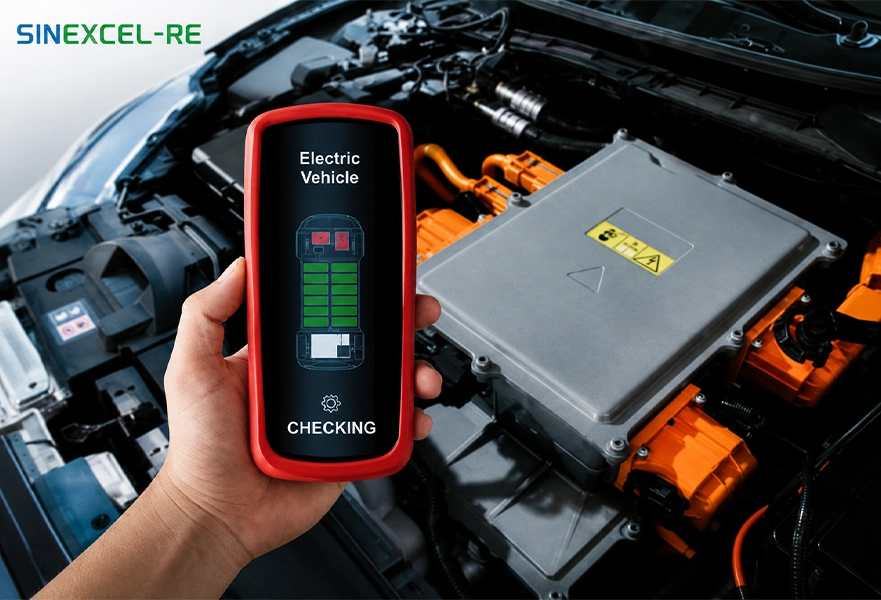
Before you choose a battery testing solution, define your actual testing requirements. The right system should match your battery’s electrical range, test volume, accuracy requirements, thermal conditions, safety needs, and future expansion plans.
- Voltage and Current Range: Match your battery’s full operating range.
- Channel Count: Choose enough channels for simultaneous testing.
- Measurement Accuracy: Verify voltage, current, and capacity measurement precision.
- Thermal Requirements: Consider temperature control, cooling, heating, and sensors.
- Safety Requirements: Check protection, alarms, interlocks, and emergency controls.
- Test Profiles: Ensure support for required charging and discharging sequences.
- Software Integration: Verify automation, data logging, and communication capabilities.
- Future Expansion: Allow additional channels, power, sensors, and testing capacity.
结论
Choose based on your test objectives, required control, and expected workflow. A battery cycler suits focused cycling tasks, while an integrated testing system fits more complex validation programs. Ready to improve battery testing performance with reliable, high-precision solutions? Explore advanced systems from SINEXCEL-RE. Contact us today to find the right battery testing solution for your R&D or production needs.
常见问题
Is a battery testing system the same as a battery cycler?
No. A cycler is typically focused on controlled charge/discharge cycling, and a testing system may provide more comprehensive measurement, monitoring, safety, and characterization capabilities in addition to charge/discharge cycling.
Which is better for cycle-life testing?
For most cases of cycle-life testing, a battery cycler is adequate.
When should you choose a battery testing system?
Select one for multi-parameter characterization, temperature measurement, safety functions, environmental control, and integrated data acquisition.
Can a battery cycler perform capacity testing?
Yes. An appropriate cycler can measure the capacity, energy, efficiency and other electrical parameters of charge/discharge.
What should you consider before choosing?
Test the battery voltage, current, chemistry, number of channels, test profiles, temperature range, measurement accuracy, safety requirements, and future expansion requirements.