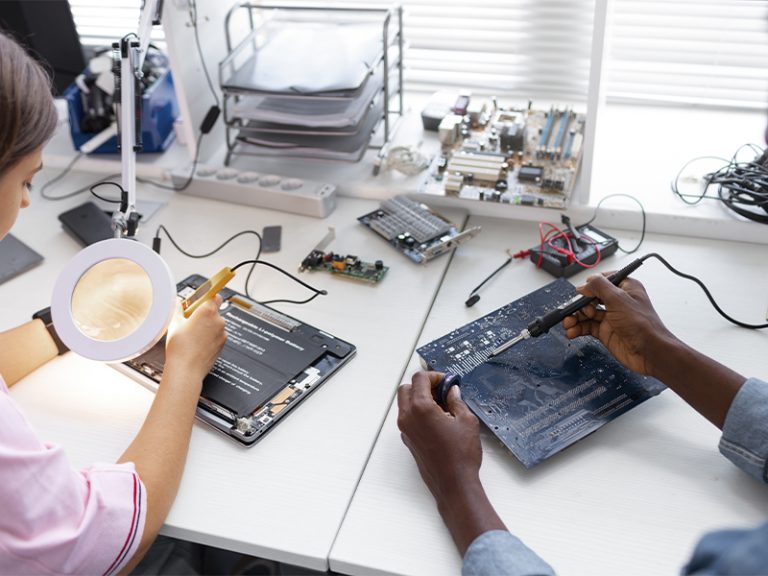
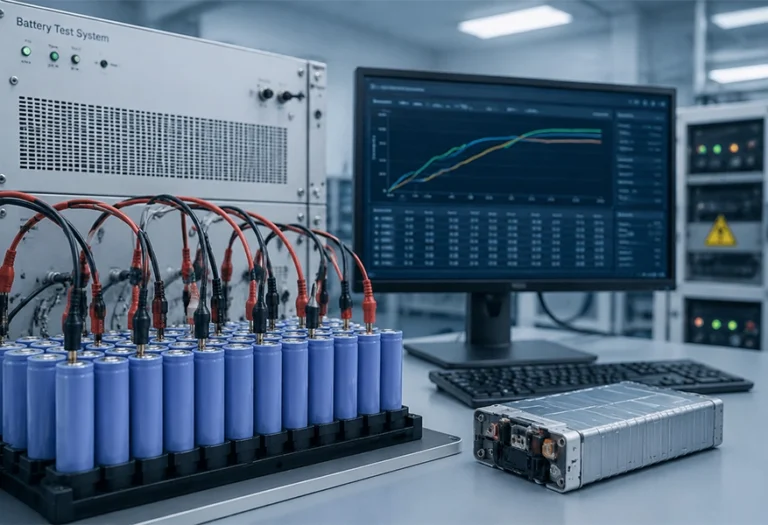
Battery testing equipment is used to evaluate the electrical, electrochemical, thermal, and lifespan characteristics of batteries. Depending on the battery type and its development stage, a variety of measurements can be performed, including voltage, current, capacity, energy efficiency, internal resistance, cycle life, and temperature.
Battery testing equipment has a wide range of applications, including but not limited to the development and testing of battery chemistries, electric vehicle battery pack testing, and energy storage system testing. Cell-level testing requires precise current measurement at low currents, while testing of modules, battery packs, and high-voltage energy storage systems requires high voltages and high currents.
This guide will introduce you to the main types of battery testing equipment, testing techniques, application examples, and test system specifications to consider.
What Is Battery Testing Equipment?
A battery testing system is a device used to control and monitor a battery’s electrical and operational parameters and to collect test data. Depending on the test objectives, the system controls charging and discharging currents, voltages, power, and test cycles, while recording parameters such as capacity, energy, efficiency, temperature, and internal resistance.
Battery testing equipment is widely used throughout the entire battery R&D and manufacturing process, ranging from material and cell testing to the validation of modules, battery packs, and energy storage systems.
The required equipment depends largely on the battery’s size and the testing objectives. Laboratories require precision cell testers for early-stage chemical performance development, while manufacturers of electric vehicles or energy storage systems need high-voltage, high-power battery testing systems.
| 测试级别 | Typical Application | Equipment |
|---|---|---|
| 细胞 | Chemistry R&D, cell qualification | Cell Battery Tester |
| 模块 | Module validation | 电池模块测试系统 |
| 打包 | EV and ESS pack testing | 电池包测试系统 |
| Cluster | ESS cluster testing | High-Voltage Battery Cluster Test System |
| System | Containerized BESS testing | 集装箱储能系统测试台 |
Types of Battery Testing Equipment
Battery testing equipment varies significantly depending on the battery size, voltage range, current requirements, and testing objective. The main categories include cell-level testers, battery cyclers, formation systems, module and pack test systems, high-voltage systems, and specialized electrochemical and environmental testing equipment.
电池循环器
Battery cyclers are used to repeatedly charge and discharge batteries under controlled conditions. They are commonly used for capacity testing, cycle life testing, rate capability evaluation, and battery aging studies.
A battery cycler typically controls current, voltage, power, and charging or discharging profiles while recording the battery’s response over time.
Battery Formation and Grading Systems
Formation and grading systems are primarily used during battery manufacturing. Formation establishes the initial electrochemical characteristics of a cell through controlled charging and discharging, while grading evaluates parameters such as capacity and internal resistance to classify cells with similar performance.
Accurate formation and grading help manufacturers identify variations between cells before they are assembled into modules and battery packs.
Battery Module and Pack Test Systems
High-voltage battery test systems are designed for applications where battery packs operate at hundreds or even thousands of volts. They are commonly used for EV battery packs, high-voltage energy storage systems, and other large-scale battery applications.
These systems need to provide accurate voltage and current control while maintaining appropriate safety functions, data acquisition, and communication with the battery management system.
EIS Testing Equipment
An electrochemical impedance spectroscopy (EIS) testing system determines a battery’s electrochemical performance by measuring its impedance response at different frequencies. Unlike traditional charge-discharge testing, EIS provides deeper insights into the internal operating mechanisms of a battery.
Environmental and Thermal Testing Equipment
Environmental and temperature testing equipment is used to evaluate battery performance under various temperature and environmental conditions. Since battery performance can vary with temperature, it is essential to conduct environmental testing on batteries.
Testing Methods
Research into battery chemistry relies on reliable experimental data to understand how battery materials, design, and operating conditions affect performance. A variety of testing methods enable scientists to understand a battery’s electrochemical characteristics, degradation processes, and reliability.
By conducting multiple tests simultaneously, it is possible to determine whether a particular battery chemistry system possesses a reasonable combination of all necessary characteristics.
| Testing Method | What It Measures | Typical Application |
|---|---|---|
| 能力测试 | Capacity and energy | Cell, module, pack |
| Charge/Discharge Test | Voltage, current, power | Performance evaluation |
| Cycle Life Test | 容量保持性 | Aging analysis |
| DCIR 测试 | 内阻 | Power and degradation |
| EIS | Electrochemical impedance | Chemistry research |
| Thermal Test | 温度行为 | Safety and thermal management |
| Fast-Charging Test | High-rate charging behavior | 电动汽车电池开发 |
充电和放电性能测试
Charge and discharge testing is one of the most fundamental methods used in battery research.
By applying controlled charging and discharging cycles, researchers can evaluate key performance indicators, including:
- Battery capacity
- Energy efficiency
- Voltage characteristics
- 能力评级
- Power output
This testing helps determine whether a new electrode material or electrolyte formulation can deliver the expected electrochemical performance.
For example, researchers developing high-energy-density lithium-ion batteries may compare different cathode or anode materials by analyzing capacity retention and voltage behavior under different charge and discharge conditions.
Battery testing equipment provides precise control of current, voltage, and test profiles, allowing researchers to compare different battery chemistries under consistent conditions.
Cycle Life and Degradation Testing
Long-term durability is one of the biggest challenges in battery development.
A battery may show excellent initial capacity but experience rapid degradation after repeated cycling. Cycle life testing helps researchers understand how battery performance changes over time.
During cycling tests, battery testing systems continuously monitor:
- 容量保持性
- Charge and discharge efficiency
- Internal resistance growth
- Voltage changes
These results help researchers identify degradation mechanisms, such as:
- Loss of active lithium
- Electrode structure damage
- Electrolyte decomposition
- Interface instability
By analyzing degradation patterns, engineers can improve material selection and optimize battery designs for longer service life.
Internal Resistance and Impedance Testing
Internal resistance is an important indicator of battery performance and aging.
As batteries degrade, resistance typically increases, causing:
- Higher energy loss
- Reduced power output
- Increased heat generation
Battery researchers use resistance measurements and electrochemical impedance analysis to understand changes inside the cell.
These tests help evaluate:
- Electrode kinetics
- Charge transfer behavior
- Electrolyte stability
- Aging mechanisms
For advanced battery chemistries, impedance analysis provides valuable information that cannot be obtained through capacity testing alone.
Thermal Performance and Safety Testing
Temperature has a significant impact on battery performance, lifetime, and safety.
During battery chemistry research, thermal testing is used to evaluate how cells behave under different operating conditions, including high current charging, fast discharge, and extreme temperatures.
Researchers analyze:
- Temperature rise during operation
- Heat generation characteristics
- 热稳定性
- Performance changes at different temperatures
This information is critical for developing safer battery materials and improving thermal management strategies for EV and energy storage applications.
Coulombic Efficiency and Energy Efficiency Testing
Coulombic efficiency measures the ratio between the charge stored during discharge and the charge supplied during charging.
Although the difference may appear small during early cycles, even minor efficiency losses can accumulate over thousands of cycles and significantly affect battery lifetime.
High-precision battery testing equipment allows researchers to measure small variations in efficiency and evaluate:
- New electrode materials
- Electrolyte formulations
- Battery aging behavior
This is especially important for next-generation batteries where researchers need to identify small improvements in chemistry performance.
Fast-Charging and High-Power Testing
As EV manufacturers pursue shorter charging times, battery chemistry must maintain performance under high charging rates.
Fast-charging tests evaluate how batteries respond to increased current levels and help identify potential issues such as:
- Lithium plating
- Excessive heat generation
- Capacity loss
By simulating real-world charging conditions, researchers can optimize electrode structures and charging strategies while maintaining battery safety.
加快验证新材料的进程
Developing a new battery chemistry requires years of validation, because researchers need to balance energy density, safety, cost, and long-term durability before commercialization.The industry does not have such time nowadays. Battery testing equipment can shorten this schedule by a number of important processes:
高通量筛选
Early Battery Chemistry During the early phases of Battery Chemistry R&D, there are hundreds of material combinations that can be tested. Contemporary testing apparatus permits parallel testing. A single test battery bench can Advanced battery testing platforms can support multi-channel testing, allowing researchers to evaluate multiple cells under identical conditions and accelerate material comparison. compared with only one cell at a time. High-throughput reduction. This is a high-throughput mechanism that reduces the number of candidate materials by choosing the best three in less than a fraction of the time.
电化学测试的精度
The volumetric expansion on charging can also result in rapid degradation when testing a new anode material, e.g., silicon-graphite composites. The sensitivity required to determine small variations in Coulombic efficiency is offered by electrochemical testing equipment. Even small differences in coulombic efficiency can accumulate over hundreds or thousands of cycles, affecting long-term battery lifetime.
Solid-State Battery Research
下一个前沿领域是 固态电池, 由于固态电解质取代了液态电解质,它将更加安全,能量密度更高。然而,电极-固体电解质界面极难稳定。现代测试仪器使研究人员能够对这些电池施加不同程度的压力和温度,从而了解导致界面失效的机械和化学应变。.
利用长期数据促进创新的激励措施
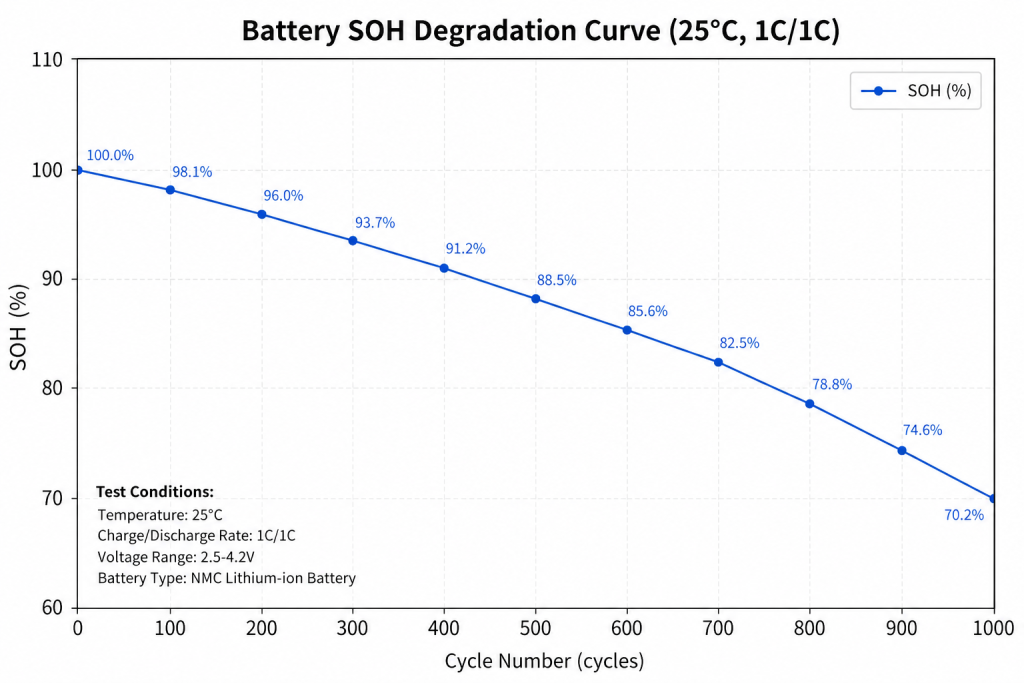
研发工作中耗时最长的是确定电池寿命。你不可能只等十年,就知道十年电池是否能用。这就需要 电池寿命周期测试 和健康状况(SOH)测试。.
加速寿命测试
先进的机器在执行加速老化时遵循复杂的算法。研究人员可以通过在适度较高的温度或适度的放电深度(DoD)下循环使用电池,在几周而不是几年内预测电池的循环寿命。.
健康状况(SOH)和收费状况(SOC)
通过精密测试,可以创建更精确的 SOH 和 SOC 算法。在研发环境中,可以知道原型的确切健康状况,使研究人员能够了解物理退化(如树枝状突起的生长)与电信号之间的相关性。这种封闭式反馈机制对于开发自愈电池技术或更智能的 BMS 软件至关重要。.
How to Choose Battery Testing Equipment
Selecting the appropriate testing equipment depends on the type of battery being used, the testing phase, voltage and current requirements, and the performance parameters that need to be determined during testing. The requirements for a lithium-ion battery testing laboratory differ from those of an electric vehicle company testing high-voltage battery packs or an energy storage company testing its battery energy storage system (BESS).
When selecting battery testing equipment, the following factors must be considered.
Voltage and Current Range
The voltage and current ranges should be suitable for the batteries under test and provide sufficient margin for various test scenarios. Battery cell testing may require lower voltages and currents but must still offer good measurement resolution; in contrast, electric vehicle batteries and large battery packs may require voltages of hundreds or even thousands of volts, as well as higher currents.
In addition, when working with high-power equipment, consideration should be given to the system’s ability to operate across different voltage and current ranges.
Accuracy and Resolution
Accuracy and resolution directly affect the reliability of battery test data. Small measurement errors can become significant during long-term cycle testing or when researchers compare small changes in capacity, voltage, or internal resistance.
For applications such as battery chemistry research, capacity characterization, and degradation analysis, a testing system should provide sufficient voltage and current accuracy as well as appropriate measurement resolution for the battery being tested.
Number of Channels
The number of channels required depends on the desired throughput and the number of batteries that need to be tested in parallel. Multi-channel battery testing systems can test multiple cells or batteries simultaneously under different operating conditions.
In the field of research and development, using more channels may be more efficient when comparing different types of battery chemistries, electrodes, and charging protocols.
Dynamic Response and Test Profiles
Dynamic performance is particularly important when it is necessary to quickly simulate transient operating conditions for batteries. For example, batteries in electric vehicles may experience sudden changes in power demand when the vehicle accelerates or brakes.
In such cases, battery test equipment should be capable of dynamic testing.
Data Acquisition and Software
Battery testing generates a massive amount of data, particularly during cycle life, aging, and long-term test procedures. The test system must be equipped with appropriate sampling rates, data logging, test programming, visualization, and data export capabilities.
Test procedures must also be repeatable, and the software should support comparisons across different test cells, modules, and battery packs.
Regenerative Capability
Regenerative capability is a key factor that must be considered when designing high-power battery test systems. During discharge, regenerative test systems can feed electrical energy back into the grid rather than wasting most of it as heat.
As the power of test systems increases, these advantages will become increasingly important for the energy efficiency and operating costs of test facilities.
BMS and Communication Integration
Battery testing equipment should also be compatible with the battery management system and other test equipment used in the test environment. Depending on the application, integration may include CAN, CAN FD, RS485, temperature chambers, water cooling systems, and other external devices.
For EV and ESS applications, communication between the test system and BMS is particularly important because battery protection, operating limits, and test conditions may need to be coordinated during the test.
Battery Testing Workflow: From Cell to Pack
Battery testing does not take place at a single stage of development. Testing requirements change as a battery moves from cell-level research to module, pack, and complete energy storage system validation.
At each stage, the test system needs to match the voltage, current, power, measurement accuracy, and test objectives of the battery under evaluation. A typical battery testing workflow can therefore be divided into several stages, from cell characterization to system-level validation.
单元格级别的测试
Cell-level testing is commonly performed during battery chemistry research, cell development, and quality evaluation. Typical tests include capacity measurement, charge and discharge performance, cycle life, rate capability, DCIR, and electrochemical impedance analysis.
At this stage, high measurement accuracy and resolution are often more important than extremely high power. Researchers may also require multiple channels to compare different cell designs or test conditions in parallel.
Formation and Grading
After cell manufacturing, formation and grading are used to establish and evaluate the electrical characteristics of the cells. Controlled charge and discharge processes are used during formation, while grading can be used to classify cells according to parameters such as capacity and internal resistance.
Consistent formation and grading are important for identifying cell-to-cell differences before cells are assembled into modules or packs.
模块级测试
Multiple cells are connected to form a battery module, increasing the voltage and current requirements of the test system. Module testing can evaluate electrical performance, capacity, thermal behavior, protection functions, and communication with the battery management system.
Test conditions should reflect the intended operating range of the module while maintaining appropriate safety limits.
Battery Pack Testing
Battery packs contain multiple modules and are commonly used in electric vehicles and energy storage systems. Pack-level testing requires higher voltage and power capabilities and often involves communication with the BMS.
In addition to basic charge and discharge tests, pack testing may include DCIR, pulse testing, dynamic load profiles, drive-cycle simulation, fast-charging evaluation, and protection-function verification.
High-Voltage EV Battery Testing
Modern EV battery packs can operate at high voltage and require testing under rapidly changing power conditions. High-voltage EV battery testing can include charge and discharge performance, fast-charging behavior, drive-cycle simulation, regenerative braking conditions, pulse testing, and thermal performance evaluation.
The test system must provide sufficient voltage and current capability while maintaining accurate measurement and fast dynamic response.
Energy Storage System Testing
Energy storage systems introduce additional testing requirements because batteries may operate for long periods under repeated charge and discharge cycles. Testing can evaluate capacity, efficiency, cycle life, dynamic response, grid-related operating conditions, and BMS performance.
For large-scale BESS, testing may extend from individual cells and modules to battery packs, clusters, and containerized systems. High-power regenerative test systems can also help reduce energy consumption during large-scale charge and discharge testing.
结论
Battery testing equipment plays a role throughout the battery development and validation process, from early-stage chemistry research to module, pack, EV, and energy storage system testing. Different applications require different combinations of voltage range, current capability, accuracy, channel count, dynamic response, and data acquisition.
These tools are the most significant drivers of innovation. As the world keeps putting additional pressure on its energy storage policies, the cooperation between such innovative companies as Sinexcel-re 和电池领域的顶尖科学家将是推动绿色能源转型的最重要方面。.
常见问题
电池寿命测试和电池性能测试之间有何区别?
电池寿命测试的目标是电池的寿命,即电池在容量降低到特定点(通常为 80%)之前能够完成的充放电循环次数。电池性能测试改变电池的行为,以检查电池在特定条件下的特性,可能包括大电流放电、极端温度或快速充电。.
电化学测试的高精度是否很重要?
在电池研发过程中,可以通过小步快跑的方式实现改进,通常是 0.1%的改进。差劲的设备可能会因为噪音小而掩盖这些改进。电池测试的精确度可以做到很高,因此数据足够干净,可以确定是真正的化学改进还是测量误差。.
什么是健康状况(SOH)检测?
健康状态 (SOH) 测试是将电池的当前状态与全新状态进行比较。它考虑了容量的减少、内阻的增加以及电压的稳定性。SOH 测试用于研发各种化学物质的老化过程。.
是否有可能对电池设备进行测试,以复制真实世界的电动汽车驾驶循环?
是的,现代电池测试台可以通过对驾驶循环(如 WLTP 或 EPA 测试)进行编程,以模拟汽车在城市中行驶、在高速公路上加速或使用再生制动时的实际功率需求。.