A failed validation run sends most engineers straight to the DUT. Fair enough. But the source behind it deserves the same suspicion: a supply that dips during a load step, overshoots at switch-on, or goes silent on its communication bus at hour 30 of a 48-hour test. Any of those leaves the whole data set open to doubt.
It is therefore good practice to make a sensible choice of programmable DC power supply, beginning with the test requirements and then moving on to the catalog page. The following addresses what it can do, which specifications are worthy of being compared side-by-side, how it fits into automated test systems, where it differs from wide-range to fixed-range to bidirectional, and how to check out a supplier. The guide is followed by a short checklist.
Programmable DC Power Supply Explained In A Nutshell
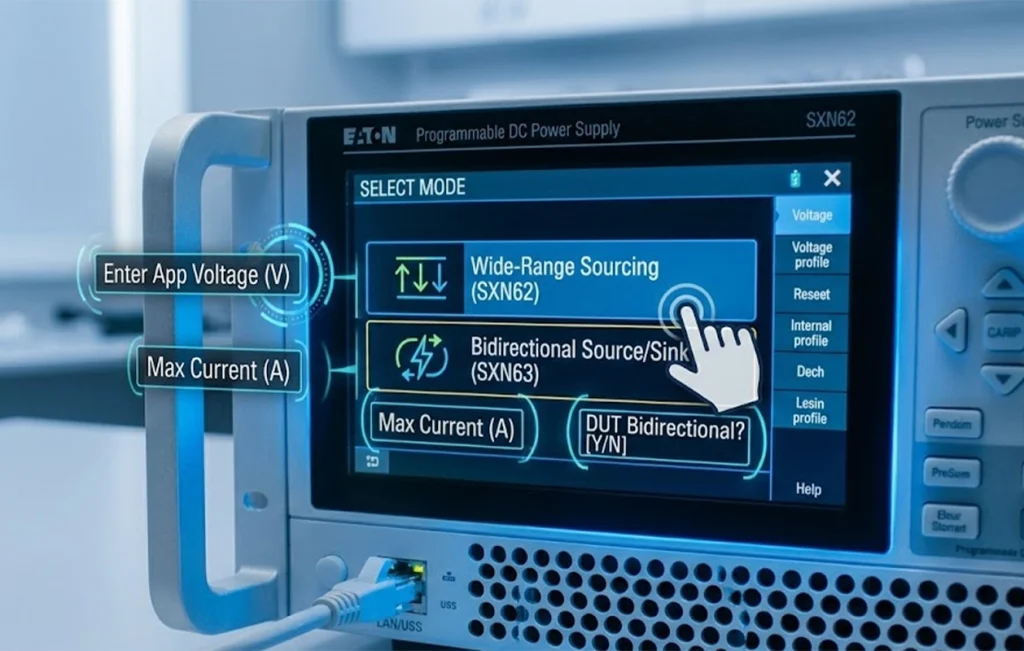
A programmable DC power supply allows users to set and control output voltage, current, and power through a front panel or remote interface. voltage/current/power set through the front panel /or remote link are held constant as load and AC line wander. The goal of the exercise is to maintain stability at the DUT terminals.
Typical modes of operation are constant voltage, constant current, and constant power. A well-designed supply automatically transitions between constant-voltage (CV) and constant-current (CC) operation as required by the load. Place a battery on a charger test, and the supply will start off in current limit mode and eventually transition into voltage regulation mode with increasing battery voltage.
The fundamentals of automation are the arrival of setpoints by command, the presence of sequences in memory, and playback without a person on the bench. See identical conditions after run 1 and run 10,000. But a bench supply with knobs cannot guarantee that, and it also doesn’t offer the same resolution, remote control, and depth of protection.
These instruments are commonly found in automotive electronics labs, server power validation, battery packs and energy storage testing, photovoltaic equipment, EV charging, fuel cell, and general automated test equipment (ATE) applications.
Key Specifications to Check Before Buying
Start from the DUT, and leave the datasheet for later. Note the worst-case voltage and current, start-up and inrush included, and add a margin of around 10–20%. The supply should be selected based on the required voltage-current operating envelope, not just its maximum voltage, current, or power rating. Transient loads, inrush current, operating temperature, and required headroom should also be considered. Watch peak power in particular. A converter that idles at 2 kW can ask for 6 kW over a few hundred milliseconds, and the supply has to ride through it.
Look at the bottom of the range too. Accuracy is quoted as a percentage of full scale, which means a 1500 V model is less precise in absolute terms at 48 V than a 100 V model would be. For tests that live down there, this can outweigh the headline rating.
Datasheets are least clear about output range. In a conventional supply, rated power appears only where maximum voltage and maximum current coincide. Lower the voltage and the current limit takes over, and power drops with it. Autoranging designs hold rated power over a far wider voltage–current band. The manufacturer’s example: a 15 kW, 500 V supply capped at 30 A delivers just 5 kW at 166.6 V, while an autoranging unit can supply 90 A there and stay at 15 kW.
The remaining parameters are easier to compare side by side.
| Parameter | What to check |
| Accuracy and ripple | Setting and readback accuracy; ripple as rms and peak-to-peak, with the bandwidth stated; load regulation; recovery after a load step |
| Protection | OVP, OCP, OPP, OTP, and input-side protection. If the DUT has a hard voltage ceiling, the OVP threshold should be adjustable |
| Interfaces | LAN, CAN, RS232/RS485, USB: which are standard, which cost extra. Analog control if older rigs are involved |
| Expansion | Whether same-rating units can run in parallel, how they synchronize, and whether every model in the series allows it |
| Input and efficiency | Single-phase or three-phase AC, power factor, efficiency. Together these decide installation work, heat load, and running cost |
Programmability and Integration with Automated Test Systems
It is not just meeting the electrical requirements that will make it happen. A supply that is incompatible with the existing test system can create integration problems and increase setup time. Four questions clear this up in no time.
What is the interface of the rig? LAN is used in rack-based ATE, CAN on automotive and battery, plain serial control via RS232 or RS485, USB on a single bench. Regardless of the answer, get the programming manual and command list, and find out if there are drivers or example code for the language your framework is implemented in.
What should be the location of sequencing? All steps of voltage, current, power, operating mode, and dwell time are stored onboard in sequence mode, allowing the steps to be carried out without a PC connected to the instrument. A multi-day burn-in is a huge benefit in that it allows the run to continue if the host crashes. For many labs, a mixture of both is the best option, as control from a PC leaves more room for complicated logic.
Does timing matter? If it is, determine command response time, transition time between setpoints, and if possible, how to synchronize more than one unit.
Does the power supply include the simulation functions required for the test? There are two candidates – solar array simulation and battery simulation. Verify the function is available on the model you want to purchase, and determine what the PC software includes. Additionally, inquire about a fault log system like a black box that stores information on operating parameters prior to abnormal occurrences. When an unattended run trips over the weekend it saves time!
Which Type of DC Power Supply Do You Need?
The first decision is the output characteristic. A wide-range (autoranging) supply and a fixed-range supply behave differently below maximum voltage, as the table shows.
| Criterion | Wide-range (autoranging) | Fixed-range |
| Output envelope | Rated power holds across a wide voltage–current band | Rated power only at maximum voltage and current; power falls away below that point |
| Best suited to | Several DUTs, several voltage levels, changing requirements | One product at one operating point |
| Main trade-off | Usually a higher unit price than a comparable fixed-range unit | Several units may be needed to cover different DUTs |
| Typical use | Validation labs, R and D, ATE with variable DUTs | Single-product production test |
The practical split is easy to state. If one instrument has to serve several DUTs, several voltage levels, or requirements that keep shifting, wide-range wins. A line that tests one product at one operating point seldom needs it.
Voltage class is next. Storage and photovoltaic systems now operate at 1000 V and beyond, so a 1500 V or 2250 V source becomes necessary. Battery cell and low-voltage converter work is the opposite case: low voltage, several hundred amperes. In that situation the current rating and cable losses weigh more than the voltage range.
Consider the lab’s direction as well. A bench built around 48 V telecom equipment may be testing 800 V components within two years. A family covering many voltage classes lets you grow while keeping the same interfaces and software. And when the DUT pushes energy back, the question changes entirely. That is the subject of the next section.
Programmable DC Power Supply vs. Bidirectional DC Power Supply
A standard programmable DC power supply is a source: current runs one way, from supply to DUT. A bidirectional DC power supply can sink as well. It takes energy from the DUT and, in regenerative designs, sends it back to the grid. Most are two-quadrant units, so the current reverses but the output voltage keeps its polarity.
When is that necessary? Whenever the DUT delivers energy at some point in the test: bidirectional DC-DC converters, on-board chargers running in reverse, battery charge and discharge cycling, the DC side of energy storage inverters. A source-only supply forces you to add an electronic load and extra cabling, and a dissipative load turns the returned energy into heat. If the DUT only draws power, a source-only unit is simpler and usually sufficient.
Bidirectional supplies are also mixed up with dedicated battery test systems, so the table separates the three categories.
| Programmable DC power supply | Bidirectional DC power supply | Battery test system | |
| Power flow | Source only | Source and sink | Charge and discharge |
| Typical role | Powers or stresses the DUT | Tests DUTs that deliver and absorb power; simulates sources and loads | Characterizes cells, modules, and packs |
| Main strength | Simple and cost-effective for consuming DUTs | Replaces a separate source and load; regenerative models return energy to the grid | Channel-based charge/discharge control and test-data management |
| Limitation | Cannot absorb energy | Not a substitute for multi-channel battery testing | Built for batteries, not as a general-purpose source or load |
A bidirectional DC power supply may support battery charge-discharge operation, but the suitability of a dedicated battery test system depends on the required test procedures, channel configuration, measurement accuracy, and data-management functions.
How to Evaluate a Programmable DC Power Supply Supplier
Evaluate suppliers based on verifiable specifications, documentation, and engineering support rather than product claims alone. Begin with the documents. A per-model datasheet should include some information about accuracy, ripple, and regulation under the test conditions, as well as state which functions are applicable to which model. Check the website, model table, and the datasheet. The mismatch between them indicates the level of documentation of the product.
Then engineering support. A good supplier will request power specifications, output range, and interfaces prior to quoting, and can direct you to another configuration. Request the programming manual and command documentation, drivers/examples, and PC software for sequencing and logging.
Then it’s all about quality and compliance: the safety and EMC certificates you need in your market, calibration, and factory testing. Verify the parallel options and available power ratings, and inquire if there’s a rating or configuration that can be adjusted to accommodate unique requirements.
Finally, the after-sales aspect. Long-term cost is influenced by warranty coverage, spare parts, firmware update policy, repair times, and local / distributor support. References from similar applications can be helpful, as can an evaluation unit or a demonstration on your own DUT, if the supplier can provide one.
Find the Right Programmable DC Power Supply for Your Test Setup
Before requesting quotations, settle these points:
- Worst-case voltage, current, and peak power of the DUT, plus margin
- The operating points that need full power (the output range)
- Whether the DUT only draws power or also returns it
- Interfaces, drivers, and the software environment
- Whether onboard sequencing, solar array simulation, or battery simulation is needed
- Parallel expansion, now and later
- The AC input available at the test site
- Certification, documentation, and support you expect from the supplier
Sinexcel-RE offers two series that map onto the decision above. Figures below come from the product pages and datasheets; model-level details should be confirmed before ordering.
"(《世界人权宣言》) SXN62 series is a wide-range, autoranging programmable DC power supply in a 3U chassis. Models span 1.8 kW to 18 kW per unit and maximum voltages from 80 V to 2250 V. Automatic CV/CC/CP transition and a sequence test mode are included, along with RS232, RS485, CAN, LAN, and USB as standard interfaces (analog control is optional). Solar array simulation, with EN 50530 and Sandia models, is listed as a series function. One caveat from the datasheet: parallel operation is not supported on the two dedicated PV simulator models, SXN6203-80-40S and SXN6206-80-80S.
"(《世界人权宣言》) SXN63 series handles the bidirectional case. It combines a source and a regenerative load, with regenerative efficiency up to 95%, and its models run from 100 V to 2250 V and ±1.8 kW to ±50 kW per unit. Read the pairings carefully: the 2250 V models are rated 15 kW and 30 kW, while the 50 kW rating applies to the 1500 V model. Constant-resistance mode, battery simulation, and a battery charge/discharge mode are added, and it offers the same standard interfaces and parallel operation.
Unsure which series fits? Send the voltage range, current, peak power, interface needs, and DUT type to the Sinexcel-RE team through sinexcel-re.com and ask for a model recommendation.
常见问题解答
How much headroom should I allow when sizing the supply?
A typical starting point is about 10-20 percent more than the DUT’s maximum voltage, current and peak power. If inrush is a problem, if the supply will be operating close to full load for extended periods of time, or if the test room is warm, you may have to add more, as datasheet ratings are based on the given operating temperature range.
When do I need remote sensing?
If the load current is greater than the point at which the leads measure a voltage drop that is of sufficient magnitude to reduce the voltage the DUT receives to less than the programmed voltage, the DUT will receive a lower voltage. The Remote sensing reads the voltage on the DUT terminals and compensates, up to a certain limit. To compare the lead drop you would expect, with the maximum compensation voltage you’re told on the datasheets, per model series.
How should overvoltage protection be set?
Set the OVP threshold above the highest expected operating voltage but below the maximum voltage the DUT can safely withstand. Check the applicable model’s datasheet for the adjustable OVP range and protection response. The threshold should be configured according to the DUT’s voltage limits and the power supply manufacturer’s specifications.
Can supplies be connected in series for higher voltage?
Only if the manufacturer’s documentation says so. Series operation depends on output isolation ratings, protection coordination, and synchronization, none of which can be assumed. The Sinexcel-RE datasheets reviewed here describe parallel operation for power expansion. For series operation, ask the supplier first.