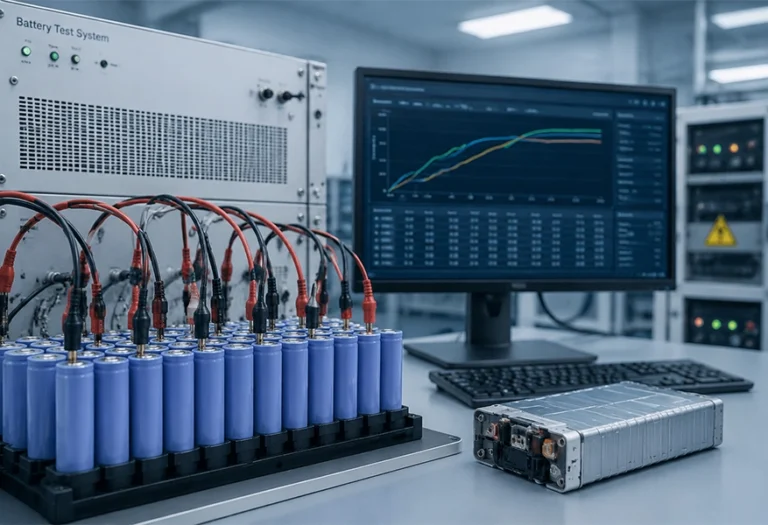
You’ve created a new cell, and the initial prototype is looking like a real winner right out of the box. Fine. What about cycle 800? Or during a cold winter, or after a couple hundred quick charges? A datasheet will not tell you, and wishful thinking won’t either. The only way to know is to test the cell and watch – the role of a battery cycler.
What follows is an explanation of how cyclers work, the primary types you’ll encounter, what they are used for, and a brief list of traps you should be aware of before you purchase one.
What Is a Battery Cycler?
In other words, a cycler charges and discharges a battery to a program you set, and records the voltage, current, temperature (if you have sensors connected), and capacity and energy based on those measurements. One machine could process one cell, another a module with several dozen cells, and another a pack of cells.
It’s all about speed. A car battery can experience one full cycle of discharge each day (or two). A test that takes a year or more on the road can be completed in a few months on a cycler if the cells are capable of it, at two or three cycles a day. It’s not a perfect stand-in, though. Batteries do not age if they are not being used either, and the story told by a cycler only covers part of that.
Nor is it just a fancy charger. When the battery is fully charged, it is considered to be in a “charged” state. A cycler is there to learn what the battery did on the way up and on the way down.
How a Battery Cycler Works
Charging is the easy part: mains AC is converted to DC and supplied to the battery at whatever current and/or voltage the program requires.
Cyclers diverge at discharge.
The energy from conventional cyclers is pushed into internal load elements and converted to heat. They’re inexpensive and easier to use, and many labs work well with them. Now run a unit 24 hours a day, and the lost power, plus the warm air you have to contend with, begins to cost you.
Regenerative cyclers are wiser on the subject. A bidirectional converter converts the discharge DC signal back to AC, sending it into the building’s supply. Other designs send the energy directly to a neighbouring channel that is charging at the time. It’s important to note that regeneration is a feature of specific models, not of cyclers in general. Ask the vendor “how much recovery is regenerative?” and “under what load did you measure it?”
Common Control Modes
Almost all test programs are created from four fundamental modes.
Constant current (CC), for example 50 amperes until the cell reaches its voltage limit, is the standard mode in capacity tests.
Constant voltage (CV) typically comes after a charge. The cycler maintains a constant voltage (4.2 V, for example) and allows the current to gradually decay.
Constant power (CP) is most important in EV work. A motor is not current-dependent; it is watt-dependent, meaning that the current must increase when the pack voltage decreases.
Constant resistance (CR) causes the cycler to act as a normal resistor.
CC, CV and CP are virtually universal. CR is common as well, but make sure to check the model you’re interested in.
What About Internal Resistance?
Many people think a cycler works like a multimeter measuring ohms – just read the DC internal resistance (DCIR). It doesn’t. A current pulse is the typical method. The cycler applies a known step to the current, and then compares the voltage just before the step with the voltage a little later (typically between 1 and 30 seconds) and divides the voltage difference by the current difference.
Thus, the answer will depend on the method of running the pulse. If the state of charge, temperature, pulse size or pulse length is changed on the same cell, a different figure is obtained. That is why there is often disagreement on the numbers for DCIR between two labs. When performing pack work, HPPC is often used, as it provides a more comprehensive picture. The quality of the result also depends on the cycler’s switching speed, voltage sampling rate and accuracy.
Some cyclers ship with built-in DCIR routines, but with others you write it yourself. AC resistance at 1 kHz and electrochemical impedance spectroscopy (EIS) are different measurements altogether, and usually need a separate meter or an add-on. Before you rely on a model, make sure you understand what it does.
Why Not Use a Power Supply and Electronic Load?
You can, and in some cases it is your duty! The programming capability of a DC supply, combined with an electronic load, and a script in the middle can often be enough for a slow function with a constant current. It’s cheaper, too.
The challenge is greater if the test keeps changing its direction. Go on a drive cycle using regenerative braking – charge in, charge out. Under one program, two instruments must pass control between themselves at an appropriate time. This will depend on the instruments, wiring and software. For some configurations, there is a momentary timing error on switch-over. Some don’t have any shown. Either way, is one that should be considered an alternative, not accepted on faith.
A bidirectional cycler gets around the problem. One controller used for both directions = you receive one continuous record. It will also be protected, and will have protection and channel management features that a loose supply and load does not.
The Use of Battery Cyclers
EV Drive Cycles
Standards such as WLTP outline the way in which a car may be driven – accelerating, cruising and stopping, against the clock. However, the battery doesn’t see speed. It sees the world as current and power – a WLTP file can’t simply be placed in a cycler.
First, the speed trace is run through a vehicle model, which incorporates mass, aerodynamic drag, rolling resistance, motor and drivetrain efficiency, auxiliary loads (heating, lights, pumps) and braking recovery. The result is the power output and/or input of the battery at any given instant. That curve is then adjusted to whatever you have on your bench, be it a cell, module or pack, according to the series and parallel configuration. The cycler actually runs the resulting current or power table. Good labs tend to do this by running it in a thermal chamber and checking the results against data captured in a real vehicle, so that the translation doesn’t vary.
Stationary Storage
Nobody is going to wait 15 years or more for answers on a solar-plus-storage plant. So the cycler will do the expected daily duty, charging in the afternoon and discharging at the end of the day, until a trend emerges that you can use to plan for degradation.
Second-Life Evaluation
There are plenty of used EV packs available that have a lot of life still in them. A cycler measures what remains (capacity, resistance, consistency of the cells with each other), and the decision is made whether the pack is good for another use, such as backup power.
I’m sure you’ll hear people talk about an EV battery being “full” at 80% or 70%, depending on the originator. Use them as convenient reference points, not guidelines. The limit and warranty are manufacturer-dependent, and what is OK is determined by where the battery goes next. The capacity could be less important than rising resistance, unbalanced cells and safety history. A pack that is 78% may be fine to use, and a pack at 85% might be refused for other reasons. Ultimately, it’s the buyer or reuser who decides on the grading criteria.
Formation and Grading
The first charge and discharge of new lithium-ion cells is carefully controlled in the factory. This is formation, and as part of it, the cell is formed with a thin protective coating on the electrode that it relies on for life. The next step is grading: the ability and resistance of the cells are measured, and the cells are divided into groups (grades) of similar cells.
The terms “cycler” and “formation equipment” are used interchangeably, but they are not synonymous. A general-purpose cycler is an R&D and validation tool that is flexible, with custom profiles, broad ranges and rich data. Dedicated formation and grading equipment is production machinery. It fits hundreds or thousands of channels into a cabinet, stores cells in trays or fixtures, tolerates low formation currents, can include clamping pressure or a temperature-control system, and can recover energy on a massive scale, while connecting to the factory tracking systems. Install a lab cycler on a production line and the costs start to add up quickly; using a formation rack to test dynamic drive cycles is not a good match either.
Cell, Module and Pack Testers
Small currents (as low as a few milliamps) are measured using cell testers, which are made to be accurate in voltage. They are the ones that chemists will consult in the use of coin cells, 21700s cylinders, and test samples of solid-state materials or sodium-ion materials.
The power increases as the module testers go up to tens of volts. They are best suited for testing busbar joints and for determining if cells are in balance when joined.
The big machines are the pack testers, which run at 800 V and above, at currents as high as several hundred amps, and even more for the largest packs. This is a secondary consideration at this size. Thermal runaway of any 100 kWh pack is an event of prime concern in a building. Check for hardware interlocks, emergency stops and independent temperature monitoring to stop a test if a pack begins to misbehave.
How to Choose a Battery Cycler
There are a number of points to consider before signing anything.
- Response speed.The slew rate indicates the rate at which the output can change from one level to another. It must be fast – typically in the low milliseconds for fast-charge and hard-acceleration profiles. Get the figure from the datasheet, along with how it is measured.
- Good hardware with bad software is a waste for engineers. See how long a nested, conditional test takes to write, and whether you can import a CSV waveform.
- Temperature control.It is important to note that the behavior of a battery at −20 °C is considerably different from one at room temperature, and so a cycler that operates a thermal chamber over CAN, TCP/IP or similar is a big bonus. It may reduce the chamber pressure, allow cells to settle and begin a cold-crank discharge.
- Channel density.Lab floor space is expensive, and more channels in the same space mean more tests running concurrently. This is one of the reasons Sinexcel RE’s cyclers are based on high power density.
- Accuracy and protection.Test the accuracy of voltage and current over the range you expect to use, and also look at which protections are standard.
Does Energy Recovery Pay Off?
In many cases, but not all. Don’t just look at the price; work out the numbers.
A laboratory that operates around the clock can consume more electricity in a few years than the cost of the equipment. In a conventional cycler, the discharge energy becomes heat – you spend money to charge it, and then you might spend additional money to cool it down. A regenerator recycles a significant portion of that energy and emits less heat. The efficiency is not a universal number but is dependent on the model and the operating point. The figures quoted range from 90 to 95 percent, and it is not inappropriate to question how they were measured.
What regeneration won’t do is get rid of cooling altogether. A little energy is lost in the converters themselves, cells heat up during the cycle, and thermal chambers consume energy to maintain a temperature. A regenerative lab will require less cooling than a traditional lab; however, a proper ventilation and air-conditioning plan will still be required for the lab.
The point at which the extra cost of the purchase pays for itself depends on running hours, the percentage of discharge and local power costs. This return may come earlier for labs with 24/7 operations, and later for labs with a few days’ operation per month. Sinexcel RE offers regenerative cyclers for labs that require substantial reductions in operating expenses without compromising measurement performance.
最终想法
The best batteries are test-run under heavy load where there is no risk of failure. A failure on the bench costs a little time. When a vehicle owner has a problem with their car, it is much more expensive.
For growth in test capacity or for cost savings in lab operation, consider the regenerative battery cyclers of Sinexcel RE.
常见问题
Are all battery cyclers part of a grid?
No. Conventional models convert it to heat. Only regenerative ones can return it to the AC supply or between channels; see the datasheet.
Does a regenerative cycler get rid of the need for lab cooling?
No. It reduces the heat, but the converter losses, cell heating and thermal chambers will still introduce loads, which means that cooling is needed.
Is it possible to replace a cycler with a DC power supply and electronic load?
Generally, yes, in simple and slow tests. For fast-switching profiles between charge and discharge, the results will depend on the integration of the two instruments. A bidirectional cycler avoids that issue.
How is internal resistance measured with a cycler?
Methods, pulse length and accuracy for calculating DCIR differ between many cyclers. Typically, AC resistance and EIS must be performed with different equipment.
Is it possible to put a WLTP cycle directly into a cycler?
No. WLTP is only a speed profile. It must be translated to a profile of battery currents or battery power by means of a vehicle model, and then scaled to the cell, module or pack level.
What is the difference between a cycler and formation/grading equipment?
Cyclers are tools that can be used for R&D and validation. Formation and grading systems are production equipment, and have numerous channels, fixtures and factory data links.
Is 80% capacity the threshold for when you have to replace an EV battery?
No. It’s only a common reference. The threshold will vary according to the manufacturer, the warranty, its use, resistance and safety.
References
Keysight, “Battery Cycling in Energy Storage”:It defines battery cycling and describes bidirectional cyclers that return discharged energy to the AC grid. It supports the cycler basics and regeneration sections. https://www.keysight.com/at/de/assets/7125-1076/solution-briefs/Battery-Cycling-in-Energy-Storage.pdf keysight
Kellner, Widanage and Marco (2016), University of Warwick, IEEE ITEC:Speed-time profiles are combined with an EV model to determine power profiles at the battery terminals. It supports the WLTP-translation section. https://wrap.warwick.ac.uk/80552 warwick
SwRI, sub-milliohm impedance research:Pulse length influenced the apparent resistance across DC pulse methods. It supports the DCIR section. https://www.swri.org/what-we-do/internal-research-development/2024/automotive-transportation/development-of-novel-reliable-methods-sub-milliohm-impedance-measurement-of-lithium-ion-cells-modules-03-r6439 swri
MDPI, World Electric Vehicle Journal 14(4):96:It explains the cell finishing steps, including SEI formation, and says cells are then sorted by quality level, known as grading. It supports the formation and grading section. https://mdpi.com/2032-6653/14/4/96 mdpi
RSC Advances (2025), calendar aging study: Lithium-ion batteries deteriorate over time even when not in use, a phenomenon called calendar aging. It supports the “cycler isn’t a perfect stand-in” point, and it also shows that the “batteries do not age if not used” sentence needs correcting. https://pubs.rsc.org/en/content/articlehtml/2025/ra/d5ra03735b rsc